Sri Lanka prison overcrowding has reached four times capacity, with the Negombo tragedy exposing deep legal and human rights failures.
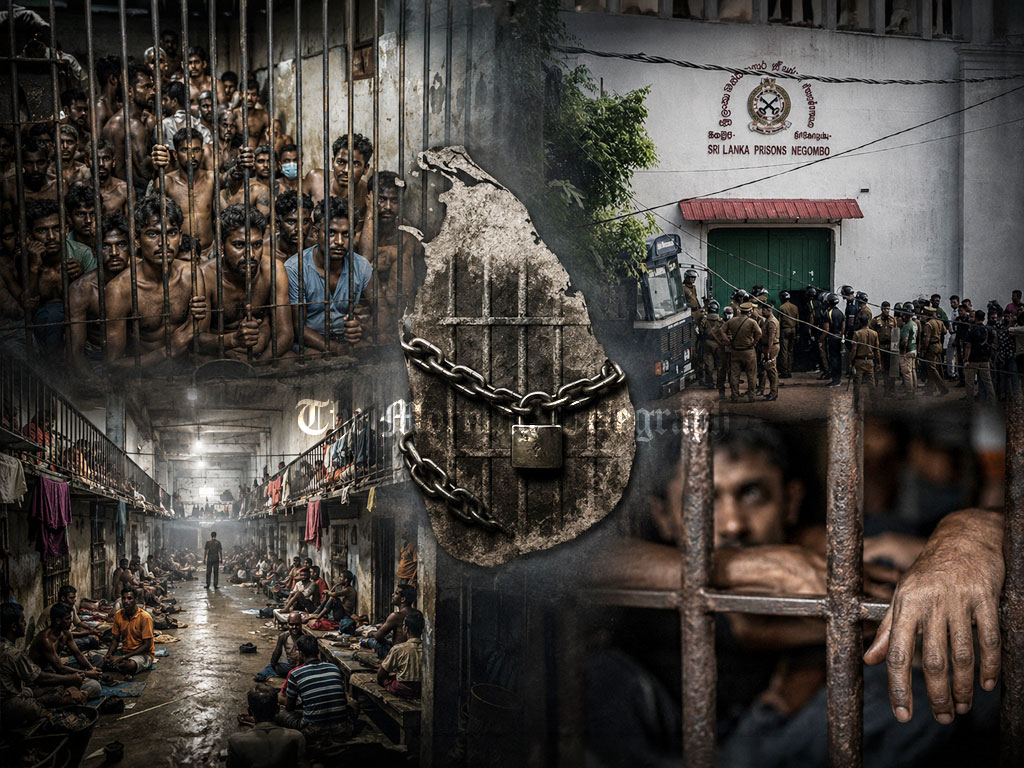
Sri Lanka prison overcrowding has reached a breaking point, with official data showing that the country’s prisons now hold nearly four times their approved capacity.
The recent tragedy at Negombo Prison has exposed a deeper structural collapse inside the island’s prison system. It has also renewed urgent questions about justice, human rights, delayed court cases, drug arrests, prison safety and ministerial accountability.
For years, Sri Lanka has spoken about prison reform. Yet the discussion rarely receives serious public attention. Many people still believe prisons hold only those who have wronged society.
However, the slogan “Prisoners are human beings too” cannot remain only a board on a wall. It must enter public conscience. The brutal reality is that many inmates live in conditions far worse than the punishment ordered by court.
This article examines the prison crisis using official data obtained from the Department of Prisons under the Right to Information Act, the fatal Negombo Prison unrest and expert views on reform.

Negombo Tragedy Exposes Systemic Collapse
The Negombo Prison clash became a bloody symbol of the collapse inside Sri Lanka’s prison network.
Authorities said the unrest began as a clash between two inmate groups detained on drug-related charges. It later escalated into violence against prison administration measures linked to drug control.
The incident ended with 29 deaths, including seven prison officers and 22 inmates.
During the unrest, inmates allegedly tried to break through the main iron gates to escape. Media footage later showed a security officer firing into the compound through a hole in the closed gate.
Human rights activists condemned the action. They argued that the use of “minimum force” exposed the harsh and inhumane nature of the prison system.
The violence also left 104 people seriously injured. They are receiving treatment at Negombo District Hospital and the National Hospital of Colombo.
During the unrest, female inmates climbed onto the prison roof. They alleged that dengue was spreading rapidly and that they were denied proper medical care.
Authorities denied those allegations. However, the prison system’s failure to provide basic sanitation and medical facilities remains an open concern, especially under extreme overcrowding.
Sri Lanka Prison Overcrowding in Numbers
Official data up to January 2024 shows how severe the crisis has become.
The statutory capacity of Sri Lanka’s 36 prisons is around 10,500 inmates. However, the total prison population has climbed to 41,257.
That means the system is operating at nearly four times its approved capacity.
System-Wide Prison Overview
| Prison Sector | Statutory Capacity | Current Inmate Population |
|---|---|---|
| Total System Island-wide | Around 10,500 | 41,257 |
| Convicted Prisoners | Not specified | 11,268 |
| Remand Prisoners | Not specified | 20,286 |
| Negombo Prison at time of clash | Limited capacity | Around 2,400 |
The country’s 18 remand prisons are holding nearly five times their intended capacity. Facilities such as Welikada, Mahara, Bogambara, Angunakolapelessa and Negombo show the worst signs of pressure.
A former inmate who had been held at Negombo and Welikada described the conditions anonymously.
“We were packed with over sixty people in a cell built for about twenty. Sleeping on the floor felt exactly like fish stuffed into a sardine tin. During the hot season, it became an absolute hell. The food was so deplorable that almost everyone constantly suffered from stomach ailments and skin diseases. These places are infested with fleas and mosquitoes.”
Remand Prisons: Population vs Capacity
| Prison | Inmate Population | Approved Capacity |
|---|---|---|
| Colombo Remand | 2,295 | 328 |
| Jaffna | 857 | 293 |
| Anuradhapura | 1,046 | 279 |
| Batticaloa | 656 | 168 |
| Badulla | 452 | 146 |
| Galle | 1,005 | 233 |
| Matara | 607 | 186 |
| Negombo | 1,881 | 496 |
| Magazine | 2,923 | 499 |
| Kegalle | 757 | 136 |
| Trincomalee | 335 | 112 |
| Kalutara | 1,528 | 460 |
| Kuruwita | 1,049 | 362 |
| Boossa | 168 | 310 |
| Monaragala | 342 | 148 |
| Polonnaruwa | 405 | 149 |
| Wariyapola | 1,598 | 418 |
| Vavuniya | 443 | 45 |
Drug Arrests, Delayed Trials and Remand Crisis
More than 60% of Sri Lanka’s prison population consists of remand inmates awaiting trial.
Many face minor, non-violent charges.
The strict enforcement campaign known as “Ratama Ekata” pushed the prison population toward the 41,000 mark. Mass arrests increased pressure on a system that lacked the infrastructure to handle such numbers.
Court delays have worsened the crisis. Delayed Government Analyst reports force many suspects to remain in prison for months or years without trial.
Speaking in Parliament, Justice Minister Harshana Nanayakkara highlighted this failure.
“People have to stay in prison for a year and a half just to find out whether what was found on them was narcotics or Panadol powder,” he said.
This is one of the core causes of Sri Lanka prison overcrowding.
A Long History of Prison Violence
The Negombo tragedy is not an isolated incident.
Sri Lanka has repeatedly failed to protect inmates in state custody across different governments.
In 1983, during President J.R. Jayewardene’s administration, 53 Tamil inmates were massacred inside Welikada Prison.
In October 2000, during President Chandrika Kumaratunga’s administration, a mob attacked the Bindunuwewa Rehabilitation Centre and killed between 26 and 29 Tamil political detainees.
In 2012, during President Mahinda Rajapaksa’s administration, 27 inmates were killed inside Welikada Prison.
In 2020, during President Gotabaya Rajapaksa’s administration, 11 inmates died during unrest at Mahara Prison.
In 2026, under President Anura Kumara Dissanayake’s administration, 29 people died in the Negombo Prison clash.
The pattern is clear. Governments change, but the prison system’s brutal structure remains.
Human Rights and State Responsibility
Once a person enters state custody, the government carries full responsibility for that person’s life and rights.
Articles 11 and 13 of Sri Lanka’s Constitution are central to this responsibility. A prisoner loses liberty, not humanity.
United Nations Special Rapporteurs on Torture have previously criticized Sri Lanka’s prison system over human rights violations and systemic corruption.
Sudesh Nandimal Silva, Chairman of the Committee for Protecting the Rights of Prisoners, said the system is built on punishment, hatred and torture.
“What exists in Sri Lanka today is a punitive system filled with hatred and torture. There is no scientific method for rehabilitating prisoners. Operations like ‘Yukthiya’ and ‘Ratama Ekata’ only worsened this overcrowding.”
He also alleged that, in some cases, police plant drugs to imprison people.
“The system of remissions within prisons must be implemented properly, and cruel punishments akin to torture, like the death penalty, must be completely abolished,” he said.
Ministerial Responsibility and the Carltona Principle
The Carltona Principle in administrative and constitutional law holds that a minister remains responsible for actions taken by officials under delegated authority.
Therefore, when prison officers or administrators fail, the line minister cannot avoid responsibility by blaming subordinates.
Justice Minister Harshana Nanayakkara has said he accepts responsibility.
However, accountability cannot end with words.
True accountability requires visible action to correct the system, protect lives and prevent another tragedy.
The Minister must show what reforms he will implement, how he will protect inmates and officers, and how he will ensure independent investigations into deaths in custody.
From Prisons to Correction Centres
Professor Pratibha Mahanamahewa, a human rights activist and lawyer, says the world is moving away from the idea of “prisons.”
“The world is moving toward the term ‘Correction Centers.’ In many countries, including China, you won’t even see a sign that reads ‘Prison.’ In Sri Lanka, these places are not correcting wrongs; they have transformed into ‘institutions that teach crime.’”
He said the main reasons for overcrowding are failures in bail, prosecution and case management.
According to him, some people remain inside prisons for years because they cannot find a guarantor or pay a small fine. Others are detained over unpaid maintenance or minor offenses.
He said Sri Lanka must introduce alternatives such as house arrest, as used in developed nations.
He also noted that drugs such as ice and heroin are major drivers of congestion. Countries like Malaysia have reduced prison inflows by combining law enforcement with demand-reduction programmes.
Professor Mahanamahewa also said Sri Lanka should consider structured prison labour frameworks. Skilled young inmates could contribute to the economy under proper safeguards and family consent.
Questions the Government Must Answer
The National People’s Power manifesto, “A Rich Country, A Beautiful Life,” pledged to prevent all forms of violence inside prisons.
Now the government must answer difficult questions.
What oversight mechanisms has it introduced to stop corruption, illegal trafficking and arbitrary conduct by prison officers?
What steps has it taken to use modern technology such as smart surveillance systems for prison security?
What measures are underway to speed up bail and introduce alternatives like house arrest?
What has been done to improve inmate healthcare, mental health and sanitation?
What independent mechanism will investigate deaths inside prisons and hold guilty officers accountable?
These questions cannot be postponed.
The Sri Lanka prison overcrowding crisis is not only about space. It is about justice, dignity, corruption, delay and the right to life.
The Negombo Prison tragedy has shown that the current system is no longer manageable through statements or temporary transfers.
Sri Lanka needs urgent judicial and prison reform. It must reduce remand congestion, improve health and sanitation, strengthen rehabilitation and ensure independent investigations into custody deaths.
If the government fails, it risks joining the same historical list as past administrations marked by prison massacres and preventable deaths.