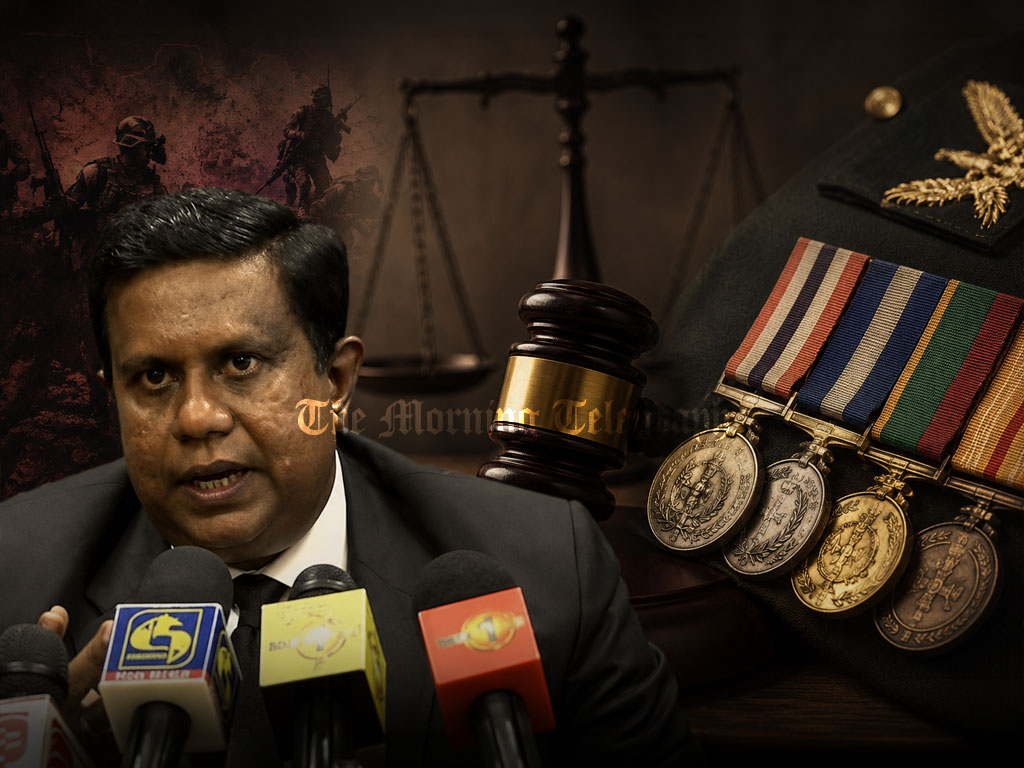
Gallantry medals controversy grows after court remarks about a decorated ex-Air Force officer’s medals during the Suresh Sallay case.
The gallantry medals controversy at the Fort Magistrate’s Court has raised difficult questions about military sacrifice, courtroom conduct and national memory.
The issue began when Additional Solicitor General Dileepa Peiris questioned why retired Air Force officer Shantha Jayathilake appeared in court wearing armed forces medals.
Flight Lieutenant Jayathilake, a decorated war hero, represented himself under Section 260 of the Criminal Procedure Code. The matter related to the trial involving Maj. Gen. Suresh Sallay, who has been described as the alleged mastermind of the 2019 Easter Sunday carnage.

During his submission, Peiris looked at Jayathilake’s medals and said: “He comes wearing pieces of tin.”
When Jayathilake objected, Magistrate Pasan Amarasena warned him not to interrupt proceedings. Peiris then said he could not see the medals properly.
Jayathilake is a recipient of the Weera Wickrema Vibhushanaya, or WWV. It is the second highest gallantry medal awarded to Sri Lankan military personnel. The Parama Weera Vibhushanaya, or PWV, remains the highest gallantry decoration that a living serviceman can receive.
Jayathilake joined the Air Force in 1989, during the height of the JVP-led insurgency. He retired in 1999. He also received the Rana Sura Padakkama, or RSP.
Gallantry Medals Controversy Erupts in Court
Senior President’s Counsel Maithree Gunaratne, appearing for Sallay, sharply responded to Peiris.
“The problem is not with your eyes, but with the red-tinted glasses you are wearing,” Gunaratne said.
“You wore blue-tinted glasses for a while, and now you wear red-tinted glasses, so the gallantry medals, earned with blood, sweat, and tears for the country, look like pieces of tin to you.”
Gunaratne requested that Peiris’s comments about the ex-officer be formally entered into court records.
The exchange took place at the Fort Magistrate’s Court on July 2, 2026.
The proceedings triggered public debate. Some criticized Jayathilake for wearing medals to court. Others strongly defended him.
The issue also spread across social media.
Some used the incident to attack the government and the Attorney General’s Department. Others criticized former State Intelligence Service Chief Sallay, who served from 2019 to 2024, for triggering unnecessary developments.
However, the central issue remains clear. Gallantry medals worn by military officers and men cannot be ridiculed by anyone, regardless of rank, position or political view.
Those medals symbolize immense sacrifice made during war. Any attempt to diminish that meaning deserves strong opposition.
Military Sacrifice and Political Memory
Those who silently backed or publicly acted against war-winning Army Chief General Sarath Fonseka after his 2010 presidential election defeat should not treat this courtroom incident as a political opportunity.
Sri Lanka remains deeply divided over investigations into the armed forces during and after the war.
Yet few cases have caused controversy like the arrest of Sallay over the 2019 Easter Sunday carnage.
Sallay had earlier served as post-war head of the Directorate of Military Intelligence. He later became Director of the State Intelligence Service from 2019 to 2024 before President Anura Kumara Dissanayake replaced him.
Some argue that President Gotabaya Rajapaksa should not have appointed Sallay to head the SIS, because the post had traditionally gone to a senior police officer.
Others argue that Rajapaksa was right to appoint a serving military officer with proven intelligence experience, given the conduct of senior police officers before the Easter Sunday attacks, despite advance warnings.
The retired Air Force officer’s intervention triggered an unexpected response from the Attorney General’s top representative.
That response has now pushed the country to revisit gallantry awards such as the Parama Weera Vibhushanaya, Weera Wickrema Vibhushanaya, Rana Wickrema Padakkama and Rana Sura Padakkama.
The Weeradhara Vibhushanaya is also awarded for bravery, regardless of risk to one’s life, for voluntary interventions outside the battlefield.
Bravery of an Exceptional Kind
During the war, Sri Lanka awarded 32 PWVs posthumously. The Army received 29, the Navy received two and the Air Force received one.
The PWV is awarded to all ranks of the armed forces, regular and volunteer, for individual acts of bravery in the face of the enemy, disregarding danger to one’s own life.
Among the 32 recipients, Maj. J.A.L. Jayasinghe, known as Lalith Jayasinghe, drew exceptional public attention. He was posthumously promoted to Lieutenant Colonel.
Many PWVs recognized sacrifices made during defensive action, when the armed forces responded to enemy attacks.
However, Jayasinghe had initiated action deep inside enemy-held territory. His actions reflected the wider military strategy.
The Army recipients included Second Lieutenant S.U. Aladeniya, Lance Corporal Y.G.G. Kularatne, known as Hasalaka Gamini, Second Lieutenant K.W.T. Nishshanka, Staff Sergeant H.P.B. Gunasekera, Lance Corporal W.I.M. Seneviratne, Lieutenant Colonel A.F. Lafir, Captain G.S. Jayanath, Major J.A.L. Jayasinghe, Major K.A. Gamage, Captain U.G.A.S. Samaranayake, H.G.M.K.I. Megawarna, Sergeant H.G.S. Bandara, Corporal P.N. Suranga, Corporal P.M.N. Pushpakumara, Corporal D.N.M.S. Chandrasiri Bandara, Lance Corporal K. Chandana, Private R.M.D.M. Ratnayake, Lance Corporal A.M.M.P. Abeyesinghe, Recruit A.M.B.H.G. Abeyratne Banda, Private T.G.R. Dayananda, Lieutenant P.N. Punsiri, Second Lieutenant W.D. Jayathilake, Sergeant K.G.N.L.R. Perera, Corporal K.P.D.T. Gunasekera, Lance Corporal H.A. Nilantha Kumara and Lance Corporal S.V.A.M. Pushpamal.
The Navy recipients were Lieutenant J.L.D.S. Wijetunga and Petty Officer K.G. Shantha.
The Air Force recipient was Squadron Leader T.D.S. Silvapulle.
Lalith Jayasinghe and LRRP Sacrifice
Although Jayasinghe died while serving in the Special Forces, he had been a proud member of the Gemunu Watch.
Gemunu Watch veteran Maj. Gen. K.B. Egodawele wrote in Hewayekuge Mathaka Sathan, first launched in 2012, that Jayasinghe was among four Gemunu Watch personnel to receive the PWV posthumously.
The others were Captain U.G.A.S. Samaranayake, Captain H.P.M.K. Meghawardena and Corporal D.M.A.M. Pushpakumara.
They all received the highest gallantry award for actions in the Vanni east region during Eelam War IV, from August 2006 to May 2009.
Jayasinghe’s wife Kaushalya accepted the PWV on May 19, 2012, at the annual Victory Day parade.
Maj. Gen. Kamal Gunaratne read the official citation. Kaushalya was five months pregnant when Jayasinghe launched a raid deep inside LTTE-held territory in Vanni east.
Gunaratne, then wartime General Officer Commanding of the 53 Division, said Jayasinghe commanded an LRRP, or Long Range Reconnaissance Patrol, also known as a Deep Penetration Unit.
Its task was to eliminate LTTE leaders.
The unit moved about 40 kilometres into enemy-held territory in Oddusuddan. It was positioned near the Mankulam-Oddusuddan road on November 26, 2008.
Jayasinghe suddenly fell ill. However, he joined other LRRP members when fierce fighting erupted.
Although he had the chance to retreat, he continued fighting. He suffered serious injuries and later died.
Jayasinghe had already earned the WWV on three or four occasions. On one occasion, he received two WWVs at the same ceremony.
Retired Maj. Gen. Dhammi Hewage, who received the RSP at the same event, later praised Jayasinghe’s high-risk LRRP operations.
Those who risked their lives in such operations helped transform the armed forces, especially the Army.
Gallantry medals were earned under many circumstances. Yet LRRP strikes deep inside LTTE-held territory shaped the direction of the war.
Those who operated there faced extreme danger. The possibility of interception by the LTTE remained very high.
Still, they moved beyond government-held areas and infiltrated enemy territory to conduct operations.
Jayasinghe’s LRRP team remains a powerful example.
Millennium City and Secret Operations
Clandestine operations received public attention before the December 2001 parliamentary election.
UNP leader Ranil Wickremesinghe suddenly alleged that the Directorate of Military Intelligence was planning to assassinate him.
Within weeks of the UNP victory, the government unleashed the police on the DMI.
Police raided the DMI safe house at Millennium City, Athurugiriya.
Army Commander Lt. Gen. Lionel Balagalle personally assured the UNP there was no basis for such claims. However, Wickremesinghe continued with his political strategy.
He gave Police Minister John Amaratunga approval for the action.
The January 2, 2002 raid led to several arrests. They included Captain Mohamed Nilam, Staff Sergeant P. Ananda Udulagama, Staff Sergeant I. Edirisinghe Jayamanne, Corporal H.M. Nissanka Herath, Lance Corporal H. Mohamed Hilmy and an LTTE operative identified as Niyaz or Subashkaran.
Others involved in such operations lived in the East and joined operations when required.
On Lt. Gen. Balagalle’s instructions, personnel tasked with attacks on selected targets trained under Special Forces instructors from Maduru Oya.
They also trained at the Panaluwa Test Firing Range, where special weapons training formed a key part of the schedule.
Those operatives often worked alone to ensure secrecy. They maintained their own arsenal, including claymore mines.
They operated strictly on a need-to-know basis.
Even many senior DMI officers and much of the Army leadership did not know the full details. Only a few were aware.
Even Deputy Defence Minister Anuruddha Ratwatte knew about hits behind enemy lines but did not know about the Millennium City safe house.
East Operations and the Ceasefire
After the DMI operation was exposed, Balagalle met Prime Minister Wickremesinghe to explain the secret operations against the LTTE.
Army officials, including Hendarawithana, accompanied him.
Tilak Marapana, then National List MP holding the Defence portfolio, and Minister Milinda Moragoda were also present.
A source familiar with the project later said that, except for Moragoda, others did not understand what the Army was doing.
The source said they acted as if the military was conspiring against the political leadership to undermine the Norwegian initiative.
The Army had begun striking targets in enemy-controlled territory under Balagalle’s concept.
The DMI failed in its first two attempts to hit targets in Batticaloa south. Those operations took place on July 18 and September 12, 2001.
The targets, identified as Jim Kelly, commander of the Jeyanthan Regiment, and Jeevan escaped death.
However, the operatives succeeded on September 17, 2001. They attacked “Major” Mano Master, who led the LTTE communications network in the Ampara-Batticaloa area.
After the UNP victory, the government terminated such operations.
The article argues that the government betrayed those who risked their lives for the country.
Ex-LTTE members and others who worked for the Army were exposed. The LTTE hunted them down. Many were killed, while some were tortured before being killed.
Apart from Mano Master, the secret raids claimed the lives of Batticaloa District Intelligence Head Lt. Col. Nizam and Capt. Thevathasan.
In the North, those killed included LTTE Air Wing Head Col. Shankar, whose real name was Vaithilingam Sornalingam, and Sea Tiger Deputy Commander Lt. Col. Kangai Amaran.
S.P. Thamilselvan, his Deputy Major S. Thangan, Vavuniya Special Commander Col. Jeyam and Deputy Military Chief Col. Balraj were believed to have been targeted in the North but escaped.
In the East, Col. Karuna, Karikalan, Jim Kelly and Intelligence Chief Lt. Col. Ramanan also survived targeted attacks.
On October 18, 2001, the Army ambushed Karikalan’s vehicle. The destruction of the vehicle fuelled media speculation that he had died.
Before that attack, the Army intercepted a radio conversation between Karikalan and his wife, a doctor in the Northern Province.
According to a source familiar with LRRP operations, she begged him to leave Batticaloa and move north to avoid deep penetration operations.
The Army struck again on November 26, 2001. “Major” Swarnaseelan and “Captain” Devadas were killed in Pulipanjikkal.
It was the last operation before the December 5 General Election.
The UNP terminated the operation. The Army revived the strategy after hostilities resumed in 2005.
Hit-and-run attacks inside LTTE territory disturbed the group enough for it to raise the issue with Norway.
The LTTE pushed Norway to include LRRP operations in negotiations. This led to the Ceasefire Agreement signed by the Wickremesinghe government in February 2002.
That CFA revealed the existence of a secret Army project targeting the LTTE in its own areas. It also called for the termination of LRRP operations.
Three PWVs and National Memory
Lieutenant J.L.D.S. Wijetunga became the first Navy recipient of the Parama Weera Vibhushanaya.
He received the award posthumously.
Wijetunga commanded an Israeli-built Dvora Fast Attack Craft. On March 30, 1996, he manoeuvred his vessel to intercept a Sea Tiger suicide boat packed with explosives.
The Sea Tiger boat was approaching a troop transport ship off Point Pedro.
Wijetunga knew the action was suicidal. Still, he moved to block the attack and saved many off-duty servicemen travelling from Kankesanthurai to Trincomalee.
The Navy earned its second PWV on November 1, 2008, off Point Pedro during Eelam War IV.
Petty Officer K.G. Shantha of the elite Special Boat Squadron rammed an explosive-laden Sea Tiger suicide craft with his Arrow boat, Z-142.
Shantha and three SBS colleagues were killed instantly. Their action saved an Inshore Patrol Craft carrying around a dozen SBS personnel.
Wing Commander T.D.S. Silvapulle received the PWV for attacking Sea Tiger boats firing at Army defences southeast of Elephant Pass on December 19, 1999.
Silvapulle flew a Mi-24 helicopter gunship in poor weather. Despite the threat of surface-to-air missiles, he engaged the enemy boats.
He forced the enemy to flee but was hit during the confrontation.
His act of gallantry received recognition in 2012, four years after the LTTE was defeated.
Then President Mahinda Rajapaksa conferred the PWV at a ceremony on May 19, 2012.
Maj. Lalith Jayasinghe received his PWV at the same ceremony.
The gallantry medals controversy at Fort Magistrate’s Court has therefore opened a larger national debate.
It is not only about one courtroom remark. It is also about how a country remembers military sacrifice.
The article argues that the 2015 betrayal of the armed forces at the Geneva-based Human Rights Council by the Sirisena-Wickremesinghe administration showed the mindset of those who held political power.
Calling gallantry medals “pieces of tin” has now reminded many of what they see as a disgraceful state of affairs.