By Dwayne Ferreira.
Mamdani’s Iran meeting controversy raises questions about City Hall judgment, federal protocol and the mayor’s political priorities.
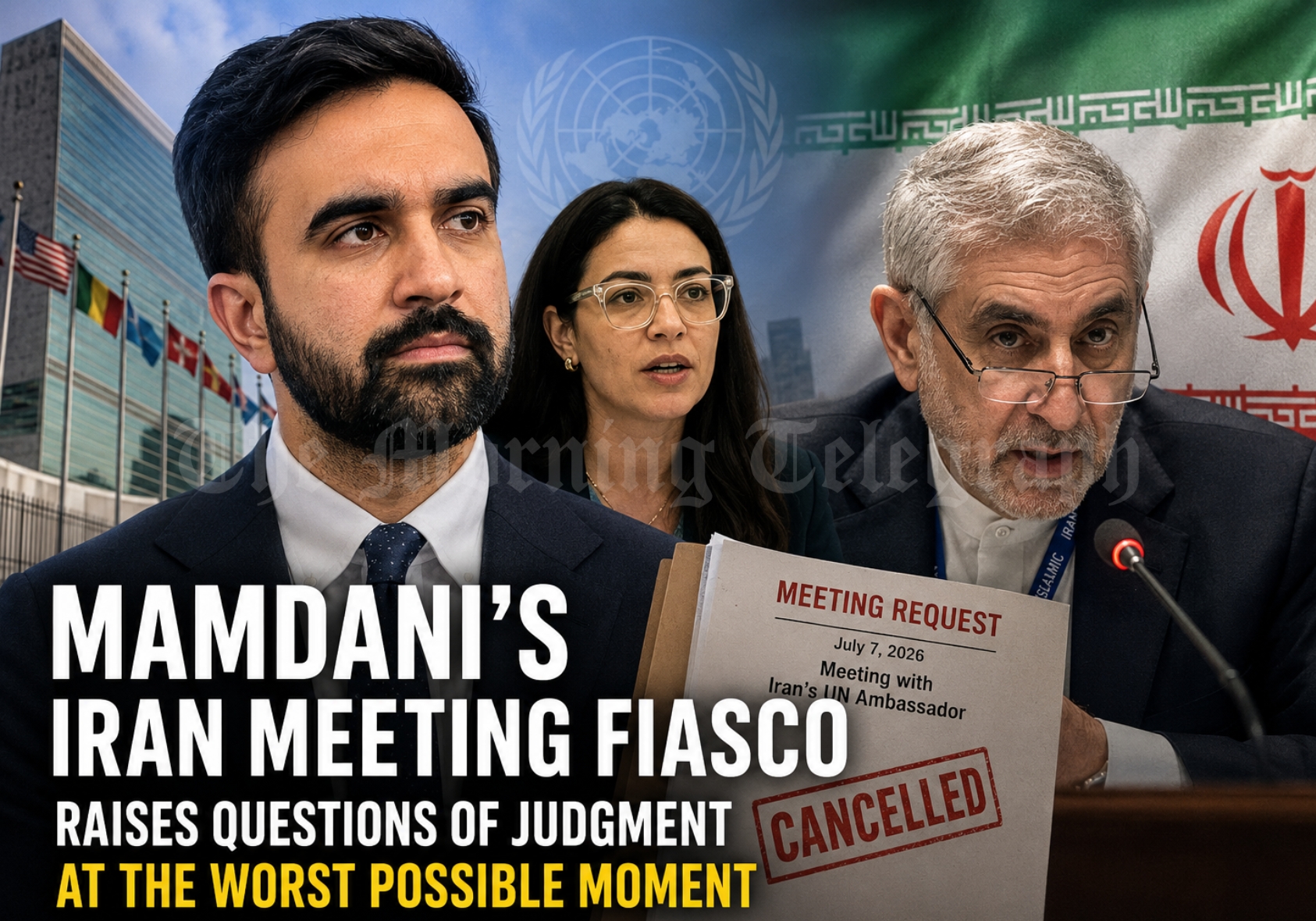
Mamdani’s Iranian meeting controversy erupted at an extraordinary moment. President Donald Trump was publicly discussing orders for retaliation if Iran assassinated him. Meanwhile, a senior official serving New York Mayor Zohran Mamdani had tried to arrange talks with Tehran’s ambassador to the United Nations.
The meeting never happened. However, the episode has sharpened questions about Mamdani’s judgment, his administration’s priorities and rhetoric that critics view as more sympathetic to America’s adversaries than to Washington.
How politically incompetent must an administration be to seek contact with Iran’s senior UN representative while the US president discusses what should happen if Tehran succeeds in killing him?

That question now confronts Mamdani after Ana María Archila, commissioner of the Mayor’s Office for International Affairs, scheduled a July 7 meeting with Iranian UN Ambassador Amir-Saeid Iravani.
Reports said the US State Department intervened before the meeting. Mamdani’s administration confirmed that it did not occur and would not be rescheduled. Reports also said Archila arranged it without first informing Mamdani or properly coordinating with federal officials.
That explanation may shield Mamdani from claims that he personally ordered the engagement. It does not remove responsibility for appointing the commissioner who pursued it.
Archila manages New York City’s relations with the diplomatic community. Her office demands sound political judgment, knowledge of federal protocol and sensitivity to national-security risks. Seeking an apparently unauthorized meeting with a government representative amid allegations of an assassination plot against the president suggests failure in all three areas.
The office is not a ceremonial platform for ideological experimentation. It helps the city manage foreign missions, visiting delegations and diplomatic institutions operating in New York.
That responsibility makes coordination essential. This is particularly true when proposed contact touches an active conflict involving the White House, State Department and US national security.
The cancellation prevented a potentially larger confrontation. However, it did not erase the underlying problem. A senior commissioner apparently moved toward a sensitive diplomatic encounter before City Hall established whether it was appropriate, authorized or useful.
Mamdani Iran Meeting Collided With Assassination Fears
The timing could hardly have been worse.
Israel reportedly gave the United States intelligence indicating that Iran was developing a fresh plan to assassinate Trump. Tehran has repeatedly threatened retaliation for the January 2020 US strike that killed Qasem Soleimani, commander of the Islamic Revolutionary Guard Corps’ Quds Force.
Trump later told the New York Post that he had issued instructions for overwhelming retaliation if Iran killed him.
“If anything happens,” Trump said, the United States should “literally bomb them at levels that they’ve never seen before.” He added: “I hope you’ll miss me.”
Trump was not literally announcing a last will and testament. Still, an American president publicly discussing orders to follow after his possible assassination shows how seriously he views the threat.
Against that backdrop, Archila’s attempted engagement was more than awkward diplomacy. It made City Hall appear to be opening its own channel to Tehran while Washington confronted assassination intelligence and renewed Iranian aggression.
Foreign policy belongs to the federal government, not New York’s mayor.
Mamdani Cannot Escape Responsibility for His Appointment
Mamdani reportedly knew nothing about the planned discussion. That may be true. However, it creates another damaging question. Why did his international affairs commissioner believe she could arrange such an engagement without consulting him?
Either Mamdani knew, which his administration denies, or a senior appointee believed she could independently conduct politically explosive diplomacy.
Neither possibility suggests competent management.
The sequence leaves Mamdani with only uncomfortable explanations. If he knew, he must explain why officials pursued the meeting. If he did not know, he must explain why a commissioner in such a sensitive role believed she could proceed without him.
A mayor cannot celebrate appointments when they succeed and plead ignorance when they risk an international incident. Mamdani chose Archila and trusted her to represent the city before foreign governments. Therefore, her judgment provides a legitimate test of his leadership.
That is why the controversy reaches beyond one appointment on a calendar. It raises questions about supervision, political discipline and the standards Mamdani applies to officials who represent New York internationally.
The controversy also does not stand alone. It fits a broader political record that has already caused critics to question Mamdani’s instincts during disputes involving Iran, Israel and the United States.
“Illegal War of Aggression” Statement Fuels Criticism
When the United States and Israel struck Iran in February, Mamdani issued an official statement calling the action a “catastrophic escalation” in an “illegal war of aggression.”
He accused both countries of “bombing cities” and “killing civilians.” He argued that Americans wanted affordability and peace, not another war seeking regime change.
Opposing military intervention does not equal supporting Iran. Americans across the political spectrum can reasonably challenge a war’s legality, necessity and human cost.
However, critics saw an imbalance. Mamdani’s first statement placed responsibility on Washington and Jerusalem while devoting less attention to Iran’s regional militias, shipping attacks, missile programmes, repression of protesters and threats against Americans.
Mamdani later called Iran’s government “brutal” while continuing to condemn US and Israeli military action. That qualification matters and belongs in the record.
Nevertheless, perceptions develop through repeated choices. Mamdani has repeatedly condemned American and Israeli power in forceful terms.
When his commissioner then seeks an unauthorized meeting with Iran’s ambassador, sceptics see a pattern rather than an administrative error.
Years of Campaigning Against Israel Deepen Suspicion
Mamdani ranks among America’s most prominent elected supporters of the Boycott, Divestment and Sanctions movement against Israel. His activism dates to college, when he helped establish a Students for Justice in Palestine chapter at Bowdoin College.
As a New York assemblyman, he promoted legislation aimed at stopping New York charities from funding groups linked to Israeli settlements or alleged international-law violations.
He has called Israel’s treatment of Palestinians apartheid and accused Israel of genocide in Gaza.
He has also condemned Hamas and publicly said he opposes the organization. Any fair account must state that clearly.
Still, Mamdani’s sustained hostility toward Israel influences how Americans interpret his administration’s conduct toward Iran. Tehran has funded and armed organizations committed to Israel’s destruction.
Criticism of Israel does not automatically mean support for Iran. Yet poorly authorized contact with Tehran becomes politically explosive when an administration already appears hostile to America’s closest Middle Eastern ally.
Rama Duwaji’s Posts Add to the Perception Problem
Mamdani’s wife, artist Rama Duwaji, holds no City Hall position. She should not carry responsibility for government policy. However, her public activity has shaped the political image surrounding the mayor.
Old social-media posts attributed to Duwaji resurfaced in 2026. Reports described offensive language, intense anti-Israel comments and content praising figures associated with Palestinian political violence.
She later apologized for harmful language from her youth and said her age did not excuse it.
Critics also highlighted Instagram activity involving strongly pro-Palestinian material after the October 7 attacks. Mamdani defended her as a private citizen. He also said some activity predated their marriage and his mayoral campaign.
None of this proves that Duwaji supports Iran’s government. Pro-Palestinian activism and support for Tehran are not the same, despite Iran’s sponsorship of Hamas and other armed organizations.
But politics does not operate only through courtroom standards of evidence. Public trust also depends on symbolism, judgment and accumulated impressions.
Mamdani has spent years attacking Israeli policy. His wife’s past posts included inflammatory material. His official statement accused the United States of illegal aggression against Iran.
Then his commissioner attempted to meet Iran’s ambassador during an assassination crisis. The administration cannot be surprised when critics connect those events.
The Real Issue Is Judgment, Not Conspiracy
The legitimate charge is not that Mamdani is Iranian, controlled by Tehran or connected to an assassination plot. No evidence supports those accusations, and responsible journalism must reject them.
The issue is whether Mamdani’s political instincts make him examine America and its allies more harshly than their enemies.
It is also whether he appointed officials who understand the boundary between municipal diplomacy and federal foreign policy.
While Trump says Iran may seek his death, Archila should not have needed State Department intervention to recognize the danger.
Any meeting with Tehran’s ambassador required extreme caution, formal authorization and a clear public purpose.
Mamdani may maintain that he knew nothing about the proposed engagement.
However, for a mayor already fighting perceptions that his ideological loyalties sit outside the American mainstream, ignorance offers little reassurance.