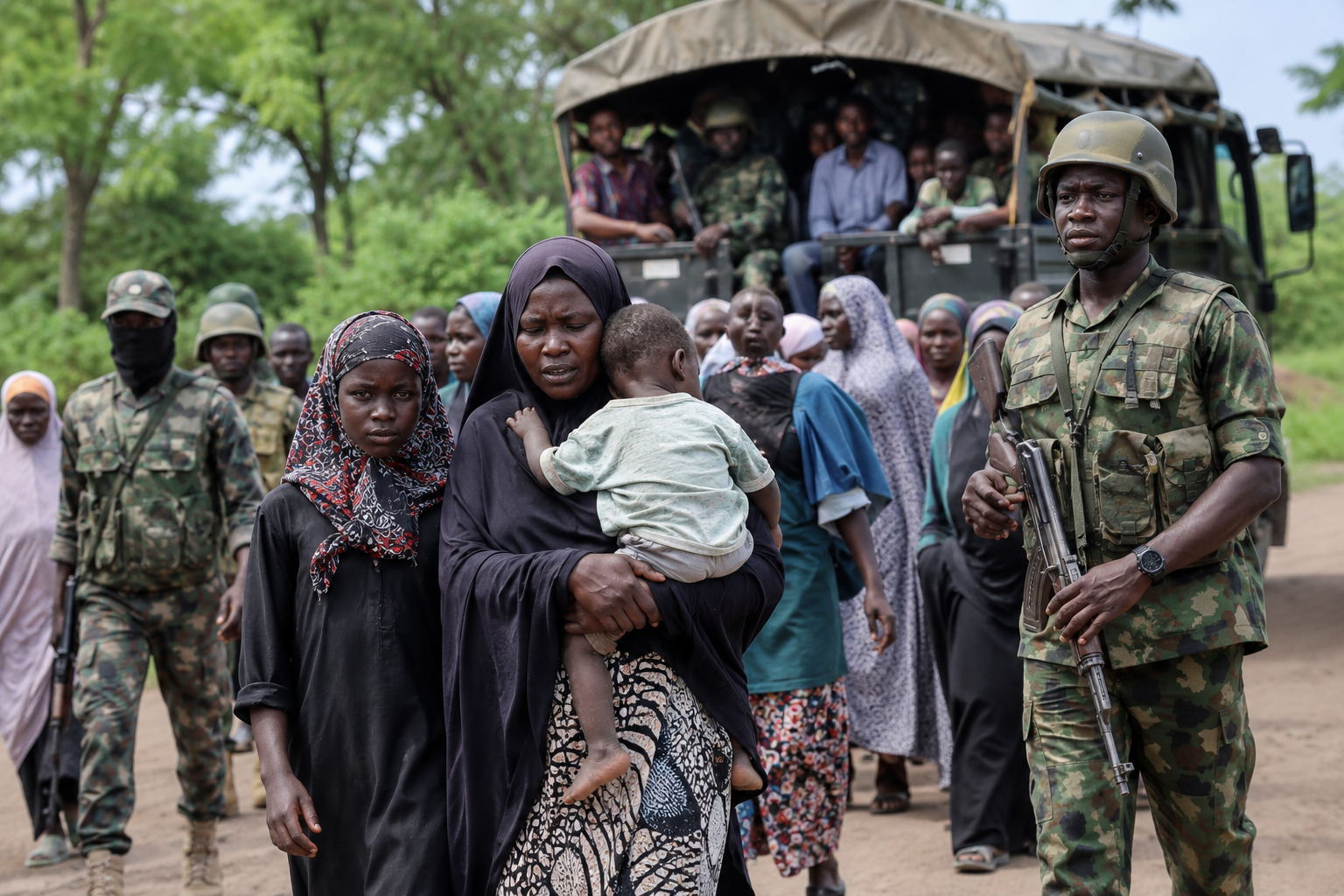
Nigeria hostage rescue operation frees 308 kidnap victims from forests after separate abductions in Kwara and Niger states.
Nigerian security forces completed a major Nigeria hostage rescue, freeing 308 people abducted during separate attacks in the country’s northern and north-central regions.
President Bola Tinubu announced the operation on Wednesday, August 5. He described it as the largest number of abducted citizens recovered by a joint Nigerian security team in a single day.
The rescued group included 163 people taken from the Woro community in the Kaiama Local Government Area of Kwara State. Armed attackers abducted them during an assault in February.

Security forces also recovered another 145 victims who had mainly been abducted from communities in neighbouring Niger State.
Authorities found the victims inside the forest surrounding Kainji Lake National Park in Niger State. Armed groups have used the remote and densely wooded region to hide captives and evade security operations.
The victims had spent several months in captivity. Officials said they were receiving medical care following their release.
Authorities did not disclose the full details of the intelligence-led operation. They also did not say whether security forces exchanged fire with the kidnappers or arrested any suspects.
There was no official confirmation that anyone paid a ransom to secure the victims’ freedom.
Nigeria Hostage Rescue Praised by Tinubu
Tinubu praised the security personnel who took part in the operation. He said their work showed improving cooperation among Nigeria’s security agencies.
“The successful execution of this intelligence-led operation demonstrates the growing efficiency and collaboration among our security services,” Tinubu said.
“I commend our gallant men and women in uniform for their bravery and unwavering commitment to safeguarding Nigerian lives.”
The president said the operation involved a joint security team, although the government did not provide a complete breakdown of every unit involved.
Reports indicated that personnel from the military, police and counterterrorism services participated in the mission.
Tinubu also called for stronger early-warning systems across vulnerable communities. Such systems could help authorities identify suspicious movements and respond before armed groups launch attacks.
The president said Nigeria must improve intelligence gathering and strengthen coordination between security agencies and local communities.
Officials are expected to reunite the victims with their families after they complete medical examinations and other assessments.
For hundreds of relatives, the rescue ended months of uncertainty over whether their loved ones remained alive.
Kidnappings Remain a Serious Threat
Despite the successful Nigeria hostage rescue, mass abductions remain one of the country’s most serious security problems.
Armed groups frequently attack villages, schools, places of worship and vehicles travelling along rural highways. The attackers often force their victims into remote forests before demanding ransom payments.
Nigeria commonly refers to many of these criminal groups as bandits. They operate mainly across the northwest and north-central regions, where limited state presence and difficult terrain complicate security operations.
Some groups emerged from conflicts involving farming and herding communities. However, many have developed into organised criminal networks involved in kidnapping, cattle theft and attacks on settlements.
Meanwhile, Nigeria continues to face a long-running Islamist insurgency in the northeast. That conflict has lasted for more than a decade and has displaced large numbers of people.
The different security threats have placed pressure on Nigeria’s police, military and intelligence services. They must respond to kidnappings, terrorism, communal violence and organised crime across vast areas.
Tinubu has faced growing public pressure to improve security and rescue people still held by armed groups.
Questions Remain After Record Operation
The rescue represents an important success for Tinubu’s government. However, authorities have not identified the group responsible for holding all 308 victims.
Officials have also not explained how security forces located the captives or removed them from the forest.
The decision to withhold operational information may protect intelligence sources and prevent armed groups from learning how the security agencies tracked them.
However, the lack of information leaves several unanswered questions. These include whether anyone escaped, whether negotiators took part and whether the kidnappers remain active in the area.
The release of 308 victims will bring relief to their families and communities. It also demonstrates what coordinated intelligence and security operations can achieve.
Nevertheless, the scale of the operation highlights the severity of Nigeria’s kidnapping crisis. Preventing future abductions will require stronger rural security, faster intelligence sharing and greater protection for vulnerable communities.
Nigeria’s government must now build on the rescue by pursuing the kidnappers and ensuring that families do not face the same ordeal again.