Google India data centre plans face legal challenges over water shortages, construction noise and risks to protected wildlife.
Google’s proposed $15 billion Google India data centre development is facing mounting opposition over its possible impact on water supplies, wildlife and nearby communities.
Construction work is already advancing near Visakhapatnam in the southern state of Andhra Pradesh. However, environmental activists have organised protests and launched several legal challenges against the massive technology project.
The development forms part of Google’s five-year Indian investment programme, covering the period from 2026 to 2030. Google describes it as the company’s largest investment in India so far.

The company plans to establish its first major artificial intelligence hub in the country. The development will include gigawatt-scale computing facilities, energy infrastructure, fibre-optic networks and a new international subsea cable gateway.
Google is working with Indian partners, including AdaniConneX and telecommunications company Airtel, to develop the infrastructure.
However, the project’s scale has raised questions about whether local resources can support its long-term operation.
Google India Data Centre Raises Water Fears
Water supplies have become the most serious point of contention.
Visakhapatnam currently receives about 410 million litres of water each day. However, the city’s estimated daily requirement stands at around 480 million litres.
That creates a daily shortfall of approximately 70 million litres. The shortage has already led authorities to introduce periodic water rationing for the city’s roughly 2.5 million residents.
Environmental activists fear that supplying a major data-centre campus could place further pressure on households, surrounding villages and farming communities.
Data centres contain thousands of servers that generate large amounts of heat. Operators must cool this equipment continuously to prevent technical failures.
Many facilities use significant quantities of water for cooling. However, consumption varies according to the technology used, the facility’s design and the surrounding climate.
Campaigners have questioned the Andhra Pradesh government’s reported commitment to guarantee the project’s water supply for 20 years.
They argue that authorities could prioritise industrial requirements over residents during future shortages.
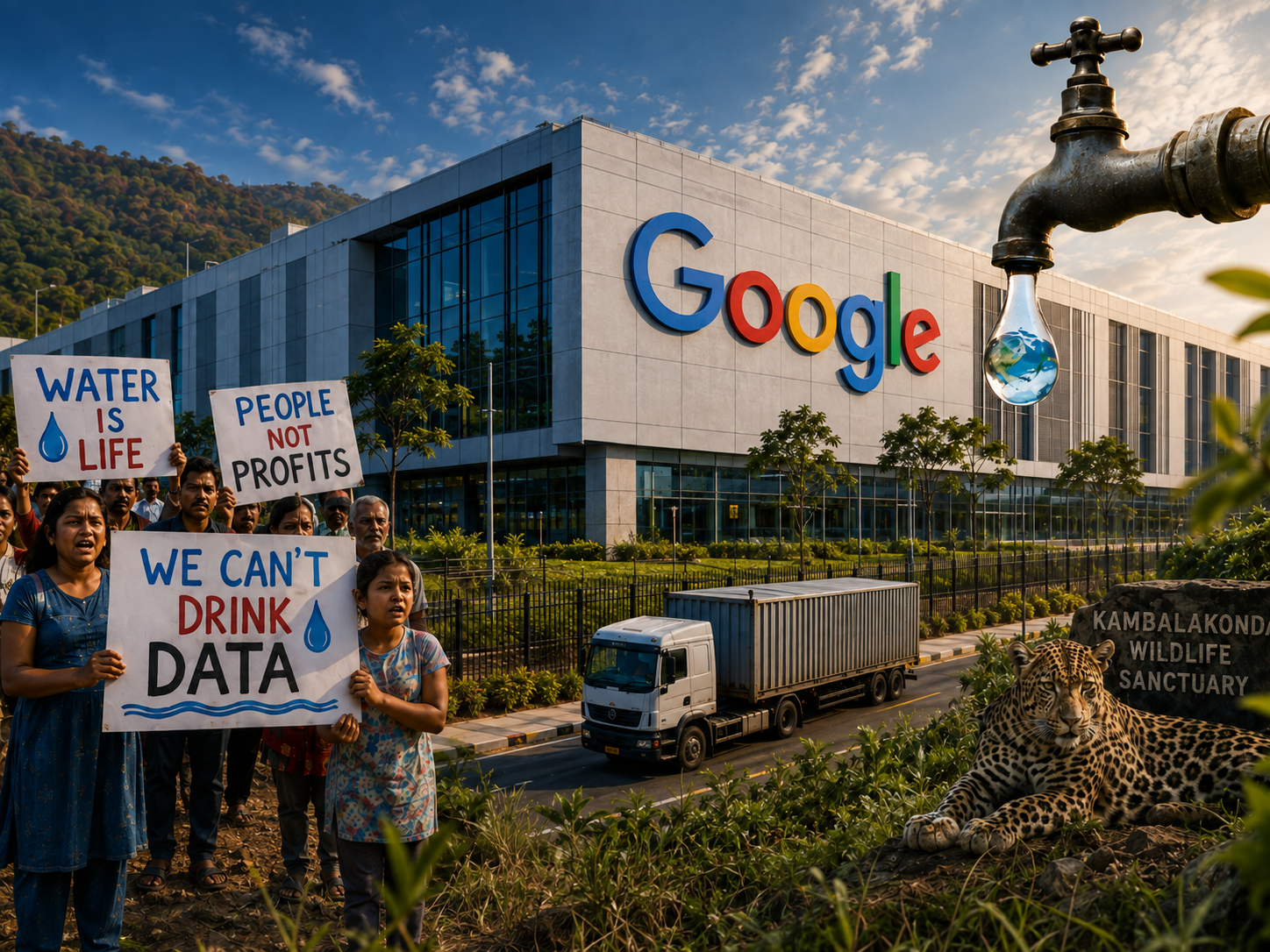
Recent demonstrations in Visakhapatnam have included environmental activists and children. Some protesters carried banners declaring that people could not drink data.
Campaigners have also announced plans for further public-awareness events and beach protests.
Court Challenges Target Environmental Approvals
The controversy has now reached India’s courts.
The Andhra Pradesh High Court has asked the state government to respond to a public-interest case filed by environmental organisation Jal Biradari.
The petition alleges that the project could place additional pressure on local water resources and affect a nearby reservoir.
The High Court is expected to consider the case again on August 24, 2026.
The Human Rights Forum has also reportedly filed three cases before India’s environmental court. The petitions demand a halt to the development.
The organisation argues that state authorities approved the project without properly assessing the consequences of drawing water from a rural drinking-water scheme.
Campaigners have also accused officials of accelerating the approval process without conducting adequate environmental consultations.
However, the Andhra Pradesh government has rejected several of those allegations. It insists that officials will not divert residential or rural drinking-water supplies to the data centres.
The government also says the project will not use water from the nearby reservoir identified by campaigners.
In a statement to Reuters, the state described several claims surrounding the development as incorrect and misleading.
Nevertheless, officials acknowledged that peaceful protest remained a democratic right. The government said it would investigate legitimate concerns, provide factual clarification and offer appropriate solutions where necessary.
Google has also defended the project. The company says it will comply with all applicable Indian laws and regulations.
It plans to introduce advanced air-cooling technology to reduce pressure on local water resources.
Wildlife Sanctuary Located Near Development
Campaigners have also raised concerns about the project’s proximity to the Kambalakonda Wildlife Sanctuary.
The protected area is home to several species, including leopards and pangolins. It reportedly lies about 860 metres from part of the development.
Environmental groups fear that heavy construction, increased traffic, land clearing and prolonged noise could disturb wildlife.
They also warn that extensive development near the sanctuary could damage the surrounding ecosystem.
However, the Andhra Pradesh government says the data-centre site is farther from the protected area than the minimum distance required under Indian law.
Google has promised to install sound-dampening measures. The company said it intends to operate as a quiet and unobtrusive neighbour to surrounding communities and wildlife.
The assurances have not ended the opposition. Activists want more detailed information about the project’s expected water consumption, electricity demand and long-term environmental footprint.
They also want authorities to conduct transparent assessments before allowing further construction.
Government Promotes Jobs and AI Investment
The Andhra Pradesh government views the project as a major opportunity to transform Visakhapatnam into an international technology and artificial intelligence centre.
Officials have promoted the development as a source of investment, infrastructure and employment.
The wider project could support as many as 188,000 jobs. However, that projection may include construction roles and indirect employment rather than only permanent positions within the data-centre complex.
Google says the hub will give Indian companies, researchers and developers greater access to advanced artificial intelligence infrastructure.
The project will also expand international digital connectivity through new subsea cable links. These connections will integrate with Google’s existing global network.
The company has also promised investment in clean-energy generation, electricity transmission and storage systems. Those facilities will help meet the project’s enormous energy requirements.
However, the dispute reflects a wider international debate about the environmental cost of the artificial intelligence boom.
Governments increasingly regard data centres as essential economic infrastructure. Countries want to attract investment while strengthening their technology sectors and digital independence.
Meanwhile, local communities are demanding clearer information about the water, electricity and land required to support those developments.
The legal challenges in Visakhapatnam could therefore become an important test for Google’s largest Indian investment.
The final outcome may depend on whether Google and the Andhra Pradesh government can prove that the project’s economic and technological benefits will not come at the expense of drinking water, rural livelihoods and protected wildlife.