By Dwayne Ferreira
As thousands of Sri Lankans depart for overseas employment, local industries struggle to find workers, construction companies seek foreign labour, and the Labour Ministry acknowledges serious gaps in the country’s workforce data.
COLOMBO, November 18, 2026 — Sri Lanka is facing a growing contradiction in its labour market, with the government promoting overseas employment for hundreds of thousands of citizens while domestic businesses struggle to fill vacancies and authorities prepare a new national policy to recruit workers from abroad.
The scale of the imbalance is striking.
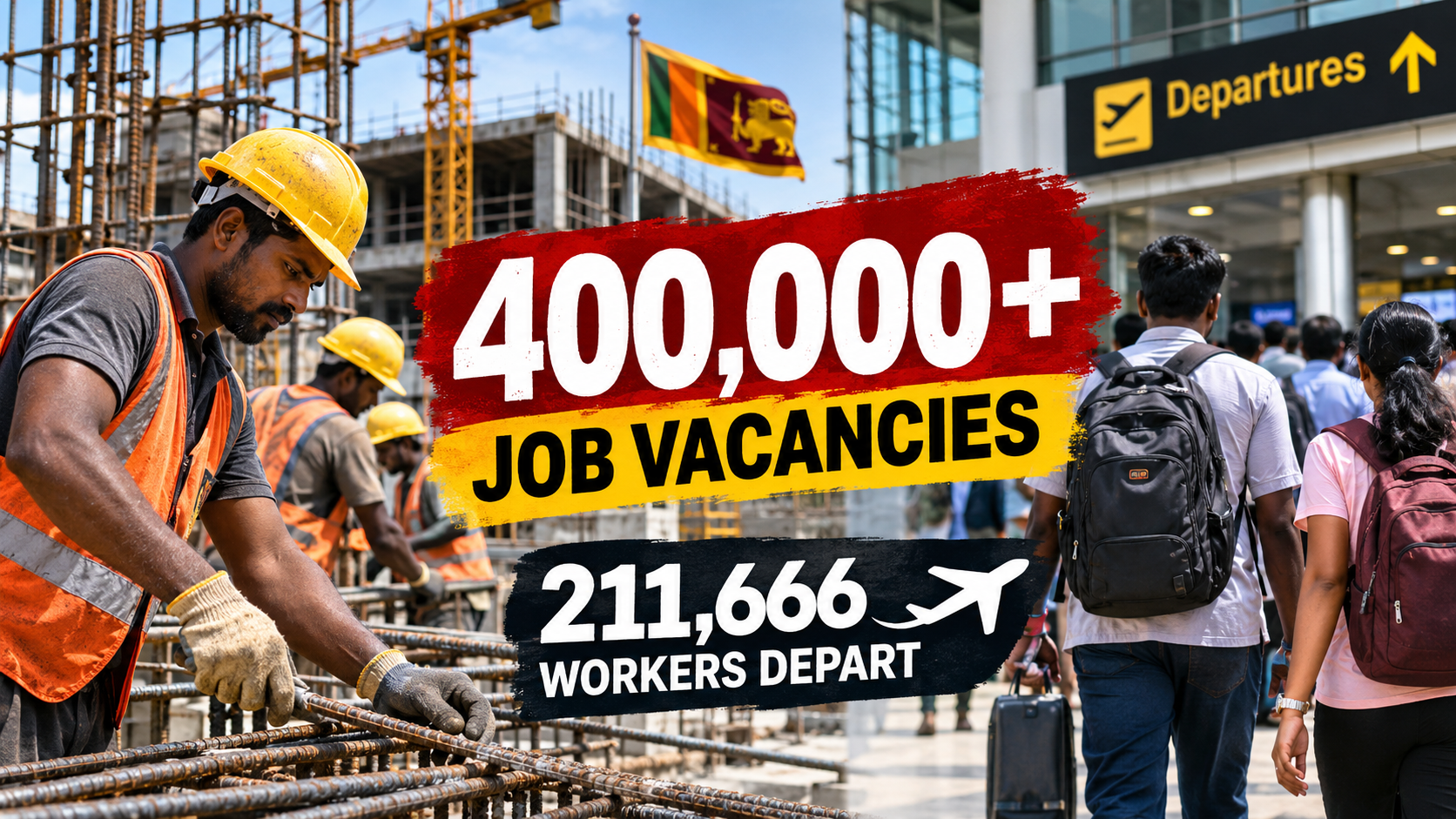
Minister of Industry and Entrepreneurship Development Sunil Handunnetti stated earlier this year that Sri Lanka’s private sector was facing more than 400,000 job vacancies, with shortages of both skilled and unskilled workers compelling some industries to consider foreign recruitment.
Yet, according to figures attributed to the Sri Lanka Bureau of Foreign Employment (SLBFE), 211,666 Sri Lankans departed for overseas employment during the first nine months of 2026 alone.

Now, in a development that raises fresh questions about the country’s employment strategy, the Ministry of Labour has confirmed that Sri Lanka’s proposed Inward Labour Migration Policy is in its final stages, with Cabinet approval expected in early 2027.
The situation exposes a fundamental economic challenge: Sri Lanka continues to facilitate the departure of its workforce while simultaneously confronting shortages of workers needed to sustain domestic production, construction and industrial growth.
More significantly, the government has acknowledged that existing institutional arrangements do not provide the coordinated information necessary to accurately determine the country’s labour requirements.
ADVERTISE
WITH US.
Place your ads here. Advertise with The Morning Telegraph now.
More Than 400,000 Jobs Reportedly Waiting to Be Filled
Speaking in June, Minister Handunnetti identified a serious labour shortage affecting private-sector industries, with employers increasingly struggling to recruit workers for both skilled and unskilled positions.
The minister subsequently referred to more than 400,000 vacancies and identified industries experiencing difficulty finding employees.
These include construction, footwear, leather products, automobile-related industries and manufacturing.
The shortage has become particularly concerning as Sri Lanka attempts to expand exports, attract investment and rebuild industries affected by the economic crisis.
However, the widely reported 400,000 figure remains a ministerial estimate rather than a publicly verified, occupation-by-occupation vacancy register.
That distinction is important because effective workforce planning requires more than a national estimate. Authorities must establish where vacancies exist, what qualifications they require, what employers are offering and why available workers are not filling them.
Without such information, it is difficult to determine whether the country is facing an absolute shortage of labour, a mismatch of skills, or an inability to attract employees under existing pay and working conditions.
211,666 Workers Depart in Just Nine Months
While employers report difficulty finding workers, overseas employment remains a major economic priority.
SLBFE figures released in October showed that 211,666 Sri Lankans had departed for foreign employment between January and September 2026.
Of those departures, 141,916 were through workers’ own arrangements, while 69,750 were facilitated through foreign employment agencies.
The figures included 134,761 men and 76,905 women, while 108,343 departures were classified within skilled employment categories.
September alone recorded 29,752 departures, the highest monthly total reported for the first nine months of the year.
The SLBFE has also targeted 250,000 overseas employment placements for 2026.
These figures demonstrate the continued significance of foreign employment to Sri Lanka’s economy. They do not, however, establish that every worker leaving was previously employed in a domestic industry experiencing shortages.
That is a crucial question requiring more detailed occupational data.
For Sri Lanka, the challenge is not simply the number of people departing, but whether their qualifications and experience correspond to the skills the domestic economy is struggling to retain.
Construction Industry Seeks Foreign Workers as Skilled Sri Lankans Leave
The construction sector provides one of the clearest examples of this emerging problem.
On November 15, the Chamber of Construction Industry of Sri Lanka estimated that the sector was experiencing a shortage of approximately 7,000 workers.
Its Chairman, Manilal Fernando, warned that temporary foreign recruitment might be necessary to sustain construction activity.
Fernando also described difficulties retaining workers trained through an initiative involving a German industrial group, estimating that approximately 60% of those trained subsequently sought opportunities overseas.
The estimate relates to that particular training initiative and should not be interpreted as a national migration rate for all construction workers.
Nevertheless, it illustrates a serious challenge facing employers: investing in training does not necessarily guarantee that the resulting skills will remain available within Sri Lanka.
Earlier in 2026, major construction companies had sought permission to recruit approximately 7,500 workers from overseas, including from India, Bangladesh and Nepal.
At that time, officials had projected a wider construction workforce shortfall of approximately 20,000 during the year.
The latest estimate of 7,000 reflects a different assessment and timeframe, demonstrating the importance of obtaining consistent, independently assessed vacancy statistics.
Construction Industry Development Authority Chairman Professor Chandana Jayalath has questioned whether broad shortage estimates are supported by sufficiently detailed evidence.
He has maintained that employers seeking foreign workers should identify the precise occupations, projects and duration of employment involved, and demonstrate why suitable workers cannot be recruited locally.
His position highlights a central issue in the wider debate: industry demand for foreign labour must be supported by credible evidence rather than broad estimates alone.
Government Acknowledges Gaps in Its Own Labour Data
Perhaps the most significant development emerged on November 13, when the Ministry of Labour announced that work on Sri Lanka’s proposed Inward Labour Migration Policy had reached its final stage.
The policy is being developed with technical assistance from the International Organization for Migration (IOM), following consultations involving government institutions and representatives of the business community.
According to the Ministry, foreign-worker recruitment approvals are currently handled through several institutions, including the Department of Immigration and Emigration, the Board of Investment and the Ministry of Industries.
These institutions operate under separate procedures.
The Ministry acknowledged that insufficient coordination and the absence of a centralised data system have created significant difficulties in accurately identifying labour shortages, assessing foreign-worker requirements and maintaining oversight.
This is a particularly important admission.
At a time when Sri Lanka is encouraging overseas employment and considering additional foreign recruitment, the responsible authorities have acknowledged serious shortcomings in the information needed to manage inward labour migration effectively.
The proposed policy seeks to address these problems through a more transparent and coordinated system.
It also aims to protect Sri Lankan employment opportunities while establishing safeguards against exploitation of foreign workers.
However, the acknowledgement raises broader questions about whether outward migration policy, vocational training, education planning and domestic industrial requirements are being adequately coordinated.
Exporters Warn That Labour Shortages Threaten Growth
Concerns about workforce availability are not limited to construction.
The National Chamber of Exporters has warned that difficulties recruiting, training and retaining workers are becoming a significant obstacle to export-sector growth.
These difficulties are especially relevant to industries that depend on specialised technical knowledge and experienced employees.
Sri Lanka’s broader export ambitions require expanding manufacturing capacity, increasing productivity and developing new industries capable of competing internationally.
But those ambitions depend on access to a reliable workforce.
Where employers cannot recruit suitably qualified employees, businesses may face production delays, higher operating costs or difficulties undertaking expansion.
The Chamber has supported the development of a structured inward migration framework, particularly where specialised skills are genuinely unavailable locally.
Such a framework could provide temporary relief to affected industries.
Yet bringing in foreign workers does not, by itself, resolve the underlying reasons Sri Lankan workers choose to leave or why some local residents remain outside the workforce.
The Problem May Be Bigger Than Migration
Sri Lanka’s labour shortage cannot be attributed entirely to overseas employment.
A broader concern is the country’s relatively low labour force participation.
Official Labour Force Survey figures cited in economic analysis show that participation fell from 54.1% in 2017 to 47.4% in 2024.
Female labour force participation declined from 36.6% to 29.8% over the same period.
These figures suggest that a substantial section of Sri Lanka’s working-age population remains outside the labour force.
The reasons are complex and can include childcare responsibilities, access to transport, limited suitable employment opportunities, skills mismatches and working conditions.
Consequently, a country can experience unemployment or low workforce participation while employers simultaneously report difficulty recruiting workers.
The existence of hundreds of thousands of vacancies therefore does not necessarily mean an equivalent number of unemployed people could immediately fill them.
Employers may require qualifications that applicants do not possess, while available jobs may offer remuneration or conditions that workers consider unattractive.
These structural problems must be addressed alongside foreign recruitment and migration policy.
Are Sri Lankan Employers Competing With Overseas Opportunities?
An equally important consideration is the ability of domestic employers to compete for experienced workers.
For many Sri Lankans, overseas employment offers the possibility of higher earnings, greater financial security or professional advancement.
Workers also have the right to pursue opportunities that improve their personal and family circumstances.
The responsibility for addressing domestic labour shortages cannot therefore rest entirely with citizens who choose to seek employment abroad.
Instead, policymakers and employers must consider whether local salaries, career progression, working conditions and training opportunities are sufficiently competitive to retain skilled workers.
Importing foreign labour might ease particular shortages, but it could also create risks if recruitment is poorly regulated or used to avoid addressing unattractive domestic employment conditions.
Conversely, restricting foreign recruitment without expanding local skills and improving labour participation could leave industries unable to operate effectively.
The challenge is to develop a system that balances economic requirements with fair opportunities and protections for both Sri Lankan and foreign workers.
A Workforce Strategy That Must Answer Difficult Questions
Sri Lanka’s situation presents policymakers with several questions that cannot be answered through migration targets or recruitment approvals alone.
How many of the reported 400,000 vacancies are verified and currently available?
Which industries and occupations account for the greatest shortages?
How many workers departing for overseas employment possess precisely the skills that local businesses are unable to recruit?
What steps are being taken to improve wages, working conditions and professional opportunities in sectors losing experienced employees?
And how will the proposed inward labour migration policy operate alongside the country’s existing strategy for overseas employment?
These questions become increasingly important as Sri Lanka seeks to strengthen its economy following the financial crisis.
The benefits of overseas employment cannot be ignored. Migrant workers provide essential financial support to their families, while remittances remain a major source of foreign exchange for the country.
Equally, the domestic economy requires skilled tradespeople, technicians, engineers, healthcare professionals and experienced workers to sustain development.
Both objectives can coexist, but only if supported by reliable data, effective training policies and coordination among the responsible institutions.
The Real Cost of Getting Labour Policy Wrong
Sri Lanka’s economic recovery cannot be measured solely by the foreign exchange earned through overseas employment.
It must also be judged by the country’s ability to maintain the workforce required to produce goods, construct infrastructure, support businesses and attract investment.
The government’s proposed inward labour migration policy represents an opportunity to improve planning and regulation. Whether it succeeds will depend on implementation, credible workforce statistics and safeguards for both domestic and foreign employees.
For now, the figures reveal an increasingly difficult balancing act.
More than 400,000 private-sector vacancies have been reported by a government minister. More than 211,000 citizens departed for overseas employment in nine months. Construction companies are calling for foreign workers. And the Labour Ministry has acknowledged that existing systems cannot adequately establish the country’s actual requirements for incoming labour.
These developments do not prove that encouraging overseas employment is inherently misguided.
They do, however, expose the urgency of developing a coherent national workforce strategy.
Sri Lanka cannot build a sustainable economy on remittances alone. It must also create an economy in which people have meaningful reasons to remain, businesses can recruit the skills they require, and those who leave have opportunities worth returning to.
Until that balance is achieved, the country risks continuing to earn foreign exchange from its departing workers while struggling to secure the workforce needed for its own future.
Sources
The article draws on the following government announcements, industry statements and published reporting.
1. Ministry of Labour – November 13, 2026
Development of the Inward Labour Migration Policy Reaches Final Stage
Primary government source confirming the policy’s progress, anticipated Cabinet approval, and acknowledged gaps in coordination and centralised workforce data.
2. Daily Mirror – July 1, 2026
Labour Shortage Compels Sri Lankan Firms to Recruit Foreign Workers
Reports Minister Sunil Handunnetti’s statement that private-sector vacancies exceeded 400,000.
3. Newswire – October 7, 2026
211,666 Leave for Foreign Employment in First Nine Months of 2026
SLBFE-based statistics covering overseas employment departures, skilled classifications and recruitment channels.
4. The Sunday Morning – November 15, 2026
Construction Industry Short of 7,000 Workers
Recent construction-sector estimates, employer interviews, worker retention concerns and CIDA’s response.
5. Daily FT — National Chamber of Exporters
Exporters Sound Alarm Over Labour Shortages
Industry concerns about the inability to attract and retain employees and the impact on export growth.
6. EconomyNext — January 2026
Sri Lanka Eyeing Foreign Labour as Construction Recovery Triggers Shortfall
Documents earlier construction-sector requests to recruit 7,500 workers and the projected 20,000-worker shortage.
7. Daily FT — July 8, 2026
Sri Lanka’s Labour Shortage Is Structural and It Is Constraining Growth
Published economic analysis citing official labour force participation data, skills shortages and the case for better workforce statistics.
8. Cabinet Office — May 18, 2026
Cabinet Decision on Formulating an Inward Labour Migration Policy
Original government decision approving the preparation of the proposed policy.