By Dwayne Ferreira
Cricket Australia announces an independent forum to hear conflicting accounts of the 2018 ball-tampering scandal, but refuses to reopen its investigation, impose further sanctions or guarantee that new testimony will be made public.
HOBART, Australia | November 18, 2026 — Eight years after one of international cricket’s most damaging cheating scandals, Cricket Australia has acknowledged that three members of the Australian team involved in the infamous 2018 Cape Town Test were never interviewed during its original investigation, raising fresh questions about the completeness of an inquiry that resulted in lengthy suspensions for three players.
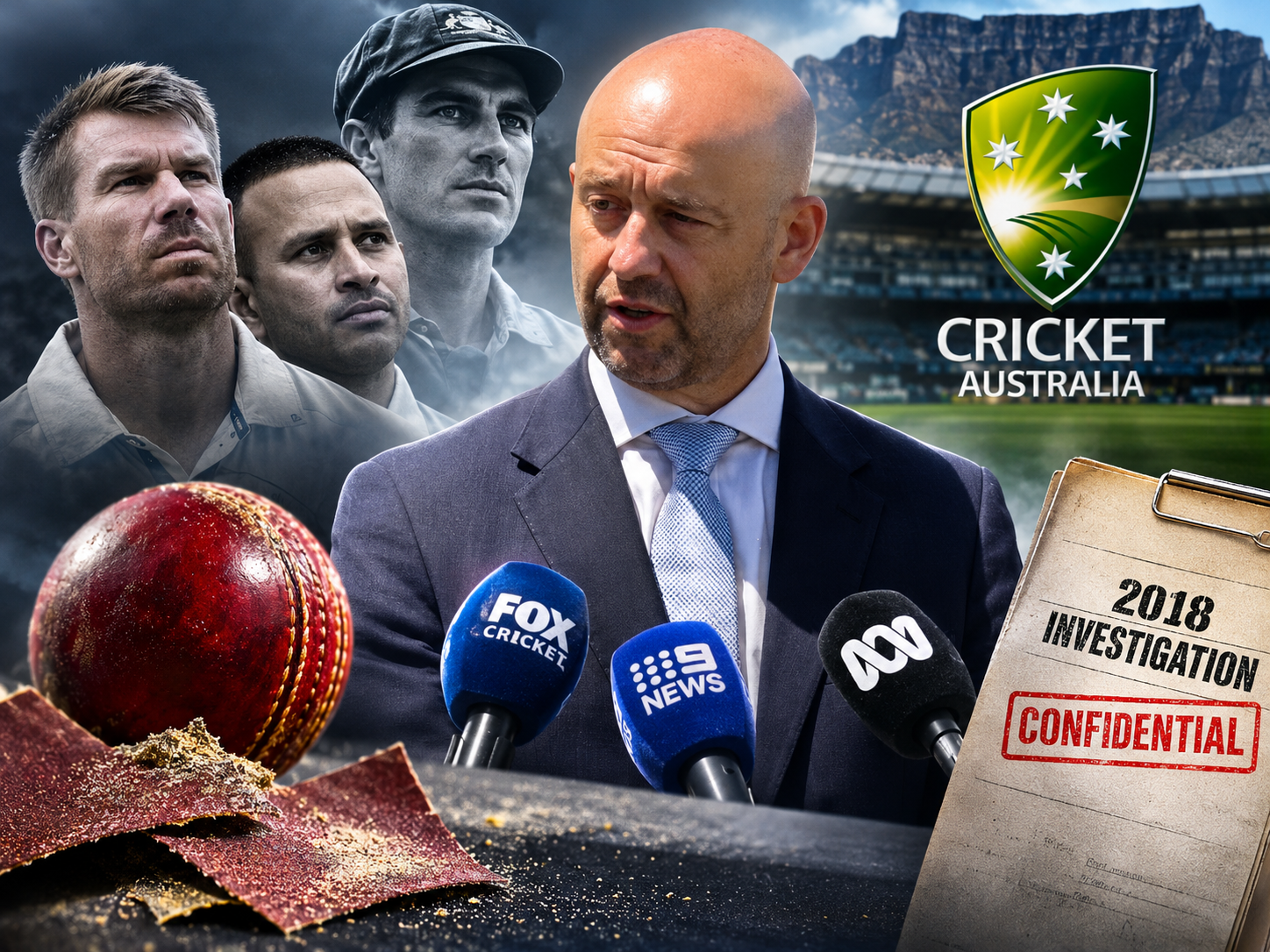
The revelation came during a press conference on Wednesday, when Cricket Australia Chief Executive Todd Greenberg and interim chairman David Boon announced the establishment of an independent forum to allow players and staff from the 2018 tour of South Africa to share their accounts of the controversy.
However, despite acknowledging substantial differences in players’ recollections, Greenberg firmly ruled out reopening the investigation, while confirming that the new process would not be designed to impose sanctions.

ADVERTISE
WITH US.
Place your ads here. Advertise with The Morning Telegraph now.
The announcement follows a renewed public dispute involving former Australian players Usman Khawaja and David Warner, whose accounts have challenged the long-standing narrative surrounding the scandal.
The governing body’s position creates a fundamental question: if Cricket Australia now recognises that not everyone was heard in 2018, can it maintain that its original investigation adequately addressed what happened?
Eight of Eleven Players Interviewed in Original Investigation
One of the most consequential disclosures came when Greenberg was asked whether Cricket Australia’s original investigation had been mishandled.
He rejected that suggestion but confirmed that investigators had interviewed only eight members of Australia’s eleven-man team involved in the third Test against South Africa at Newlands, Cape Town.
Greenberg explained that investigators had operated under considerable time pressure, with only a short period between the scandal and Australia’s next Test match.
The disclosure is particularly significant because the original investigation established the basis for disciplinary action against then-captain Steve Smith, vice-captain David Warner and opening batter Cameron Bancroft.
The trio were the only players sanctioned by Cricket Australia over the incident, with Smith and Warner receiving 12-month playing bans and Bancroft receiving a nine-month ban. Warner also received a lifetime prohibition on holding Australian team leadership positions, which was subsequently lifted in 2024. ABC News+1
Although Greenberg defended the original inquiry, the admission that three players were not interviewed raises legitimate questions about how investigators established the extent of knowledge within the Australian dressing room.
The identities of those three players were not disclosed during Wednesday’s press conference.
Importantly, reporting by Australia’s ABC has indicated that all four members of the bowling attack — Pat Cummins, Mitchell Starc, Josh Hazlewood and Nathan Lyon — spoke to investigators. That reporting does not identify the full group of players who were not interviewed. ABC News+1
Khawaja’s Explosive Claims Reignite Eight-Year Controversy
The renewed controversy gained momentum following the publication of Usman Khawaja’s autobiography, Sabr, in which the former Australian Test opener challenged the established account of the scandal.
Khawaja claimed that knowledge of the use of sandpaper was more widespread within the Australian dressing room than Cricket Australia’s original findings suggested.
He also alleged that sandpaper had been used during the preceding Test in Port Elizabeth, not just during the Cape Town match where Bancroft was caught.
These allegations were reported by ABC News on November 7, 2026, and directly challenged the position that knowledge of the specific tampering plan was confined to the three sanctioned players. ABC News+1
David Warner subsequently supported Khawaja’s account and publicly questioned the thoroughness of Cricket Australia’s investigation.
Warner’s intervention intensified the dispute, particularly after current Australian captain Pat Cummins rejected Khawaja’s claims.
Cummins described the suggestion that the entire team knew about the plan as “complete and utter nonsense”, reiterating that he had no prior knowledge of sandpaper being taken onto the field to alter the condition of the ball. ABC News+1
The conflicting claims have placed the spotlight not only on what occurred in South Africa but also on whether the evidence examined in 2018 was sufficient to identify everyone who knew about the scheme.
Neither Khawaja’s allegations nor the denials of other players have been independently resolved through a new formal investigation.
Cricket Australia Confirms Earlier Matches Were Not Investigated
Wednesday’s press conference also established a further limitation of the original investigation.
When Greenberg was asked whether the 2018 inquiry had examined possible sandpaper use during earlier Test matches, he answered that it had not.
He explained that the inquiry had been a specific review of the Cape Town incident.
That admission is relevant because Khawaja’s recent allegations extend to the preceding Test at Port Elizabeth.
Consequently, Cricket Australia’s original investigation cannot be treated as having definitively examined or ruled out similar conduct during earlier matches.
This does not establish that sandpaper was used in those matches. It confirms that the original inquiry did not examine the broader allegation now being made.
Greenberg acknowledged that he could not establish whether the practice had occurred previously.
Independent Forum Announced, but No Fresh Investigation
Cricket Australia’s proposed response is to establish an independent forum, potentially overseen by a former judge, where players and staff from the 2018 South African tour can provide confidential accounts.
Participation will be voluntary, and the forum will operate separately from the governing body’s administration.
Greenberg emphasised that the process was intended to allow individuals who had not previously spoken, or who believed they had not been properly heard, to contribute.
However, he repeatedly stressed that the forum would not reopen the original investigation.
It would not be established to prosecute allegations or recommend further sanctions.
The distinction is important.
A forum can document testimony and potentially help reconcile disagreements, but without a mandate to test competing evidence or determine responsibility, it cannot necessarily establish which account of events is accurate.
The forum’s findings may also remain confidential.
Greenberg confirmed that the Cricket Australia board would determine what information could eventually be released, taking into account the confidentiality promised to participants.
Reuters independently reported on November 18 that Cricket Australia’s initiative was intended to address the damaging debate but would not reopen the 2018 investigation, and that its findings would not necessarily be published. Reuters+1
Cricket Australia’s Most Controversial Response: No Search for the Perfect Truth
Perhaps the most revealing exchange occurred when Greenberg was challenged about the possibility that some players had provided inaccurate accounts of the scandal.
A journalist asked what would happen if evidence emerged that players had lied.
Greenberg responded by emphasising that recollections could contradict each other, adding:
“Looking for the perfect truth doesn’t exist and we’re not chasing that.”
Later, when asked how contradictory accounts from Usman Khawaja and Pat Cummins could both be accurate, Greenberg suggested that each player was expressing his own version of events.
The remarks highlight the difference between Cricket Australia’s proposed reconciliation process and a formal investigation intended to establish facts.
While two players may genuinely believe their respective recollections, contradictory statements about whether a particular incident occurred cannot automatically be accepted as equally accurate.
For Australian cricket supporters, this leaves the central controversy unresolved: whether the original investigation identified the full extent of knowledge and involvement in the ball-tampering scheme.
Greenberg’s comments do not prove that anyone lied or concealed evidence. They do, however, indicate that the new forum is not being established to determine whether particular players’ accounts are supported by evidence.
Cricket Australia Acknowledges Its Own Role in the 2018 Culture
Greenberg also made an important admission about the culture that existed within Australian cricket at the time.
He acknowledged that Cricket Australia had contributed to an environment in which winning was prioritised above other considerations.
The organisation’s responsibility was not limited to the dressing room, he suggested, but extended into its wider leadership and administration.
This position is supported by the independent cultural review conducted by The Ethics Centre following the 2018 scandal.
That review identified an organisational culture focused on winning without sufficient consideration of the costs, with the emphasis on results contributing to the erosion of important values.
The Ethics Centre’s published findings provide independent support for the argument that the scandal reflected wider institutional problems rather than simply the actions of three individual cricketers. A matter of balance+1
Cricket Australia’s own published response to the cultural review also accepted that its leadership had a share of responsibility for the circumstances surrounding the incident.
Recommendation 19 specifically addressed leadership accountability, while Recommendation 21 proposed greater transparency through the publication of board minutes, an approach Cricket Australia did not adopt in full. Cricket Australia
These historical findings are significant because they establish that concerns about Cricket Australia’s culture and governance were documented years before the present dispute.
Greenberg nevertheless defended the cultural transformation undertaken by the Australian team since 2018, crediting former captain Tim Paine, former coach Justin Langer, current captain Pat Cummins and coach Andrew McDonald for helping rebuild standards within the team.
Warner and Khawaja Question Whether the Forum Will Deliver Answers
The governing body’s proposed solution has already attracted scepticism from the players whose recent statements helped reignite the controversy.
Following Wednesday’s announcement, Warner and Khawaja publicly questioned what the forum would achieve if its findings were not disclosed.
According to ABC News’s coverage of their reactions, Warner emphasised that he did not seek further punishments against players or officials but wanted transparency and accountability.
Both players also expressed a desire for Australian cricket to move beyond the controversy. ABC News
This distinction is important.
The dispute is not necessarily about imposing additional suspensions eight years after the event. It increasingly concerns whether the historical record is complete and whether the sport’s governing body is prepared to make that record available for public scrutiny.
Questions Remain Over Transparency and Accountability
The independent forum may provide an opportunity for individuals to speak without fear of disciplinary consequences. Such an environment could encourage testimony from people who previously felt unable or unwilling to come forward.
However, several questions remain unresolved.
Why were three members of the playing eleven not interviewed in 2018? Were they approached? What evidence was considered sufficient to exclude further involvement? And why has Cricket Australia ruled out a new investigation before hearing the additional accounts it is now inviting?
Another question concerns public disclosure.
With the Cricket Australia board retaining the authority to decide what information from the forum is released, the process may provide private reconciliation without delivering the answers sought by supporters and former players.
Greenberg indicated that he hoped the forum could conclude within approximately a month, although no firm deadline was established.
The original 2018 investigation report will also remain confidential, according to his remarks at Wednesday’s press conference.
Eight Years Later, Sandpapergate Remains Unresolved
The Sandpapergate scandal fundamentally changed Australian cricket. Three internationally recognised players were sanctioned, leadership arrangements were reshaped and the governing body was forced to confront serious questions about its culture.
Eight years later, the latest public disagreements suggest that the controversy has never been fully settled among those involved.
Cricket Australia has now acknowledged that not every player was interviewed, that its original inquiry did not investigate earlier matches and that significantly different accounts continue to exist.
Yet it remains unwilling to reopen that inquiry or guarantee that new information will be made public.
The independent forum may help repair relationships and allow previously unheard voices to contribute. Whether it can restore public confidence without testing competing accounts remains uncertain.
Cricket Australia wants to close one of the most painful chapters in its history. But until the unanswered questions surrounding the original investigation are addressed, the distinction between moving on from the scandal and establishing the full truth may remain at the centre of the debate.
Sources
1. Fox Cricket — Cricket Australia CEO Announces Independent Forum (November 18, 2026)
Original press conference featuring Todd Greenberg and David Boon.
https://www.youtube.com/watch?v=v9SIpsQkqpA
2. Cricket Australia — All 42 Cultural Review Recommendations (2018)
Official recommendations and Cricket Australia’s responses following Sandpapergate.
https://www.cricket.com.au/news/3289979/all-42-culture-review-recommendations
3. The Ethics Centre — Cricket Australia: A Matter of Balance
Independent assessment of the organisational culture surrounding the scandal.
https://ethics.org.au/casestudy/cricket-australia/
4. Reuters — Cricket Australia Attempts Sandpapergate Circuit Breaker Through Player Forum (November 18, 2026)
https://www.reuters.com/sports/cricket/australia-give-all-players-chance-give-accounts-2018-ball-tampering-incident-2026-11-18/
5. ABC News — Cricket Australia CEO Todd Greenberg and David Boon Speak in Wake of Sandpapergate Saga (November 18, 2026)
https://www.abc.net.au/news/2026-11-18/cricket-australia-sandpapergate-khawaja-warner-greenberg/107398200
6. Reuters — Warner Backs Khawaja’s Comments About Ball-Tampering Scandal (November 9, 2026)
https://www.reuters.com/sports/cricket/warner-backs-khawajas-comments-about-ball-tampering-scandal-2026-11-09/
7. Reuters — Cummins Denies Involvement in Sandpaper Plot (November 12, 2026)
https://www.reuters.com/sports/cricket/utter-nonsense-australia-skipper-cummins-denies-involvement-sandpaper-plot-2026-11-12/
8. Reuters — Warner Blasts Cricket Australia Investigation (November 14, 2026)
https://www.reuters.com/sports/cricket/stinks-cover-up-warner-blasts-cricket-australia-probe-2026-11-14/
9. ABC News — Cricket Australia Rules Out New Sandpapergate Investigation (November 10, 2026)
https://www.abc.net.au/news/2026-11-10/cricket-australia-no-sandpapergate-investigation/107367290
10. ABC News — Why Australian Cricket Is Struggling to Move On From Sandpapergate (November 16, 2026)
https://www.abc.net.au/news/2026-11-16/why-australian-cricket-struggling-to-move-on-from-sandpapergate/107391726