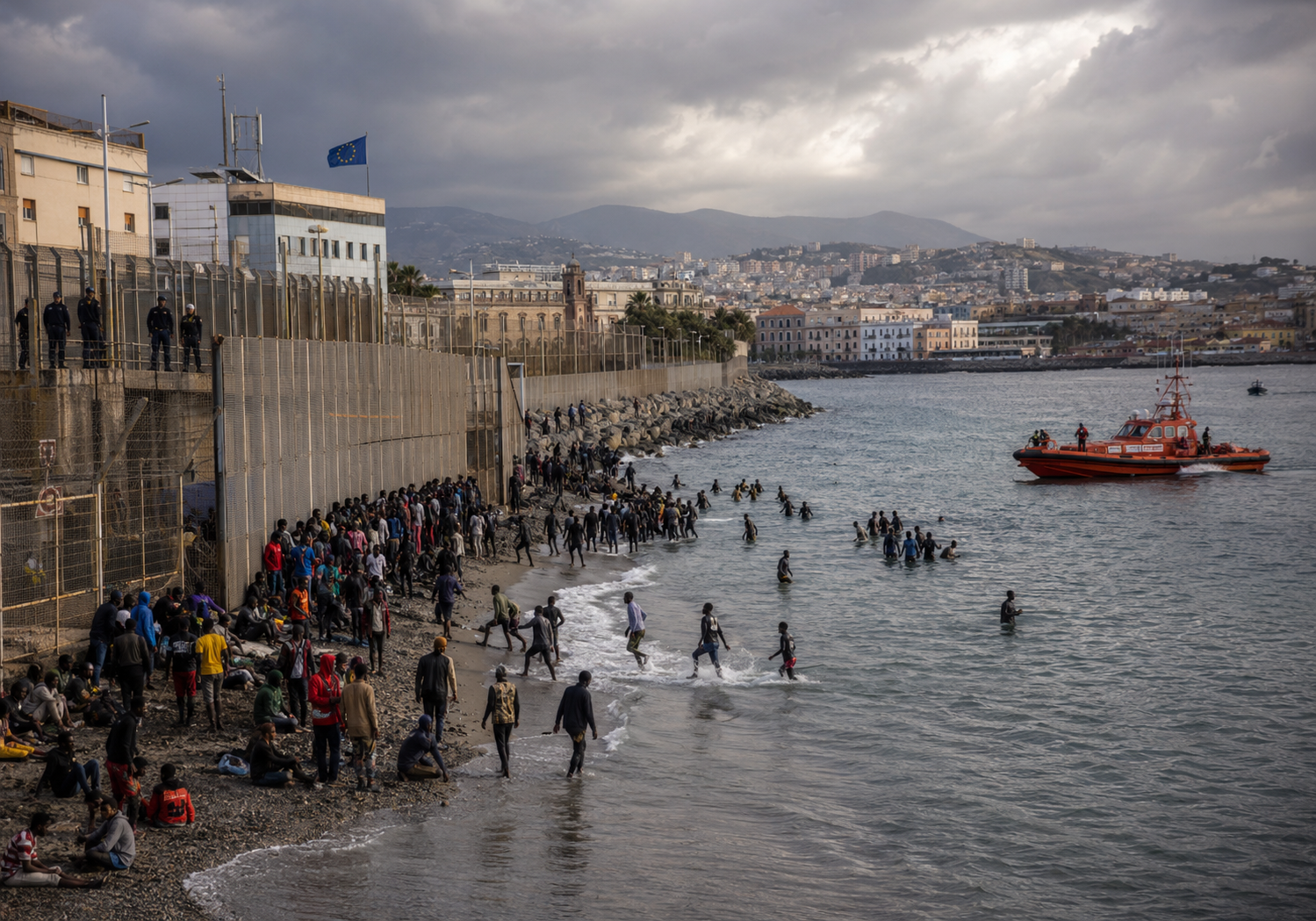
The Ceuta migrant crisis pushes the EU to consider visa and trade leverage after about 72,000 people entered the Spanish enclave.
The Ceuta migrant crisis has pushed the European Union to consider using visa rules, trade policy and wider diplomatic leverage to secure stronger cooperation from Morocco after approximately 72,000 people entered the Spanish territory.
EU Migration Commissioner Magnus Brunner said the extraordinary border surge exposed Europe’s vulnerability when protection of its external frontiers depends heavily on neighbouring countries.
The mass crossings into Ceuta, a Spanish enclave on the North African coast beside Morocco, began late last week. Migrants reached the territory by sea, moved around coastal barriers and passed through overwhelmed sections of the border.

Spanish authorities estimated that around 72,000 people entered during the crisis. However, Interior Minister Fernando Grande-Marlaska said approximately 70,000 later left Ceuta or returned to Morocco.
Brunner said cooperation with neighbouring states remained essential. However, he argued that the EU must be ready to use its economic and diplomatic influence when that cooperation falls short.
“We have leverage,” he said, referring to visa arrangements, trade relations and other agreements between the European Union and Morocco.
Ceuta Migrant Crisis Fuels EU Policy Debate
Brunner’s comments did not amount to a formal announcement of sanctions or trade restrictions. Instead, they suggested that the European Commission could link future economic and visa cooperation with Morocco to progress on migration control.
The commissioner also called for deeper cooperation on migrant returns and readmission agreements. These arrangements allow EU countries to return people who do not qualify for asylum or legal residency.
European interior ministers have already discussed the Ceuta migrant crisis and demanded stronger action against migrant-smuggling networks. They also called for closer cooperation with countries outside the bloc to prevent similar mass movements.
Spanish authorities said the rapid departure of most migrants stopped the crisis from spreading into mainland Europe. Ceuta sits outside the European Union’s passport-free Schengen zone. Madrid also said the wider Schengen area never faced a direct threat.
Still, the scale and speed of the crossings caused alarm across Europe. They also placed intense pressure on Ceuta, whose normal population is only slightly larger than the number of migrants who entered.
Local authorities struggled to provide shelter, medical care, food and security. Thousands initially slept outdoors, while reception centres became severely overcrowded.
The crossings also caused significant loss of life. Migrants attempting to reach Ceuta faced dangerous sea currents, overcrowding and difficult coastal terrain. Authorities reported dozens of deaths, although the final toll remained subject to change as emergency teams continued their searches.
Morocco’s Border Role Faces Scrutiny
The crisis has renewed debate over Morocco’s role in controlling migration towards Europe.
Some European politicians and officials questioned whether Moroccan authorities temporarily reduced border enforcement. Others asked whether officials responded quickly enough as tens of thousands gathered near Ceuta.
Morocco rejected claims that it deliberately enabled the crossings. Moroccan officials instead highlighted the country’s previous efforts to stop irregular migration and dismantle human-smuggling networks.
Morocco, Spain and the European Union have long cooperated on migration, security, fishing, trade and development aid. However, earlier border emergencies have shown how quickly migration can become linked to diplomatic disputes between Rabat, Madrid and Brussels.
Brunner said the latest events showed that the European Union could not allow the security of its external frontier to depend entirely on a third country.
His comments are likely to intensify debate over whether the EU should make trade access, financial support and visa arrangements conditional on stronger migration enforcement.
For now, Brussels has not formally approved new visa restrictions or trade measures. However, the scale of the Ceuta migrant crisis has increased pressure on the EU to develop a tougher, more coordinated approach to migration partnerships with neighbouring states.