Turkish Airlines emergency landing followed a bird strike after takeoff from Katunayake, forcing the aircraft to burn fuel before landing safely.
A Turkish Airlines emergency landing unfolded on Saturday morning after a bird strike forced a wide-body Airbus A330 bound for Istanbul to abort its journey shortly after departing Bandaranaike International Airport. The aircraft remained airborne for 195 minutes before returning safely to Katunayake after burning excess fuel.
Airport officials confirmed that all 246 passengers and crew landed safely after the aircraft completed an extended holding pattern over the Negombo Lagoon and surrounding sea area before touching down at 10:21 a.m.

Bird strike forces flight to abandon departure
Turkish Airlines flight TK-731, operating an Airbus A330 service from Katunayake to Istanbul, departed Bandaranaike International Airport at 7:07 a.m.
The aircraft had been loaded with approximately 80 tons of fuel for its scheduled six-hour flight.
Shortly after takeoff, however, the aircraft experienced a bird strike. The flight crew immediately informed Air Traffic Control at Katunayake and initiated emergency procedures.
Although initial assessments indicated the aircraft had not suffered significant structural damage, the crew determined that returning immediately was not an option because of the aircraft’s weight.
Turkish Airlines emergency landing required lengthy fuel burn
According to airport officials, international aviation safety procedures prohibit an aircraft from landing with such a heavy fuel load.
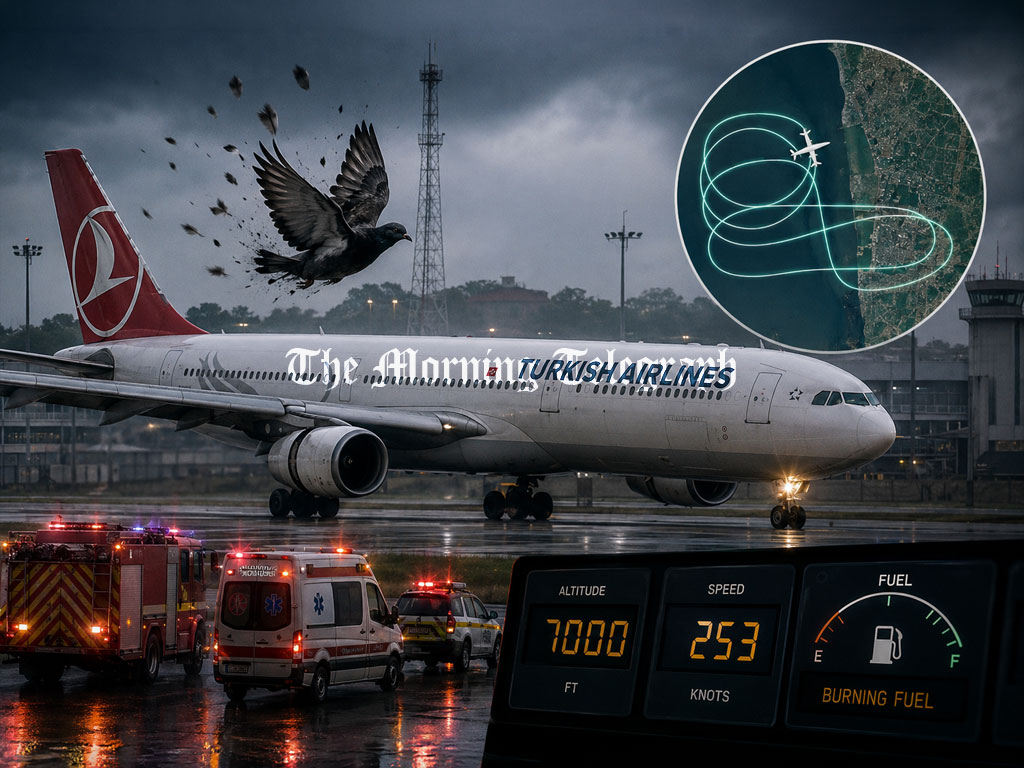
With approximately 80 tons of fuel still onboard, the Airbus A330 remained too heavy for a safe landing. The aircraft therefore entered a controlled holding pattern above the Negombo Lagoon and adjacent sea area.
The crew maintained the aircraft at approximately 7,000 feet while flying at a reduced speed of around 253 knots to gradually burn fuel and reduce the landing weight.
The aircraft continued circling for three hours and 15 minutes, equivalent to 195 minutes, before reaching a safe operating weight for landing.
Emergency services placed on full standby
Because the flight declared an emergency return, airport authorities activated extensive contingency measures on the ground.
Officials deployed airport fire engines, emergency ambulances, specialist doctors, nurses and rescue teams near the runway in preparation for a possible emergency landing.
Authorities also confirmed that the passenger manifest included a director from the International Labour Organization (ILO) along with numerous foreign dignitaries, prompting heightened security and emergency readiness.
Despite the precautionary measures, the landing proceeded without incident.
Aircraft lands safely at Katunayake
After completing the extended fuel-burning operation, the Airbus A330 safely returned to Bandaranaike International Airport at 10:21 a.m.
Airport officials confirmed that the aircraft landed normally and that all 246 passengers and crew were safely accounted for.
Engineering personnel have since begun a detailed inspection of the aircraft following the bird strike before it can resume service.
The incident highlighted the importance of international aviation safety procedures, with the prolonged holding pattern allowing the aircraft to reduce its weight and complete a safe emergency landing without injury to those on board.