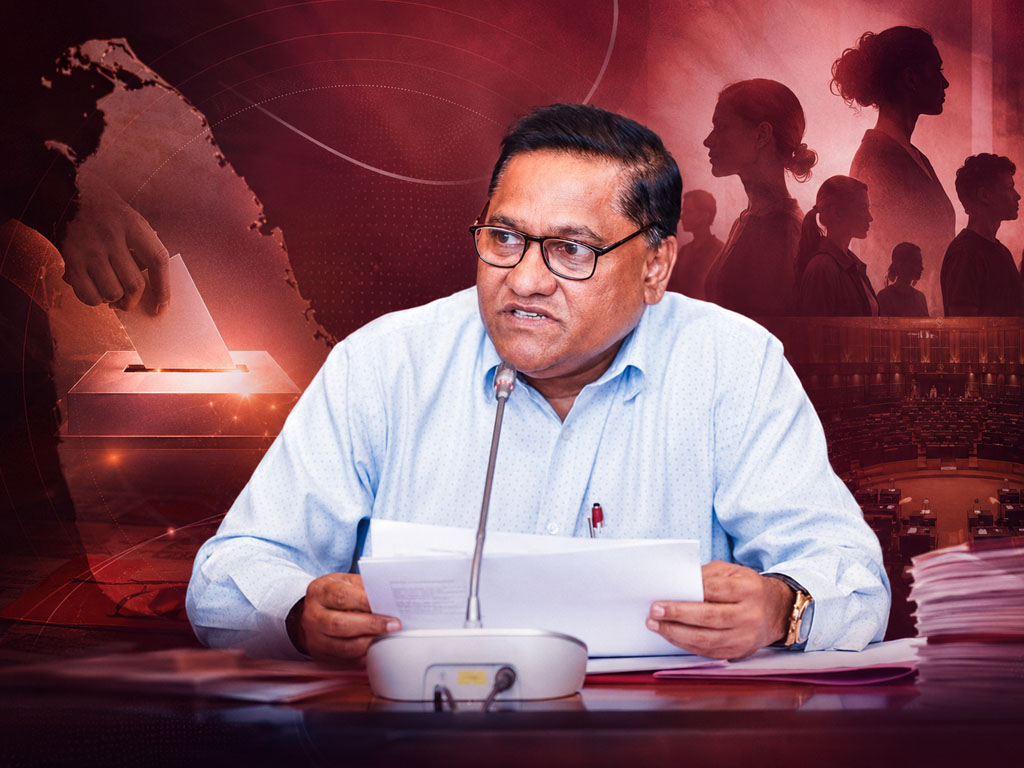
Provincial Council elections face a fresh push as the Just Society movement submits three proposals to Minister Vijitha Herath’s committee.
Sri Lanka Provincial Council elections must take place without further delay, the National Movement for a Just Society has told a parliamentary committee chaired by Minister Vijitha Herath.
The organisation submitted three proposals aimed at ending the prolonged suspension of the country’s nine Provincial Councils, which have remained dissolved and inactive for seven, eight, or nine years.
The proposals also seek guaranteed representation for women and young people.
Secretary-General Sunil Jayasekara forwarded the recommendations after discussions with Dr. Sujatha Gamage, Professor Sudantha Liyanage, and Attorney Lihini Fernando.

Three Proposals for Provincial Council Elections
The movement’s first proposal calls for restoring the preferential proportional representation system used before 2017.
It argues that Parliament can revive the system through a simple legal amendment. Renewed discussions about a mixed electoral system would require fresh delimitation of districts and wards, potentially delaying elections for several more years.
The second proposal seeks mandatory representation for women. It recommends requiring women to make up one-third, or 33.3%, of every candidate list.
The organisation says guaranteeing 25% female representation in the final councils would be impractical under the preferential system. Therefore, it proposes placing the requirement directly on nomination lists.
The third proposal calls for one-sixth, or 16.7%, of candidates on nomination papers to be young people.
A 25% youth quota already applies under the Local Government Elections (Amendment) Act.
Years of Inactivity and Stalled Legal Reforms
Provincial Council elections were last conducted in 2012, 2013, and 2014. Since then, the absence of elected councils has weakened development work and disaster-relief mechanisms, the movement said.
It cited difficulties during the recent “Ditta” cyclone as an example of the consequences of prolonged council inactivity.
The electoral process stalled after Parliament rejected the delimitation report covering 222 constituencies under the Mixed Elections Act No. 17 of 2017.
M.A. Sumanthiran later introduced a private member’s bill to abolish that framework and restore the previous system. The Supreme Court approved the bill in April 2024.
However, it lapsed when Parliament was dissolved. The movement argues that the current government could introduce a simple amendment based on those provisions.
Costs, Campaigning and Future Electoral Reform
The old preferential system has attracted criticism over high campaign costs and the wide areas candidates must cover.
However, the proposals say authorities could address those concerns through the Election Expenditure Regulation Act No. 3 of 2023, additional legal safeguards, and social media.
Scholars involved in the discussions suggest Sri Lanka could pursue broader electoral reform after these urgent elections. They also point to lessons from local government experiences in 2025 and 2028.
The movement says the government must now make a political decision to restore functioning Provincial Councils and protect citizens’ political rights.
It urged authorities to set aside complicated legal arguments centred in Colombo and immediately return the councils to democratic operation.