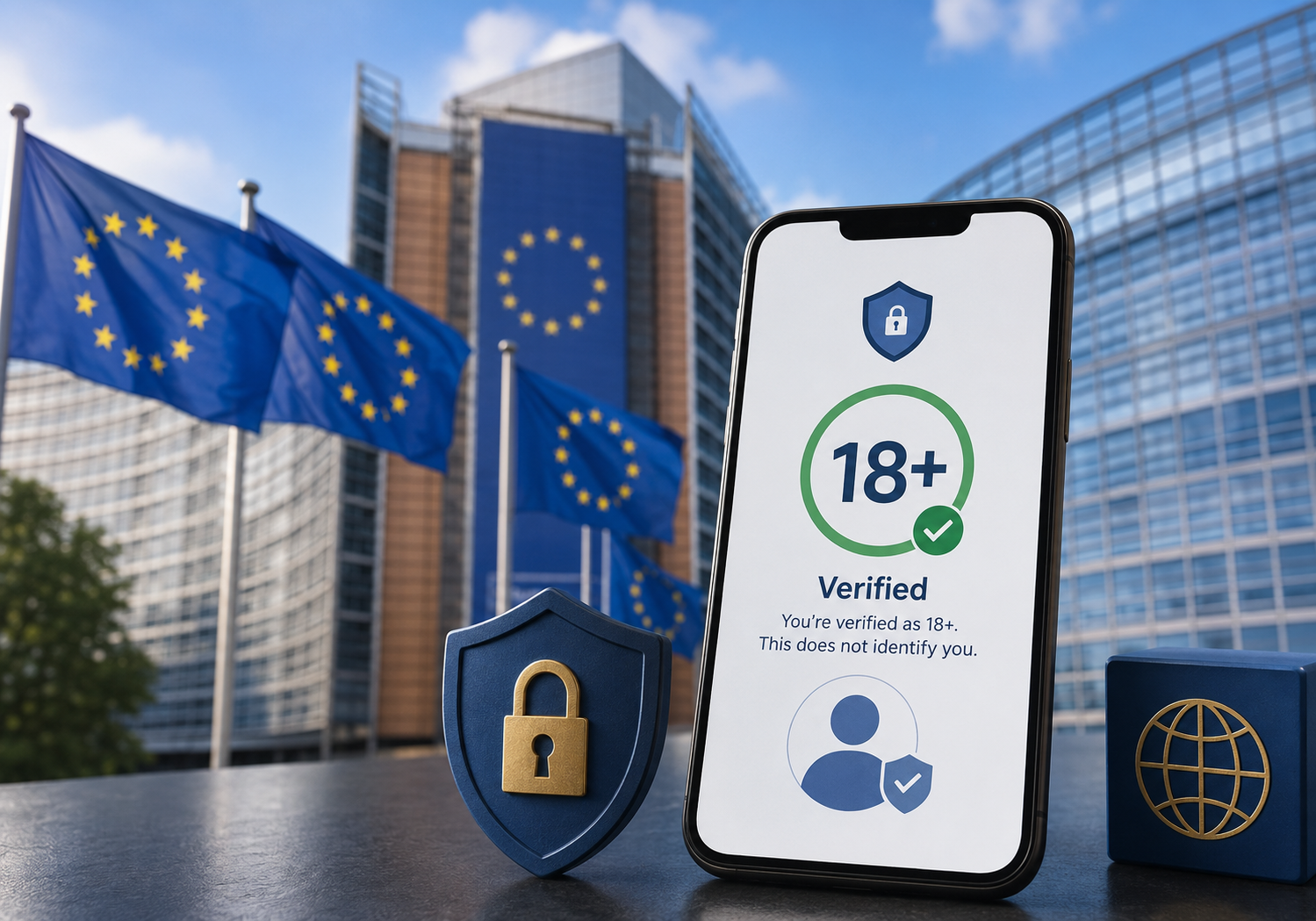
EU internet passport claims are misleading. The planned system verifies age for restricted services without identifying ordinary internet users.
Viral claims that the European Union plans to introduce an EU internet passport before people can browse the web are misleading.
The measure under discussion concerns age-restricted online services and child safety. It does not require Europeans to obtain government permission before using search engines, reading news, sending emails or accessing the wider internet.

Social-media posts seen by millions claim users will soon need an approved digital identity before visiting websites. Some describe the proposal as an “internet passport” and warn that anonymous internet use will disappear.
However, the European Commission has proposed no universal licence for going online.
What the EU age-verification plan does
The controversy centres on an EU age-verification system designed to confirm that users meet the legal age requirement for certain online services.
The European Commission has cited adult content, online gambling and alcohol purchases as possible examples.
Under the proposed design, a website would receive confirmation that a user is over 18. It would not necessarily receive the person’s name, exact date of birth, passport number or address.
In simple terms, the website would see that the user meets the age requirement without learning their full identity.
The Commission says the system forms part of its wider effort to protect children from inappropriate or harmful online content under the Digital Services Act.
That is very different from requiring identification before every internet search or website visit.

Credit: European Commission/Wikimedia Commons, CC BY 2.5
How the “EU internet passport” claim spread
“Internet passport” is not the official name of the age-verification system.
The phrase appears to have emerged after social-media users combined two separate EU initiatives: the age-verification tool and the European Digital Identity Wallet.
The digital identity wallet will allow citizens and residents to store and present digital credentials. It could be used to prove identity, sign documents or store qualifications and travel information.
EU member states must make these wallets available. However, that does not mean people will need one to browse ordinary websites.
The Commission has also said the age-verification tool can operate separately from the wider digital identity wallet.
Viral posts have blurred those differences and created the impression that Brussels plans to track everyone’s online activity.
There is no credible evidence supporting that claim.

Credit: European Union, 2020/European Commission Audiovisual Service, CC BY 4.0
Will websites know who users are?
The Commission says the system aims to reveal as little personal information as possible.
An adult-content website, for example, could receive confirmation that a visitor is over 18 without receiving the visitor’s birthday or legal name.
The system is also intended to prevent separate age checks from being linked together. That safeguard aims to reduce the risk of building a record of someone’s browsing habits.
However, privacy concerns remain legitimate.
Digital-rights groups have warned that poorly designed age-verification systems can collect excessive data, expose sensitive information or exclude people without suitable documents or smartphones.
Critics also warn about “function creep,” where technology introduced for a limited purpose later expands into other areas.
Those concerns deserve scrutiny. But they are not proof that the EU has already decided to identify every internet user.
Why the Distinction Matters
Governments face difficult questions about protecting children online without creating intrusive surveillance.
Age-verification systems involve genuine concerns about privacy, security, free expression, parental responsibility and access to information.
The EU has also debated other controversial digital measures, including proposals involving the detection of child sexual abuse material in private communications.
Those proposals deserve close examination.
However, combining several different EU policies into one supposed plan to censor the entire internet gives the public a false picture.
The Verdict
The claim that Europeans will soon need a universal EU internet passport before going online is misleading.
The EU is developing age-verification technology for legally restricted services. It is also considering stronger protections for children using social media.
There is currently no credible evidence that the European Commission plans to require identification before every internet search, record every website a person visits or make government approval a condition for ordinary internet access.
Privacy concerns should not be dismissed. But the debate should focus on what the EU has actually proposed, not viral claims about the imminent censorship of Europe’s internet.