The Chemmani mass grave has yielded two more infant skeletons as a new report examines disappearances, obstruction and decades of impunity.
JAFFNA, Sri Lanka — The Chemmani mass grave has yielded the skeletal remains of two more infants, three decades after the first horrifying revelations from the burial site outside Jaffna. A newly released investigation says the discovery deepens evidence of a prolonged state-sponsored obstruction campaign while families of the disappeared continue searching for remains and justice.
The International Truth and Justice Project published the report, titled Chemmani Mass Grave: “We Are Still Searching.” The title echoes the words that repeatedly close testimonies from families who have waited a generation for answers.

Mass graves mark several parts of Sri Lanka. However, investigators describe Chemmani as a singular monument to state impunity. They also cite evidence that the military continued using the salt flats outside Jaffna to dispose of corpses even after the first excavations began.
Chemmani Mass Grave Linked to 1996 Disappearances
The graves trace back to the summer of 1996, after a suicide bomber assassinated Jaffna town commandant Brigadier Ananda Hamangoda. Following the attack, the Sri Lankan military launched what the report describes as a campaign of retribution against civilians.
Amnesty International estimates that about 600 people disappeared within a few months. Arbitrary and callous seizures defined the terror of that period.
Soldiers took a shop assistant from the roadside, and he was never seen again. They seized a local tailor at a crowded junction in front of witnesses. A cashier who refused to surrender his employer’s groceries at a checkpoint was arrested and disappeared. His family later received only a dismissive explanation that authorities could not find him.
During another incident, soldiers severely beat a 19-year-old baker and his coworkers at night. A masked informant then identified the young man, and military personnel dragged him away.
On July 19, 1996, after an insurgent raid on an army camp, military forces sealed off seven villages near Navatkuli. Hundreds of residents had to walk past masked informants. Soldiers detained at least 150 people at the Subramaniam rice mill.
Frantic relatives gathered outside, but soldiers concentrated on driving them away. Meanwhile, 24 detainees vanished permanently.
Captain Duminda Keppetiwalana, who commanded the nearby Navatkuli camp, later told investigators that local residents liked him. He said he often distributed Coca-Cola to build goodwill. Yet his name appears repeatedly in affidavits concerning the disappeared.
Krishanthy Kumaraswamy Murder Exposed the Graves
The violence reached its most notorious point with the abduction of Krishanthy Kumaraswamy. Soldiers stopped the 18-year-old schoolgirl at the Chemmani checkpoint while she travelled home after a chemistry examination.
Soldiers raped and murdered her. Her mother, 16-year-old brother and a neighbour then went to the checkpoint looking for her. They were also killed and buried.
An irrigation worker tried to warn Krishanthy’s mother about the abduction. He later disappeared. The witness who saw authorities arrest that worker also vanished, systematically erasing the chain of witnesses.
A rare breach in the military’s wall of silence emerged during the 1998 trial of those accused of Kumaraswamy’s murder. Convicted soldiers gave detailed confessions under Human Rights Commission oversight.
Lance Corporal Somaratne Rajapakse testified that between 300 and 400 bodies lay buried at Chemmani. He said trucks delivered corpses almost every night.
According to Rajapakse, soldiers killed captives either at the checkpoint or after taking them to the main camp. He said he and other officers routinely buried bodies in abandoned bunkers. They also dropped bodies into deep wells and covered them with soil.
Lance Corporal Dissanayake Jayatilake estimated the death toll at about 300. He recalled burying bodies by torchlight after curfew and seeing injuries and scars across them.
Named Commanders Avoided Prosecution
The lower-ranking soldiers named several superiors, including Lieutenant Tudugala, Major Amal Karunasekara and Brigadier Gamini Jayasundara. However, prosecutors did not bring charges against those commanders.
Instead, the whistleblowers faced retaliation. A prison guard beat Rajapakse unconscious. His family also received a threatening letter signed by “Some members of the Army.”
The note warned that if Rajapakse helped identify graves, his relatives would pay “a big price” by sacrificing their lives. It said this would prevent a major stigma from falling on the government and military.
Authorities tightly restricted and hurried the first excavation in 1999. Investigators recovered only 15 skeletons.
The Ministry of Defence later sent letters of regret to 355 families in an apparent attempt to calm growing outrage. The letters effectively closed the cases. Authorities also moved legal proceedings to Colombo, making it unsafe or impossible for many Tamil witnesses to testify.
Meanwhile, the accused officers advanced through the military hierarchy rather than facing justice.
Amal Karunasekara, accused of leading the intelligence unit that supplied corpses, became a major general and Army chief of staff. He later commanded Sri Lankan peacekeepers in Haiti during a period when U.N. investigators examined systematic sexual abuse. Authorities arrested him in 2018 over the abduction of journalist Keith Noyahr.
Gamini Jayasundara retired as a major general. Duminda Keppetiwalana served on a U.N. peacekeeping mission before also retiring as a major general.
Other named officers continued rising through the ranks. Shashika Perera became a major general, while Sachindra Wijesiriwardena reached the rank of brigadier.
Infant Bones Deepen Chemmani Questions
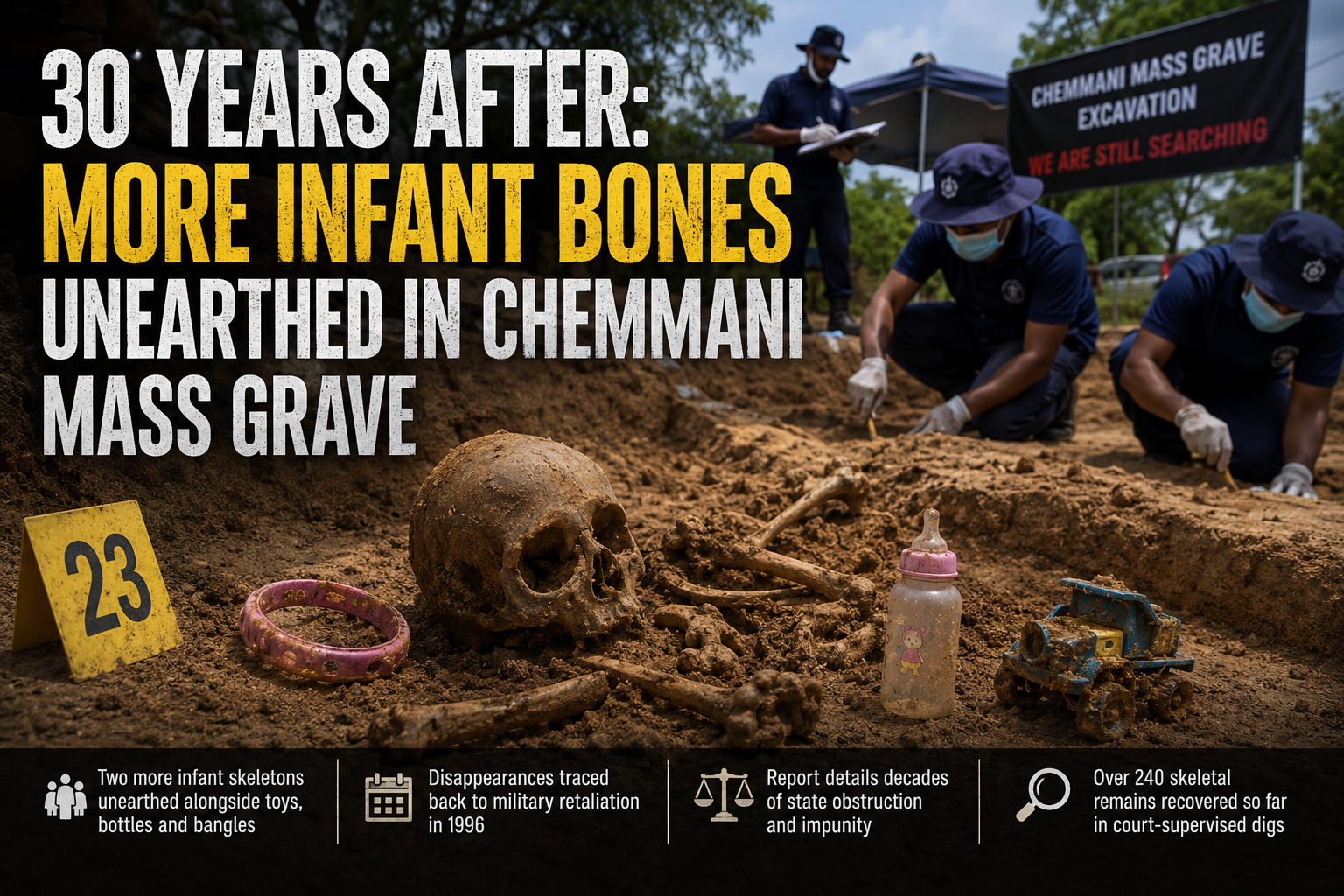
Court-supervised excavations have now uncovered more than 240 skeletal remains, sharply increasing the known scale of the Chemmani mass grave.
Among the most disturbing recent discoveries are the delicate bones of two infants. Excavators also found child-sized bangles, feeding bottles and toys.
These findings directly challenge the state’s historical narrative that those buried at Chemmani were exclusively active combatants. They also deepen the prolonged grief of families who still do not know what happened to their loved ones.
One mother searched for her son for 158 days. She eventually saw him inside an army truck, but the vehicle sped away before she could reach him.
Decades later, another woman faced a cruel choice. Officials required her either to accept a death certificate for her missing husband or lose the state benefits on which she survived.
For these families, the evidence of children buried in Chemmani’s clay represents far more than another forensic discovery. It stands as an unbearable record of stolen lives, unanswered disappearances and a 30-year cover-up that remains intact.