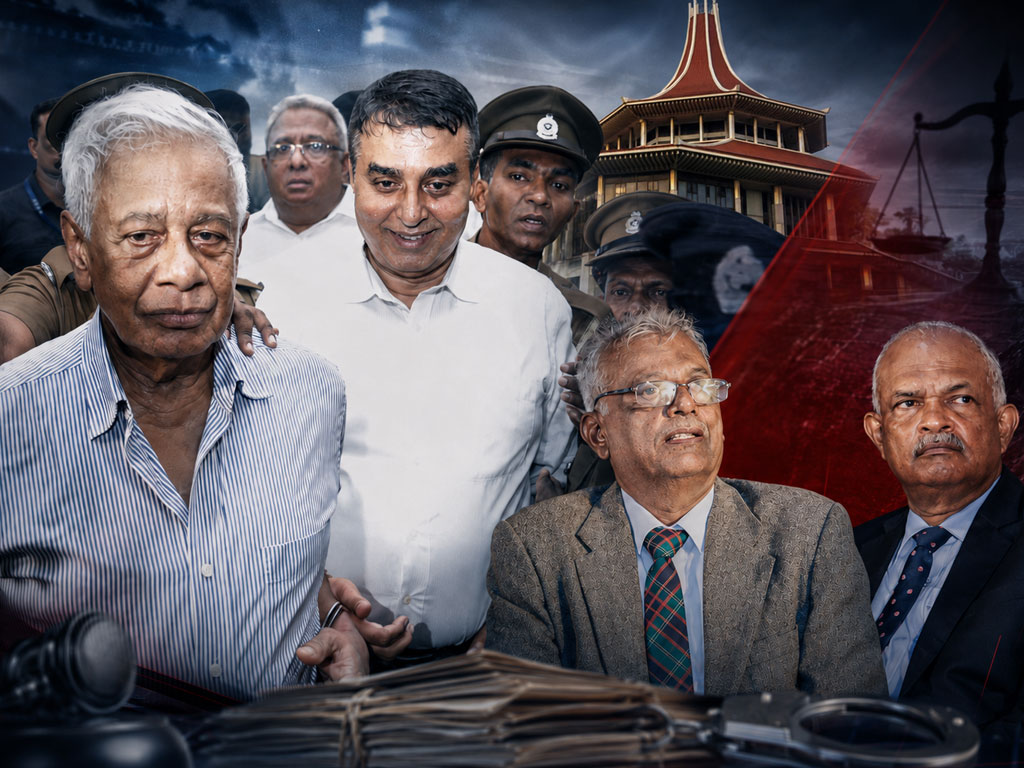
Easter Sunday accountability faces a fresh test as unresolved official findings raise questions about Shani Abeysekara and Ravi Seneviratne.
The Easter Sunday accountability debate has entered a new phase after the High Court’s majority verdict redefined the legal consequences of command responsibility.
The ruling now raises a difficult question. Can officials whose conduct has also faced official scrutiny continue leading institutions entrusted with delivering justice?
“Justice should not only be done, but should manifestly and undoubtedly be seen to be done.”
Gordon Hewart
The issue facing Sri Lanka extends far beyond whether authorities are pursuing criminal accountability for the Easter Sunday terrorist attacks.
It concerns whether the justice system can maintain public confidence when officials associated with serious adverse findings continue holding influential positions within law enforcement.
Those findings do not establish guilt. However, when they remain unresolved, they can raise legitimate questions about institutional credibility.
Get
Breaking News
First
on WhatsApp
Follow The Morning Telegraph for instant alerts, top stories and exclusive updates delivered straight to your phone.

Pujith Verdict Redefines Command Responsibility
The majority judgment delivered by the Colombo High Court Trial-at-Bar against former Inspector General of Police Pujith Jayasundara represents a major criminal determination.
By a majority of two to one, the court concluded that Jayasundara repeatedly received credible intelligence warnings of an imminent terrorist attack.
The majority found that he failed to fulfil the statutory and constitutional duties attached to his office.
According to the ruling, that failure amounted to criminal culpability and justified the ultimate sentence prescribed by law.
The judgment remains open to appellate review. Therefore, its final legal position has not yet been settled.
However, its constitutional importance is already clear.
The majority affirmed that command responsibility is not merely an administrative theory. It is a legal duty capable of producing personal criminal liability.
That liability may arise when an official consciously fails to act and that failure contributes to catastrophic loss of life.
The principle cannot apply selectively.
The Easter Sunday attacks did not reveal the failure of only one official or institution.
They exposed weaknesses across intelligence gathering, information sharing, operational policing and executive decision-making.
They also exposed questions concerning the criminal investigation that followed the attacks.
Where institutional failure is collective, scrutiny cannot focus only on one individual.
Every official who held relevant authority before, during or after the attacks must remain answerable according to the responsibilities of that office.
Questions Surround Shani Abeysekara and Ravi Seneviratne
Within this legal and institutional context, the continued prominence of Ravi Seneviratne and Shani Abeysekara deserves legitimate public examination.
Both officers held senior command positions in the Criminal Investigation Department during the investigation into the Easter Sunday attacks.
Official inquiries later made adverse observations concerning aspects of their conduct.
Most notably, the committee chaired by retired Judge A. N. J. de Alwis criticised significant elements of the CID investigation.
The committee also recommended considering criminal proceedings against both officers over alleged negligence in carrying out their investigative duties.
Those recommendations remain disputed.
They have not resulted in criminal convictions or a judicial determination of guilt.
That distinction is essential and must remain clear.
However, serious findings contained in an official report do not disappear simply because authorities have not resolved them.
The issue is therefore not one of presuming guilt.
Nor should anyone treat the recommendations as proof of criminal liability.
The question instead concerns institutional legitimacy and public confidence.
People may reasonably question the justice system when officials linked to unresolved criticism arising from the same national tragedy retain substantial influence over accountability processes.
That concern becomes especially significant after a court has imposed criminal liability on the country’s former police chief for failing to act on intelligence.
Easter Sunday Accountability Must Apply Consistently
The legitimacy of a legal process depends on more than actual fairness.
It also depends on whether a fair-minded and informed observer can recognise that fairness.
This principle has deep roots within the common law.
In Pinochet (No. 2), the House of Lords set aside its own judgment because an undisclosed association created an appearance capable of weakening public confidence.
The decision did not depend on a finding of actual impropriety.
Similarly, Porter v Magill established a broader test. It asked whether a fair-minded and informed observer would conclude that a real possibility of bias existed.
These principles are not limited to judges.
They express a wider constitutional doctrine concerning every part of the justice system.
A process must not only operate fairly. It must also appear objectively fair to an informed public.
That principle applies with equal force to criminal investigations.
Across established legal systems, authorities may recuse, reassign or replace investigators when legitimate questions arise about their impartiality.
Such measures do not amount to findings of wrongdoing.
Instead, they protect the independence and credibility of the investigation.
They also prevent avoidable questions about investigators from overshadowing the search for truth.
Sri Lanka cannot credibly adopt a lower standard.
Years of Conflicting Reports Have Weakened Confidence
The Easter Sunday investigation has become fragmented through overlapping commissions and competing official findings.
Successive investigations have sometimes reached inconsistent conclusions.
Political narratives have also shifted as governments changed.
Victims and their families have endured years of institutional disagreement while authorities transferred responsibility between agencies, commissions and administrations.
The recent Trial-at-Bar judgment has now found, at first instance, that Sri Lanka’s highest-ranking police officer incurred criminal liability.
The majority attributed that liability to his failure to respond adequately to intelligence warnings.
Meanwhile, other officials whose conduct attracted adverse official scrutiny continue holding influential positions.
The public is entitled to ask why.
Authorities should clarify whether that situation reflects institutional confidence, political judgment, unresolved legal processes or another consideration.
Government appointments cannot by themselves answer those questions.
Political authority has the power to appoint, reinstate, promote or protect officials.
However, it cannot erase unresolved accountability concerns.
Executive confidence is not a substitute for institutional scrutiny.
Likewise, appointment to senior office does not prove that an official has been exonerated.
Political endorsement cannot function as legal absolution.
Public office grants authority. It does not provide immunity from legitimate examination.
Transparency Is a Public Duty, Not a Favour
Governments and courts do not carry the entire burden of protecting confidence in the justice system.
That responsibility also falls on investigators, police officers and other officials who exercise legal power.
When serious criticism remains unresolved, transparency becomes a public obligation.
Officials who maintain confidence in their conduct should not resist independent scrutiny.
They should welcome a credible process capable of examining the allegations, testing the evidence and resolving the questions.
An independent review would not assume that Ravi Seneviratne or Shani Abeysekara committed wrongdoing.
It would instead determine whether the findings against them have merit and whether their continued official roles affect public confidence.
Such a process should provide them with a full opportunity to respond.
It should examine the original records, the reasoning of the de Alwis committee and any evidence contradicting its findings.
Authorities should then communicate the outcome transparently.
That is the only credible way to distinguish unresolved criticism from proven misconduct.
Silence leaves uncertainty in place.
Political assurances may protect individuals temporarily, but they cannot restore institutional legitimacy.
Only an impartial process can do that.
One Standard Must Govern Every Official
The Easter Sunday attacks killed hundreds of innocent people and produced one of the gravest failures in Sri Lanka’s modern history.
The country therefore cannot afford selective accountability.
If the law can reach the office of the Inspector General of Police, no lower standard should govern other officials whose conduct remains under serious official criticism.
This does not mean every adverse finding must lead to prosecution.
Nor does it mean every official named in an inquiry should lose office automatically.
It means the state must address each finding through a fair, consistent and transparent process.
The same legal and ethical standards must apply regardless of rank, political support or institutional influence.
The rule of law cannot depend on who currently holds power or who enjoys executive confidence.
Once accountability becomes conditional on office, influence or political convenience, it stops functioning as accountability.
The Easter Sunday accountability process must therefore examine every relevant official proportionately and without prejudice.
Pujith Jayasundara’s judgment remains subject to appeal.
The recommendations concerning Shani Abeysekara and Ravi Seneviratne also remain unresolved and do not establish guilt.
However, those differences do not justify institutional silence.
Sri Lanka must now show that command responsibility and investigative accountability operate through one consistent standard.
Anything less will deepen public doubt and further weaken confidence among victims, families and citizens still waiting for the complete truth.