By Roy Denish
A high-level European diplomatic delegation is set to visit the Chemmani mass grave site as excavations continue to uncover the scale of atrocities committed under Gotabaya Rajapaksa’s military leadership.
A high-level delegation of ambassadors from four European nations and the European Union (EU) is scheduled to visit the sprawling mass grave site in Chemmani, Jaffna. The delegation, comprising diplomats from France, Germany, Italy, the Netherlands, and the EU, is set to arrive in Jaffna on Tuesday, July 21. An application has been submitted to the Jaffna Magistrate’s Court seeking formal permission for the group to inspect the Chemmani mass grave site the following day, Wednesday, July 22. During their visit to the northern peninsula, the diplomats are also scheduled to hold discussions with local political party representatives and civil society activists.

The international spotlight returning to these sites brings renewed attention to the harrowing story of the whistleblower who first broke the silence surrounding this ground. The horrific secrets of the shallow graves were only dragged into the light due to the explosive testimony of a former Sri Lankan army soldier, an elite military police officer convicted for his role in the 1996 rape and murder of Jaffna schoolgirl Krishanthi Kumaraswamy. Facing execution, the soldier shattered a wall of military omertà, confessing that his atrocities were not an isolated incident. He detailed how the salt-flats and garbage dumps of Chemmani had been transformed into a covert dumping ground, claiming he had personally helped bury between 300 and 400 bodies of young Tamil youths who had vanished after being taken into military custody at checkpoints. Despite intense state pressure, systemic intimidation, and a culture of denial designed to bury his testimony alongside the victims, his chilling blueprints of the burial locations forced a reluctant state to dig. Decade after decade, his confessions continue to prove devastatingly accurate as the earth yields exactly what he promised it would.
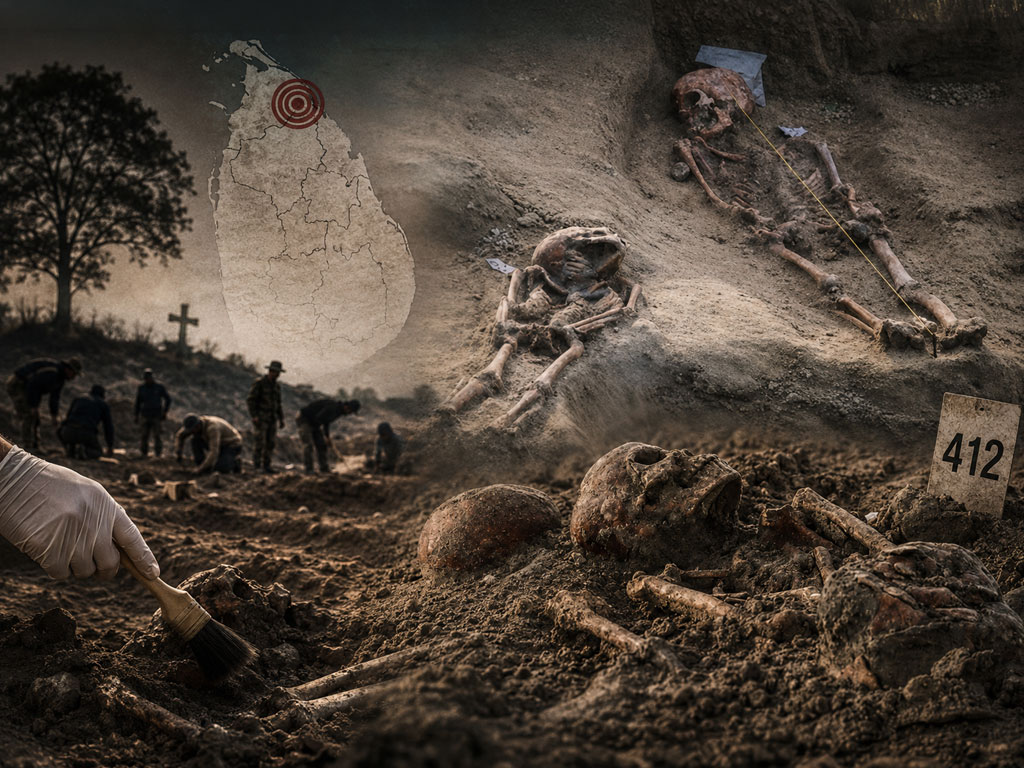
This upcoming diplomatic visit comes amid the grim, mounting scale of the ongoing excavations, which have finally vindicated the whistleblower’s decades-old claims. Since the latest round of investigations began, a staggering 412 skeletons have been discovered at the site, making it the largest mass grave in the country. The court recently granted permission for a 56-day third phase of excavations to continue probing the site. On Friday—the 35th day of the current phase—11 new skeletons were identified, adding to the devastating tally. During Friday’s excavation, teams discovered a damaged ring, a copper ring still attached to a decayed finger bone, and two distinct clusters of skeletal remains packed together in the shallow soil, haunting physical remnants of lives cut short.
The horrors of Chemmani deeply mirror the gruesome discoveries at the Matale mass grave in the Central Province, where the remains of over 150 individuals were unearthed. Both of these massive burial sites serve as grim monuments to eras heavily defined by Gotabaya Rajapaksa, whose iron-fisted authority binds these dark chapters of Sri Lankan history together.
During the bloody 1987–1989 Janatha Vimukthi Peramuna (JVP) Marxist insurrection, Gotabaya Rajapaksa served as the military commanding officer (Military Coordinating Officer) for the Matale district from May 1989 to January 1990, the exact window during which the state brutally crushed the rebellion and thousands of local youths vanished into extrajudicial death squads. Decades later, during the brutal final phases of the LTTE civil war era, he wielded absolute power as the powerful Secretary to the Ministry of Defence, directing the military offensives that led to thousands of enforced disappearances in the north, including the victims buried at Chemmani.
Ultimately, both eras of mass atrocities culminated under his eventual tenure as the President of Sri Lanka. Rights groups and international observers have heavily emphasized that throughout his rise from a ruthless wartime commanding officer to the head of state, Gotabaya Rajapaksa’s administrations systematically institutionalized impunity, actively obstructing investigations, ordering the destruction of police archives, and ensuring that the architects of the mass killings at Matale and Chemmani remained entirely shielded from accountability.