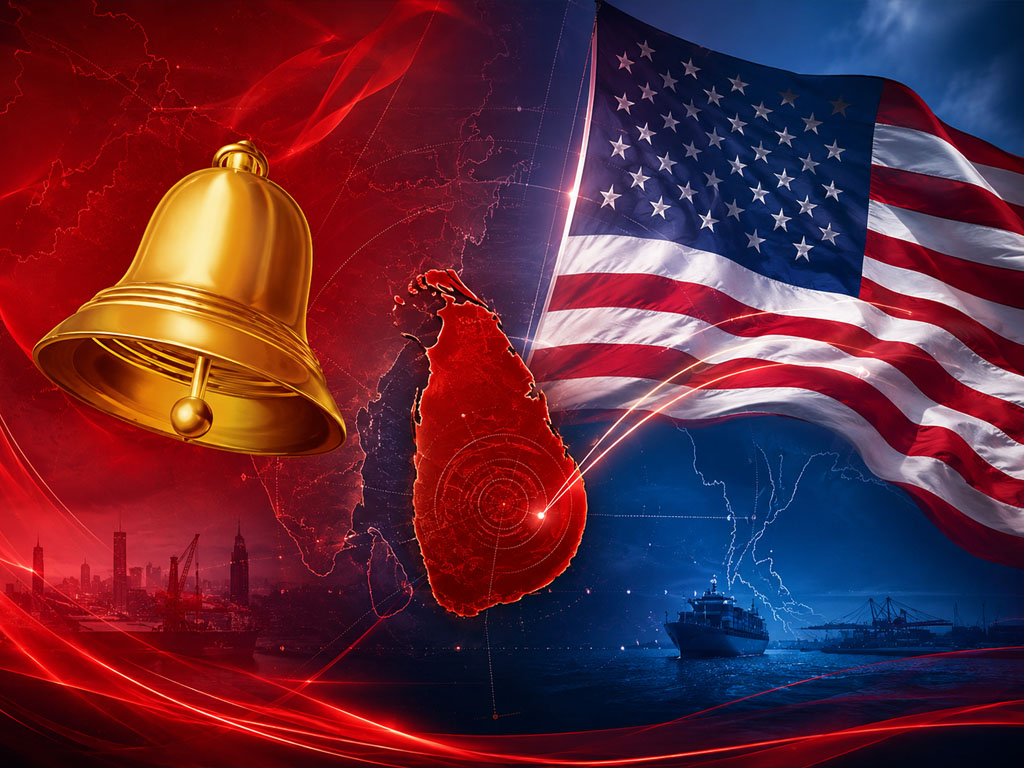
The JVP and United States have moved closer as Washington increasingly views Sri Lanka as a strategic Indian Ocean security partner.
The evolving relationship between the JVP and United States has become one of the most striking features of Sri Lanka’s current political landscape. When Ranil Wickremesinghe became President and was trying to secure approval for the first IMF tranche, the head of the CIA reportedly made a secret visit to Sri Lanka.
After meeting him, Ranil instructed the intelligence services to brief the CIA chief on conditions in the country. Intelligence agency heads explained that the JVP, a left-wing party, could win power at the next national election. They presumably delivered that message at Ranil’s request.
Ranil may have believed that raising the possibility of a JVP government would alarm the CIA chief. He may also have expected the United States to help him remain in power.

Wijeweera, the CIA and an Old Political Accusation
“Wijeweera was a CIA agent…”
The Communist Party’s official newspaper, ‘Aththa’, carried that headline during the 1970s. At the time, Ranil served as Deputy Foreign Minister in J.R. Jayewardene’s government.
During the 1971 insurrection, the Communist Party and Lanka Sama Samaja Party accused Rohana Wijeweera of working as a CIA agent. They claimed he launched the rebellion at the CIA’s direction. According to them, its objective was to overthrow Sri Lanka’s first democratically elected left-wing coalition government.
Similar allegations resurfaced during Wijeweera’s campaign against the 1987 Indo-Lanka Accord. The Lanka Sama Samaja Party, Communist Party and Vijaya Kumaratunga’s Mahajana Party argued that the CIA opposed intervention by Soviet-aligned India. They claimed it had assigned Wijeweera to sabotage the agreement.
Whether those allegations contained any truth remains uncertain. However, Wijeweera publicly opposed American imperialism. He used Che Guevara’s image to attract young people to the 1971 insurrection. At that time, Che Guevara stood as the JVP’s revolutionary hero.
After leaving prison, Wijeweera invoked Iran’s spiritual leader, Ayatollah Khomeini, to inspire support for his second revolution. In his speeches, he described a revolution modelled on Khomeini’s uprising against the Shah’s pro-American government.
Although Wijeweera’s revolutions failed, the JVP governs Sri Lanka today. Recently, Iran’s second spiritual leader, Ali Khamenei, was killed in U.S. and Israeli attacks. His funeral took place with great ceremony. Sri Lanka’s JVP-led government sent the Deputy Speaker as its representative.
The Emir of Qatar also died recently. Qatar is widely regarded as a pro-American state in the Middle East. Prime Minister Harini Amarasuriya represented Sri Lanka at the Emir’s funeral.
“Is the JVP that afraid of America?”
There appears to be no reason for such fear. Sri Lanka is experiencing its longest period without a U.S. Ambassador. Yet neither country appears troubled by the absence. The argument is that Washington no longer sees Sri Lanka as a threat.
How the JVP and United States Moved Closer
“Does that mean America approves of the JVP government?”
The United States watched Sri Lanka closely during the Rajapaksa years. The main concern was their alignment with China and their place within an anti-American geopolitical bloc. Washington did not accept that direction. Mahinda Rajapaksa later said publicly that foreign powers caused his 2015 election defeat.
The United States strongly wanted Mahinda defeated in 2015. However, Ranil became its biggest obstacle because he could not win elections. He had also weakened the pro-American UNP.
At that point, the JVP helped achieve Washington’s objective. It did not field its own presidential candidate. Instead, JVP leaders travelled across Sri Lanka, attacking the Rajapaksas from platform to platform. Their campaign indirectly helped opposition common candidate Maithripala Sirisena win.
“So, was it surprising that America aligned itself with the JVP in 2024?”
No. Mangala Samaraweera had already built a bridge between the JVP and United States. He persuaded the party not to contest the 2015 presidential election.
After Anura Kumara Dissanayake became President, the United States tested his government. The first test concerned Ranil’s ban on Chinese research vessels entering Sri Lankan waters. Despite pressure from China, Anura did not lift the restriction. He passed that test.
The next test came during the Iran war. Anura’s government did not condemn the attacks on Iran. From Washington’s perspective, he passed that test too.
Sri Lanka’s Strategic Value to Washington
Sergio, the U.S. Ambassador to India and President Trump’s special envoy for South Asia, including India and Sri Lanka, is now described as a friend of Anura.
During Sergio’s visit to Sri Lanka, he toured the Port of Colombo. He climbed its cranes and observed the Indian Ocean from inside the port. His visit reflected Washington’s view that Sri Lanka remains an indispensable strategic security location.
“Seventy-five percent of the world’s oil passes close to Sri Lanka’s southern coast. About half of the world’s containers travel along Sri Lanka’s sea lanes. Sri Lanka is a strategic location vital not only to the global economy but also to America’s security…”
Kapoor, the U.S. Assistant Secretary of State for Central and South Asia, made those remarks before the U.S. Senate Foreign Relations Committee during his recent visit to Sri Lanka.
America’s renewed interest in Sri Lanka has intensified with the Iran war. Previously, Washington focused mainly on countering Chinese influence. Now, amid conflict in the Middle East, it increasingly views Sri Lanka as a strategic security asset in the Indian Ocean.
This strategic shift has also reshaped the relationship between the JVP and United States. Washington does not want to antagonize Anura. It also appears less concerned about democracy, human rights and media freedom in Sri Lanka.
That leaves the final question: would Anura have sent only the Deputy Speaker to Iran’s funeral while choosing not to send Harini to Qatar’s funeral?