Tamil-Muslim political unity gathers momentum as minority parties coordinate demands on constitutional reform, elections and land rights.
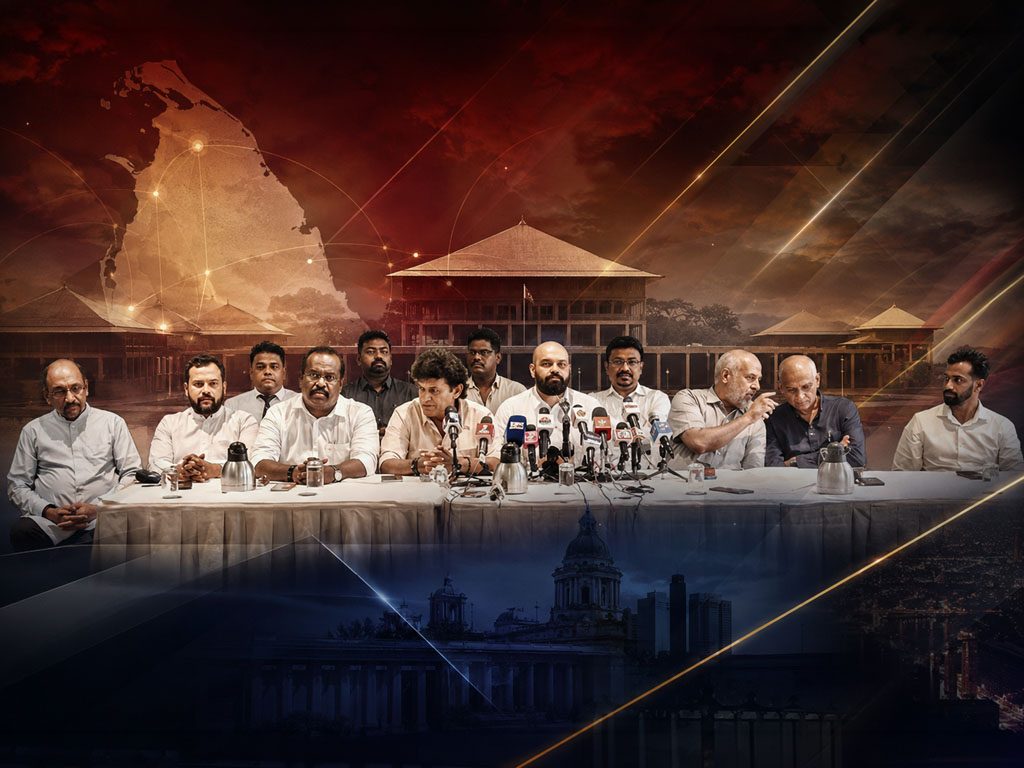
The Tamil-Muslim political alliance has sent shockwaves through government ranks, marking one of the most significant political developments in recent months. Amid the fallout from the Negombo Prison clash, another major political development dominated headlines last week, the unprecedented joint media briefing held in Parliament by Tamil and Muslim political parties representing the North, East, and the Hill Country.
The media conference brought together the Ilankai Tamil Arasu Kachchi (ITAK) led by M.A. Sumanthiran, the Sri Lanka Muslim Congress (SLMC) led by Rauff Hakeem, the All-Ceylon Makkal Congress (ACMC) led by Rishad Bathiudeen, UNP parliamentarian Jeevan Thondaman representing the plantation community, and leaders of the Tamil Progressive Alliance, including Mano Ganesan and Palani Digambaram. In effect, it marked the coming together of almost every major Tamil and Muslim political force in the country.

A United Front Emerges
What made the event particularly significant was the participation of Hakeem, Bathiudeen, Ganesan and Digambaram, all of whom are members of the Samagi Jana Balawegaya-led opposition alliance. Several pro-government media outlets and political commentators quickly portrayed the development as evidence that 18 SJB MPs were preparing to break away and form a separate alliance, claiming that the Opposition had fractured beyond repair and was heading towards collapse.
However, none of those media organizations or even those claiming to provide balanced reporting, explained what was really behind this emerging alliance. As always, our investigation reveals that this new political alignment has sent an extremely serious warning signal to the Government.
From the very beginning, we have consistently argued that the government’s continued failure to hold provincial council elections would eventually create a major political crisis. We also pointed out several months ago that the emergence of Thalapathy Vijay as the Chief Minister of Tamil Nadu would likely accelerate that process.
Pressure from Tamil Nadu
Traditionally, whenever decisive issues affecting Sri Lanka’s Tamil population arose, the Indian Central Government took the lead in responding. However, following Vijay’s rise in Tamil Nadu politics, we predicted that political pressure would increasingly originate from Tamil Nadu itself before reaching New Delhi. That pressure, we argued, would then influence the Indian Central Government through multiple channels.
Today, this process appears to have already begun. For this reason, we urge the public not to be misled by politically motivated propaganda, fabricated news reports or misleading political analyses driven by hidden agendas.
Meanwhile, under the current political climate, the Government itself is in no position to comfortably hold Provincial Council elections. Internal opinion surveys conducted over recent months have reportedly warned the leadership against conducting the elections, predicting severe political consequences if they proceed.
The Genesis of the Alliance
Contrary to public perception, last week’s gathering of Tamil and Muslim political parties was not a sudden reaction to recent political events. Rather, it was the culmination of a series of discussions that had been taking place over the past month and a half. The first of these meetings was held on June 3 at the Colombo residence of former MP M.A. Sumanthiran, General Secretary of the Ilankai Tamil Arasu Kachchi (ITAK). Except for a few Tamil and Muslim party leaders, invitations were extended to virtually every major representative from these communities.
Notably, four MPs were deliberately left out of the discussions. They were Archuna Ramanathan, the newly elected MP from the North, Kader Mastan, Gajendrakumar Ponnambalam, and Imran Maharoof. Political leaders involved in organising the initiative had reached a consensus from the outset that these four parliamentarians would not be invited for a variety of political reasons.
Three Key Issues Unite the Alliance
Those who gathered at Sumanthiran’s residence began discussions on three key issues: introducing a new constitution, holding long-delayed Provincial Council elections, and resolving the longstanding land disputes affecting Tamil communities in the North, East and the Hill Country. These were all issues on which the NPP government had made repeated promises, both during the presidential election campaign and after assuming office.
President Anura Kumara Dissanayake and other senior government leaders had travelled to Jaffna and publicly pledged to introduce a new constitution, hold provincial council elections without delay and release lands in the North still occupied by the military to their original civilian owners.
However, despite nearly two years in office, the Government has neither presented a new Constitution nor initiated any meaningful public discussion on constitutional reform. Similarly, when it comes to Provincial Council elections, the Government now appears to be following the same path as former President Ranil Wickremesinghe by continuing to postpone them rather than taking concrete steps to hold them. Although some progress has reportedly been made in releasing military-held lands, large areas in the North and East remain under the control of the security forces.
Against this backdrop, participants at the first meeting agreed that all Tamil and Muslim political parties should work together on these three issues. It was also proposed that a coordinator be appointed to manage the alliance’s future activities. While Jeevan Thondaman suggested the need for such a position, Rauff Hakeem recommended Shanakiyan Rasamanickam, describing him as someone fluent in all three national languages and capable of maintaining good working relationships with every political party represented. The proposal received unanimous approval.
Subsequently, the party leaders met several more times both inside and outside Parliament to continue discussions on the three issues. They also agreed to hold a joint media conference to formally present their collective position to the country. At the same time, they reached another important understanding. While each party would remain free to make its own decisions on other political matters arising inside or outside Parliament, they would maintain a common position on the three agreed issues — constitutional reform, Provincial Council elections and the land question.
The Electoral Reality Driving Unity
Another important factor behind this unprecedented unity was the outcome of the 2019 and 2024 Presidential Elections. In 2019, Gotabaya Rajapaksa, and in 2024, Anura Kumara Dissanayake, secured victory primarily through overwhelming support from the Sinhala-Buddhist electorate in the South. That voting bloc accounted for approximately 76 per cent of the total vote, while the combined Tamil and Muslim vote represented only 24 per cent.
This reality has prompted growing concern among Tamil and Muslim political parties. Their assessment is that if future presidential elections can continue to be won solely on the strength of the Sinhala-Buddhist vote, the bargaining power of minority parties will be significantly weakened, and the political voice of Tamil and Muslim communities will carry far less influence. Consequently, they believe the time has come for all Tamil and Muslim political parties to unite and strengthen their collective voice. That objective, insiders say, has become one of the key driving forces behind the formation of this new political alliance.
A Message from India
Meanwhile, it can be observed that the government has launched several special political initiatives aimed at winning the support of the Tamil and Muslim communities in the North and East, as well as the Malayaga (up-country) Tamil community in the plantation sector. This is because the government’s view is that, unlike in previous national elections, there is a greater possibility that the Sinhala Buddhist vote base in the South will be divided rather than united. In such a situation, the key factor that could determine the outcome of an election would be the Tamil and Muslim votes in the North, East, and the plantation areas.
However, anyone who understands the politics of this country and the political behaviour of the Tamil and Muslim communities in the North, East, and plantation areas accepts a well-known reality: all these Tamil and Muslim political parties are deeply connected with India and Tamil Nadu when making their political decisions. They hold discussions with them and make decisions based on the messages they receive from them. Therefore, when a united political alliance is being formed around the three major issues affecting the Tamil people in the North, East, and plantation areas — the creation of a new Constitution, holding Provincial Council elections, and resolving the land issue — it cannot be assumed that such a development would take place without the knowledge and approval of India and Tamil Nadu.
Government Under Pressure
According to those who understand politics, in the face of this emerging political influence, the government is expected to come under strong pressure from the North, East, and plantation areas within the next year to hold Provincial Council elections. Accordingly, this new political alliance has already decided to meet the President at the first stage and hold special discussions focusing on three issues: the new Constitution, Provincial Council elections, and the land issue. If the President attempts to delay holding Provincial Council elections, as happened in the past, by engaging in verbal arguments and explanations, this Tamil-Muslim political alliance has already decided to take this issue to the international level.
The President’s Strategic Response
Amid all these developments, what is the President doing these days? Previously, the President could be seen publicly expressing his views at various events based on different political developments. However, despite several political events taking place during the past few weeks, many have noticed that the President has maintained a certain silence. Even when the President came to Parliament, there was no occasion on which he expressed his views.
However, although the President has not made any public statements, last week he took steps to hold two highly important discussions behind the scenes. One of these discussions was held with the JVP and the NPP (National People’s Power). The second important discussion was held with economic advisers from the Ministry of Finance and the Treasury.
The first discussion was held by the President with officials from the Ministry of Finance and the Treasury. During this meeting, the President took steps to make several important decisions. In particular, since the 2027 Budget is scheduled to be presented to Parliament in November this year, the President clearly informed officials about the government’s policy direction during these discussions.
During the meeting, the president first asked officials about the areas where previous governments had spent the largest amounts of money in past budgets. Officials informed him that the government had spent more mainly on health and education. The President then asked officials how much money previous governments had allocated for the transport sector. In response, officials said that successive governments had allocated around 1% or less of the national budget for transport.
However, after receiving this answer, the President gave a response that surprised everyone. “As a policy decision, our government and I have now decided to allocate a large amount of money for transport. One of the biggest problems faced by the people of our country is the issue of transportation. In the next Budget, we need to bring about a major change in the transport sector. We need to take steps to bring the bus service and railway service to the highest possible level. That is our policy.”
The President further stated: “If ordinary people receive a good public transport service, they do not need to spend millions of rupees to buy vehicles. Our neighbouring countries and other countries around the world have high-quality public transport systems. But in our country, the public transport service is still not at a level that can be accepted.”
He also outlined plans to introduce an electric railway service focusing on areas such as Fort–Ragama, Fort–Panadura, and Fort–Kottawa, where a large number of people travel to offices. The President also addressed what he described as a key reason for delays in implementing budget proposals, instructing ministries to begin the tender process for projects before the budget is passed to save time.
A Nationwide Political Campaign
The President’s next key meeting was with senior leaders of the JVP and the National People’s Power (NPP), where they held lengthy discussions on the country’s current political climate and emerging challenges. Although no national election is expected in the immediate future, the meeting concluded with a decision to launch a massive nationwide political campaign. The plan includes a series of large district-level rallies featuring the President and senior NPP leaders, alongside an extensive door-to-door campaign to engage and educate voters nationwide. The campaign is expected to continue uninterrupted for around three months.
France Visit Cancelled
Another important issue that received relatively little public attention last week, largely because of the Negombo Prison violence, was the sudden postponement of President Dissanayake’s planned visit to France. The visit had been scheduled to begin on July 13 but was abruptly cancelled without any official explanation. Although the matter was not widely discussed publicly, it became the subject of considerable speculation in political and diplomatic circles.
The invitation had originated during a meeting in New Delhi, where French President Emmanuel Macron personally invited President Dissanayake to visit France. The Sri Lankan President had reportedly been particularly enthusiastic about the trip. So keen was he on the visit that he instructed the Foreign Ministry to expedite the appointment of a permanent Sri Lankan Ambassador to France, replacing the acting envoy already serving there.
So far, neither the President’s Office, the Ministry of Foreign Affairs nor the French Government has issued an official explanation. However, citing Foreign Minister Vijitha Herath, several international media outlets reported that the visit had been postponed due to unforeseen developments and would be rescheduled.
Several theories are circulating regarding the cancellation. One line of speculation links the postponement to renewed military action by US President Donald Trump against Iran. According to this view, the escalating tensions between the United States and Iran have placed France in a difficult diplomatic position, prompting President Macron to defer the meeting and propose an alternative date.
Another source suggests that, although it has received relatively little international publicity, the violent incident at Negombo Prison may also have contributed to the postponement of the President’s French visit. According to reports, the European Commission has already begun raising serious questions with Sri Lankan authorities over the killings inside Negombo Prison. The current GSP+ arrangement is due to expire in March next year, and Sri Lanka has already entered a new round of negotiations with the European Commission seeking an extension. However, the Commission has reportedly indicated that the events at Negombo Prison appear, at first glance, to involve serious human rights violations. Several parties are now said to be lobbying the European Commission not to renew Sri Lanka’s GSP+ benefits.
In addition, reliable sources indicate that the Negombo Prison incident is expected to feature prominently at the UN Human Rights Council session in Geneva this September. Several influential countries are reportedly considering tabling a resolution against Sri Lanka based on the prison incident.
Judiciary Opposes Government Proposal
In last week’s column, we revealed extensive details about the growing opposition within Sri Lanka’s legal fraternity to the Government’s proposal to extend the retirement age of the Chief Justice and Supreme Court judges by two years. The Judicial Service Association (JSA), which represents Magistrates and District Judges, held its General Assembly on Saturday the 11th.
The drama began just 24 hours before the meeting, when Judge Pasan Amarasena, who had been serving as President of the Judicial Service Association, submitted his resignation through a written letter. Despite his resignation, the meeting proceeded as scheduled under the leadership of the Association’s Secretary. A total of 65 representatives attended. The most striking outcome was that all 65 members unanimously rejected the Government’s proposal to extend the retirement age of Supreme Court judges.
Perhaps anticipating such an outcome, an unsigned report suddenly surfaced on Saturday claiming that the Government was planning not only to extend the retirement age of Supreme Court judges but of all judges by two years. Political observers were quick to dismiss the report as an attempt by the Government to “test the waters,” particularly because it originated from no identifiable or credible source.
Sajith Enters the Battle
Several days before the Judicial Service Association’s General Assembly, Opposition Leader Sajith Premadasa quietly launched a political initiative to rally the entire Opposition against the Government’s proposal. In an unprecedented move, Sajith began personally contacting leaders of both parliamentary and non-parliamentary opposition parties in an effort to build a united front.
Following that, Sajith personally telephoned Rauff Hakeem, Rishad Bathiudeen, Mano Ganesan, Palani Digambaram and M.A. Sumanthiran. He also contacted Archuna Ramanathan, Gajendrakumar Ponnambalam and Douglas Devananda. In addition, he spoke with Chamara Sampath Dassanayake, who entered Parliament under the UNP-backed “Gas Cylinder” symbol. Most notably, Sajith also reached out to UNP leader Ranil Wickremesinghe and SLPP National Organiser Namal Rajapaksa, seeking discussions on building a common strategy.
During these conversations, Sajith stressed the need for a coordinated opposition campaign to defeat the Government’s proposal. He also informed party leaders that he had convened a special meeting at the Opposition Leader’s Office on July 23 to discuss the matter further and invited them all to participate. According to sources, every leader responded positively to the invitation.
So far, neither the Government nor President Anura Kumara Dissanayake has made an official statement on the matter. Even at the Cabinet media briefing, officials merely confirmed that the issue had been discussed by the Cabinet. According to information obtained, however, the President has now taken a step back from the original proposal and is prepared to support extending the retirement age across the entire judiciary rather than limiting it to Supreme Court judges alone. The proposal is reportedly expected to be brought before Parliament for approval through a formal resolution.
Mahinda Samarasinghe Returns
If one were asked who has emerged as Sri Lanka’s most accomplished diplomat in recent decades after the late Lakshman Kadirgamar, many seasoned political observers would answer without hesitation: Mahinda Samarasinghe. Like Kadirgamar, Samarasinghe has left a lasting mark on Sri Lanka’s diplomacy.
Following the military defeat of the LTTE in 2009, when Sri Lanka faced a war crimes resolution at the UN Human Rights Council in Geneva, Samarasinghe successfully mobilised international support and led the first-ever successful effort to defeat such a resolution through a vote. He later served as Foreign Minister under President Gotabaya Rajapaksa before being appointed Sri Lanka’s Ambassador to the United States. During his tenure in Washington, he helped secure significant American assistance for Sri Lanka during both the COVID-19 pandemic and the subsequent economic crisis.
When President Anura Kumara Dissanayake came to power, many expected Samarasinghe to be recalled along with other ambassadors. Although the new administration replaced most envoys, Samarasinghe was among the handful retained. Despite widespread expectations that a left-leaning NPP Government would strengthen ties primarily with China and Russia, Samarasinghe instead played a key role in fostering close relations between Washington and the new administration. He was instrumental in establishing a close working relationship between President Dissanayake and Sergio Gor, a senior US official responsible for South and Central Asian affairs and a close associate of President Donald Trump. Samarasinghe also helped reduce US tariffs on Sri Lankan exports from 44 per cent to 19 per cent, while facilitating the transfer of several US Coast Guard vessels and helicopters to Sri Lanka.
Despite these achievements and despite having time remaining in his term, Samarasinghe decided to retire as Ambassador at the end of this month. During his farewell remarks, Samarasinghe disclosed for the first time that no one had asked him to resign; the decision had been entirely his own. He also hinted that Sri Lanka could soon receive more positive news regarding the current 19 per cent US tariff, suggesting that further progress was on the horizon.
Samarasinghe is scheduled to return to Sri Lanka on July 31. Political sources say that several parties and senior political leaders have already begun making approaches in the hope of persuading him to return to active politics. However, sources close to Samarasinghe indicate that he has no intention of accepting any political offer. Instead, Samarasinghe is said to have decided that, rather than aligning himself with any political party or office, he intends to use his extensive diplomatic experience and international network to serve Sri Lanka in whatever capacity he can.