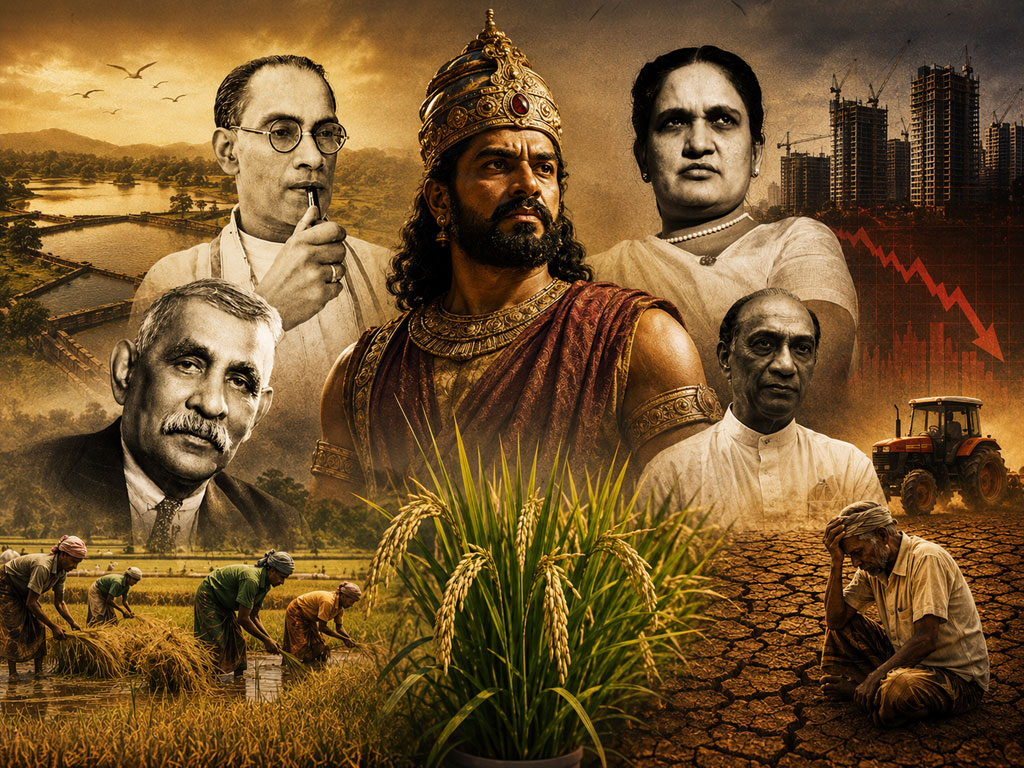
The Sri Lanka farmer crisis exposes a widening divide between socialist political promises, market-based reforms and the needs of cultivators.
The Sri Lanka farmer crisis reflects a painful contradiction in a nation whose history, prosperity and food security have always depended heavily on agriculture.
From the earliest kingdoms to the decades after independence, Sri Lanka prospered when its farmers prospered. Today, however, the cultivator who feeds the country remains trapped between rising production costs, unstable markets and inadequate government intervention.
The contradiction becomes sharper under an administration that came to power carrying socialist and Marxist political ideals. Despite that ideological legacy, critics increasingly see policies associated with neoliberal economic management.

Ancient Kings Placed Agriculture at the Centre
Sri Lanka’s ancient rulers understood a lasting truth. A nation’s strength begins in its fields.
King Dutugemunu, King Parakramabahu and other monarchs invested heavily in reservoirs, canals and extensive irrigation systems. They recognised agriculture as the foundation of economic stability, national security and social survival.
Farmers were not treated merely as producers. They served as guardians of the kingdom’s prosperity and food supply.
The vast irrigation civilisation created by those rulers continues to support agriculture more than 2,000 years later. Those systems remain evidence of the political importance once given to cultivation and rural development.
After independence, successive governments largely preserved that philosophy.
D.S. Senanayake made agricultural development a central part of nation-building. His colonisation schemes, irrigation projects and rural settlement programmes aimed to create self-sufficient farming communities.
These policies also sought to strengthen national food security.
Dudley Senanayake continued that approach. He believed a country capable of feeding its people could protect both its economic independence and social stability.
State Protection for Rural Communities
The governments of S.W.R.D. Bandaranaike and Sirimavo Bandaranaike expanded the State’s responsibility towards farmers and rural communities.
Their policies reflected the belief that markets alone could not protect small-scale cultivators.
Price support schemes, agricultural subsidies, cooperative movements and state purchasing mechanisms aimed to shield farmers from exploitation and sudden market changes.
Those policies were not without limitations. However, they ensured that farmers remained central to national development planning.
The major change arrived with the economic liberalisation introduced by J.R. Jayewardene in 1977.
Open markets, privatisation, reduced state involvement and global competition transformed the relationship between government and agriculture.
Economic growth became increasingly associated with cities, foreign investment and service industries. Meanwhile, farming gradually lost the privileged position it had previously occupied.
Farmers were expected to compete in markets where production costs continued rising. At the same time, guaranteed prices and secure returns became increasingly uncertain.
Sri Lanka Farmer Crisis Tests Socialist Promises
Nearly five decades later, that contradiction has become even more visible.
The present administration entered office carrying the political legacy of Marxism. That philosophy traditionally supports state protection for workers and producers facing inequalities created by unrestricted markets.
Farmers, who remain among Sri Lanka’s most vulnerable producers, therefore expected stronger state intervention.
They expected fair guaranteed prices for paddy, affordable fertiliser, better irrigation, easier credit access and protection from unstable markets.
Instead, many farmers and critics perceive a growing gap between political ideology and government practice.
The reluctance to guarantee profitable farm-gate prices remains a major concern. Farmers also continue to struggle with expensive agricultural inputs.
Meanwhile, the Government has placed strong emphasis on fiscal discipline and market-based economic reform.
Critics argue that these policies increasingly reflect neoliberal priorities rather than the administration’s publicly stated socialist commitments.
Fiscal stabilisation remains essential for Sri Lanka’s economic recovery. However, reforms that neglect food producers could weaken both social justice and long-term food security.
Can Marxist Ideals Survive Market-Led Policies?
The Sri Lanka farmer crisis raises an unavoidable ideological question.
Can a government genuinely claim to follow Marxist principles while allowing market forces to determine the livelihoods of those who produce the country’s food?
Karl Marx argued that the State should address structural inequality and protect labour from exploitation.
However, many cultivators must sell their produce at prices that allegedly fall below production costs. At the same time, intermediaries and market distortions heavily influence the final price.
Under those conditions, the promise of economic justice becomes increasingly difficult to reconcile with reality.
Sri Lanka’s history offers a consistent lesson.
The country flourished when governments maintained a strong commitment to agriculture. This principle remained evident from the hydraulic civilisation of the ancient kings to the agricultural vision of D.S. Senanayake.
It also shaped the rural-centred policies of several post-independence governments.
Political administrations changed. Ideologies evolved and economic systems shifted. Yet one principle remained constant: neglecting the farmer eventually weakens the nation.
Farmers Need More Than Political Promises
Political ideologies gain legitimacy through their impact on ordinary people, not through manifestos, speeches or slogans.
Sri Lanka cannot meaningfully discuss social justice, national development or economic progress while those cultivating its fields struggle for fair prices, dignity and recognition.
Farmers require reliable markets, affordable inputs, modern irrigation and access to reasonable credit. They also need a state policy that recognises agriculture as a matter of national security rather than a declining economic activity.
Restoring farmers to the centre of public policy does not require abandoning fiscal responsibility. Instead, it requires recognising that agricultural stability supports economic recovery, rural employment and food security.
The Sri Lanka farmer crisis is therefore not only an agricultural problem. It is also a test of whether the Government can translate its ideological promises into meaningful protection for vulnerable producers.
Agriculture once helped build and sustain Sri Lanka. Returning the farmer to the heart of national policy is not an act of nostalgia. It is an investment in the country’s future.
OURCE:- LANKA NEWS