India Gen Z protests turned Abhijeet Dipke into a national figure after one viral post inspired the Cockroach Janta Party movement.
The India Gen Z protests began with six words that Abhijeet Dipke posted on X during a moment of frustration.
“What if all cockroaches come together?”
The message transformed the 30-year-old political communications strategist into the most recognisable face of a rapidly growing youth movement.
It has since become one of the largest street challenges to Prime Minister Narendra Modi’s government since he took office in 2014.
Dipke published the post on May 16. It responded to remarks by Chief Justice of India Surya Kant, who compared unemployed young people attacking institutions to “cockroaches.”
Kant later said people had misconstrued his comments. However, Dipke’s response had already spread across social media and captured growing youth anger.
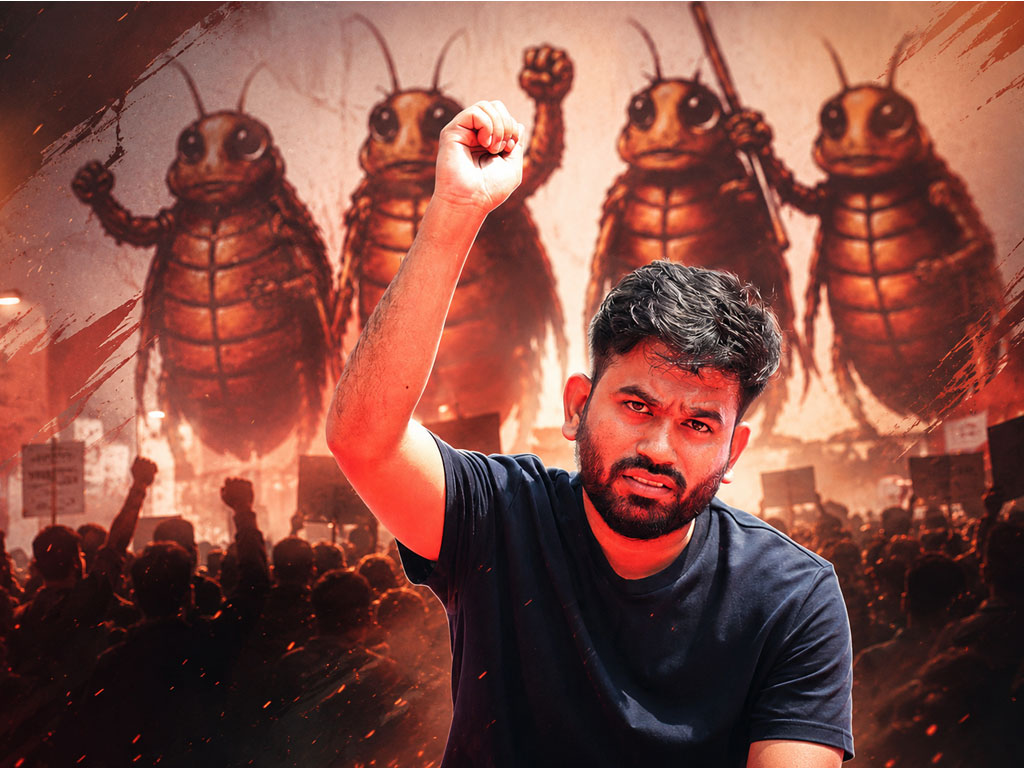
A satirical platform called the Cockroach Janta Party, or CJP, soon emerged. It gave millions of young Indians a shared symbol for their frustration.
Many supporters cite unemployment, examination paper leaks and a lack of government accountability as their main concerns.

India Gen Z Protests Move From Screens to Streets
Tens of thousands of protesters have gathered in New Delhi over recent days. They are demanding the resignation of Education Minister Dharmendra Pradhan.
The demonstrations followed the alleged leak of a medical entrance examination paper affecting about 2 million students in May. Protesters have also linked the crisis to several student suicides.
Meanwhile, smaller demonstrations have occurred elsewhere, including Mumbai.
At the centre of the movement stands Dipke.
He lived in Boston until early June but returned to India to launch a demonstration near Jantar Mantar in central Delhi.
Since then, he has maintained an almost constant presence at the protest site. His profile grew further after police moved against demonstrators on Monday, sparking widespread public anger. Reuters and other international outlets have described the movement as a major challenge to Modi’s administration.
Wearing a T-shirt and jeans, the bearded activist regularly addresses crowds from a raised platform.
He urges supporters to remain peaceful while continuing to pressure the government.
The CJP has several organisers. However, Dipke has become its public face, attracting both admiration and criticism.
Last week, a woman threw blue ink at him while he addressed supporters. She later accused the movement of insulting Lord Ram, a major Hindu deity.
Dipke responded by sharing footage of the incident with the caption: “Blue is my colour.”
The phrase appeared to reference the colour associated with the Ambedkarite movement.
Dalit Identity Shaped Dipke’s Political Outlook
Dipke was born into a Dalit family in Aurangabad, Maharashtra. Dalits belong to one of India’s most historically disadvantaged communities.
“My father comes from a very humble background. He grew up in extreme poverty. My grandfather was just a farmer,” Dipke told Reuters during a telephone interview from Chicago in May.
His Dalit identity has strongly influenced his political outlook.
When Dipke arrived in Delhi on June 6, he held up a copy of B.R. Ambedkar’s “My Autobiography.”
Ambedkar championed Dalit rights and played a central role in drafting India’s democratic Constitution. Supporters and security personnel surrounded Dipke as he displayed the book.
In 2020, Dipke joined the social media team of the Aam Aadmi Party.
He said the experience helped him develop a communication style built around humour, satire and internet memes.
Dipke no longer has formal links with the party. However, AAP and several other opposition parties have backed the protest movement.
In 2023, he moved to the United States to pursue a master’s degree in public relations in Boston. Still, he continued following Indian politics closely.
Dipke says he is now trying to understand his sudden prominence.
A Satirical Website Becomes a National Movement
Delhi-based YouTuber Meghnad S. was among the first people to amplify Dipke’s message.
Soon after the original post appeared, Meghnad and a friend used artificial intelligence tools to create a satirical website announcing the Cockroach Janta Party.
“I saw the page and thought it was damn hilarious,” Meghnad said.
The related Instagram account reportedly gained 22 million followers within days. Its audience later rose to around 25 million.
“That’s how organic it was,” Meghnad said.
However, the stakes grew alongside the movement’s online reach.
Speaking to Reuters from Boston in May, Dipke described the campaign as an attempt to transform Indian political debate.
“This is a movement to change the political discourse of India. The youth of India has largely vanished from the mainstream political discourse,” he said.
Despite reported threats against himself and his family, Dipke returned to India. He has promised to remain until the students receive justice.
Since June 6, he has stayed at the demonstration site as the crowds expanded.
Supporters regularly see him calling for calm, speaking with journalists or sleeping briefly between appearances.
The India Gen Z protests have now grown beyond the original social media joke. They have become a wider expression of anger over education, jobs and political accountability.
Addressing supporters from the stage on Wednesday, Dipke made clear that he intends to continue.
“Let me make it clear, we will also not stop until we win.”