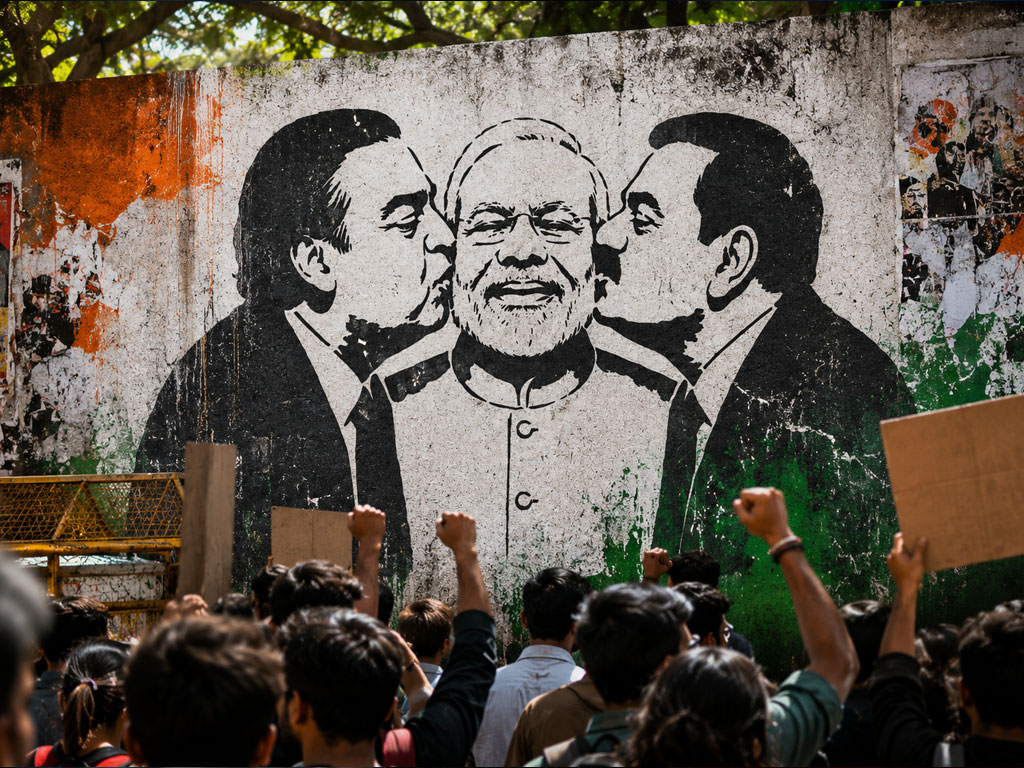
NEET protest street art at Jantar Mantar uses satire involving Modi, Adani and Ambani to challenge political power and corporate influence.
NEET protest street art has become a striking symbol of youth anger in India, turning political criticism into bold visual messages on streets and social media.
Art does more than celebrate beauty. In moments of political unrest, it can become a powerful weapon for challenging authority.
Amid the recent NEET examination paper controversy, young protesters have increasingly used art as a central part of their campaign. India’s streets and digital platforms are now filled with creative material produced and shared by Gen Z activists.
Instead of relying only on traditional slogans, protesters have carried memes, posters, stencil paintings and other artistic creations into public spaces.

The most discussed image from this protest wave shows Prime Minister Narendra Modi receiving kisses on both cheeks from billionaire businessmen Gautam Adani and Mukesh Ambani.
The stencil is humorous at first glance. However, its message is sharply political.
The artwork reflects criticism of what opponents describe as close ties between the ruling Bharatiya Janata Party and powerful corporate interests. It also represents the public perception that political leaders have prioritised wealthy business groups while neglecting ordinary people’s concerns.
The artist behind the controversial image is Tyler Street Art, often described as “Mumbai’s Banksy.”
His work commonly uses graffiti and street art to raise political and social questions that directly affect the public.
Groups such as the Cockroach Janata Party have also used creative protest methods during the campaign.
Their activism suggests that when authorities attempt to silence public frustration, protesters may answer with greater imagination.
The artwork emerging from Jantar Mantar has therefore become more than a political joke. It represents a changing form of communication in which satire, symbolism and visual culture shape modern protest movements.