Sri Lanka’s Excise alcohol wastage rule has drawn strong objections from liquor manufacturers, who warn it will increase taxes and disrupt production.
Excise alcohol wastage regulations have become the focus of a dispute between Sri Lanka’s leading liquor manufacturers and the Excise Department after authorities sharply reduced the permissible alcohol wastage allowance during production and storage, prompting warnings of higher tax costs and operational difficulties.
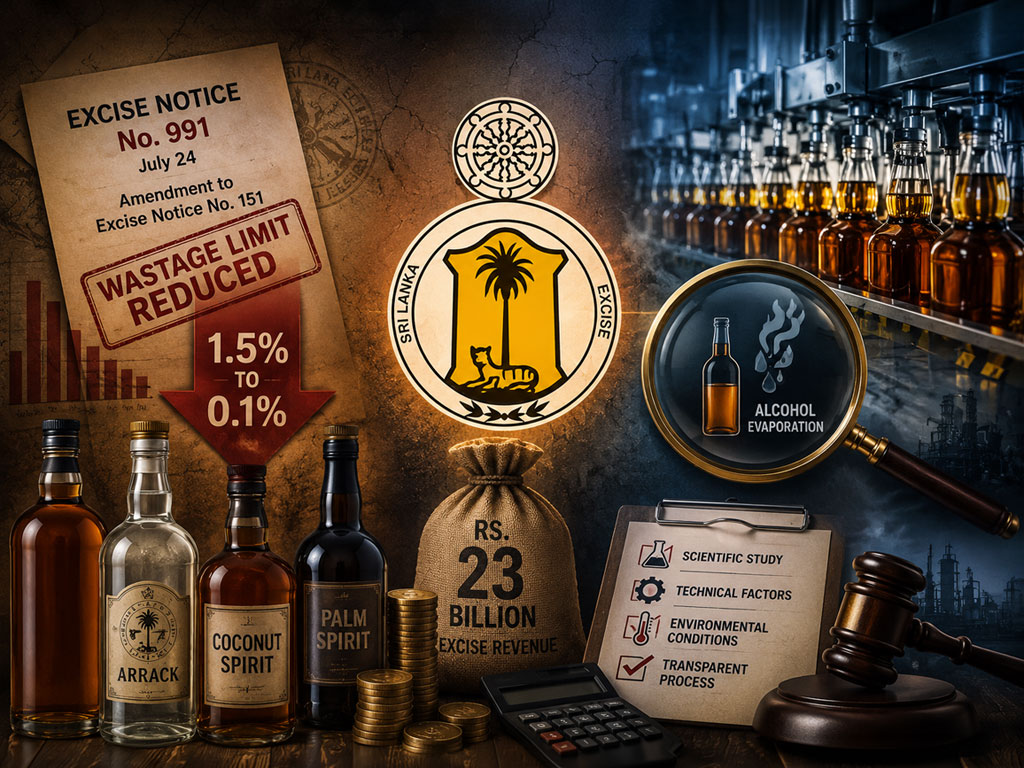
Sri Lanka’s leading liquor manufacturers have strongly objected to the Excise Department’s decision to reduce the permissible alcohol wastage percentage from 1.5% to just 0.1% during the production and storage process.
The change comes under Excise Notice No. 991, issued on July 24, which amends the limits previously specified under Excise Notice No. 151.
Manufacturers argue that the revised allowance will significantly increase their tax burden, despite the industry already contributing more than Rs. 23 billion annually in excise revenue to the government.
Industry representatives have formally written to the Excise Department, warning that maintaining current production levels will become extremely difficult if the new regulations remain in force.
Get Breaking News First
on WhatsApp

Excise Alcohol Wastage Raises Technical Concerns
Manufacturers say alcohol loss during production is an unavoidable technical and scientific process rather than a result of negligence.
They explain that evaporation naturally occurs while spirits are transferred through production lines, during bottling operations, and while using modern automated bottling equipment.
According to industry representatives, such losses have long been recognized as part of standard manufacturing practices.
They also point out that liquor samples collected by Excise officers for testing by the Government Analyst are themselves calculated using the existing permissible wastage percentage.
Because of this, manufacturers argue that reducing the allowance to 0.1% fails to reflect the realities of alcohol production and storage.
Industry Calls for Scientific Review
Liquor manufacturers have further accused the Excise Department of introducing the amendment without sufficient technical justification.
According to their representations, the revised figures appear to rely primarily on wastage data related to arrack, coconut spirits, and palm spirits, rather than the wider range of alcoholic beverages produced in Sri Lanka.
They insist that any revision to the permissible alcohol wastage rate should follow a comprehensive scientific study examining evaporation levels, production methods, environmental conditions, storage practices, and other technical factors that influence alcohol loss.
Manufacturers argue that introducing new limits without such research creates unnecessary financial pressure on producers while increasing uncertainty across the industry.
They have urged the Excise Department to reconsider the decision and engage with industry stakeholders before implementing regulations that could affect production, taxation, and the long-term sustainability of the sector.