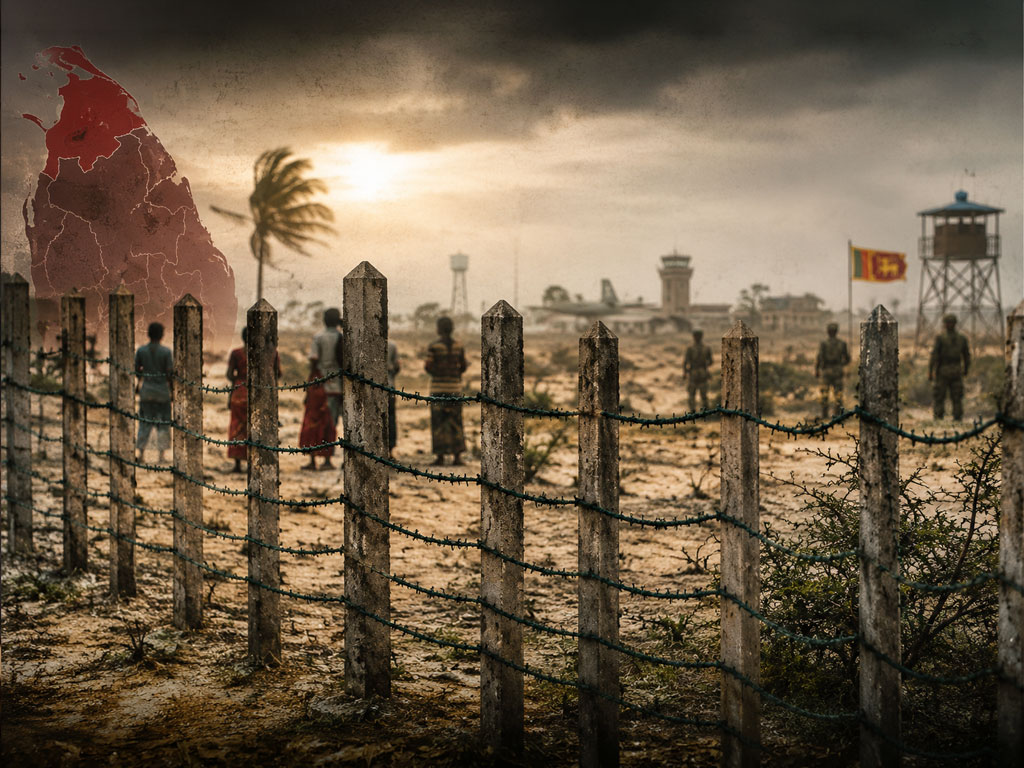
Palali land acquisition plans have reignited anger in Jaffna as Tamil families demand military-held lands promised for possible release.
Sri Lanka’s proposed Palali land acquisition has intensified tensions in the North, where Tamil residents are already protesting for the return of private lands held by the military for decades.
The controversy sharpened after Deputy Minister of Defence Major General (Retired) Aruna Jayasekara told Parliament on July 9, 2026, that authorities were considering further land requirements linked to the future development of Jaffna International Airport.
His remarks came shortly before President Anura Kumara Dissanayake told representatives of Tamil political parties that releasing privately owned lands occupied by the military and other state institutions remained an aspiration of his administration.
The contrast between those positions has caused deep concern among residents of Valikamam North, according to testimony from affected landowners and civil society representatives.
Get
Breaking News
First
on WhatsApp
Follow The Morning Telegraph for instant alerts, top stories and exclusive updates delivered straight to your phone.

Palali Land Acquisition Plans Raise Fresh Questions
Responding to Independent MP Dr. Ramanathan Archchuna, Jayasekara said the Civil Aviation Authority had requested land for the future development of Jaffna International Airport.
He told Parliament that the Air Force had submitted a report to the Ministry of Defence. The report recommended coordination with the Ministry of Lands, Survey Department, Sri Lanka Army and Divisional Secretaries of Valikamam North and Tellippalai.
“Concurrently with the current land acquisition process, regarding the land requirement for the future development of the Jaffna International Airport, the Civil Aviation Authority has made a request, and the Air Force has submitted a report to the Ministry of Defence,” he said.
Jayasekara added that the report recommended identifying land beyond the present limits used by Palali Airport and the Sri Lanka Air Force.
He said discussions were continuing among the Defence Ministry, Civil Aviation Authority and Jaffna District Secretary to identify specific plots.
The Deputy Defence Minister also told Parliament that land considered essential for tri-forces use could not currently be released.
He said arrangements were underway to formally transfer 1,661 acres presently used by the Army within the Palali high-security zone to the Army and compensate civilian landowners.
“We inform that the Ministry states there is no possibility of releasing the land on which the Palali Army Hospital is established from Army use,” he said.
He added that the land was strategically and tactically important because of its proximity to the airport runway and its role in airport and national security.
According to his explanation, the process would regularise the 1,661 acres already used by the Army and provide compensation to civilian owners.
For families seeking the physical return of ancestral land, however, compensation may not resolve the dispute. Their campaign centres on resettlement, community restoration and returning to property lost during the conflict.
Residents Say More Than 2,500 Acres Remain at Stake
The issue drew strong criticism at an August 3 media briefing in Colombo after campaigners submitted a petition to the Presidential Secretariat.
They demanded the return of lands acquired from Tamil residents in the North and East during the war.
Jaffna teacher V. Jeganathan said Jayasekara’s parliamentary remarks had caused deep pain among families seeking the return of their property.
“Under the name of military high-security zones, 2,506 acres of land in Valikamam North are still being held without release,” Jeganathan said.
He referred to 1,661 acres identified for military purposes and another 774 acres which, he said, were required for airport expansion.
“That means he is saying they are acquiring more than 2,500 acres of our land because they need it. That causes us heartache,” he said.
Residents from Palali, Mylitti, Vasavilan, Kattuwan, Kurumbasitti and Thaitti have protested since April 2026, demanding the release of land affected by a gazette issued during former President Mahinda Rajapaksa’s administration.
According to the account presented by campaigners, that gazette remains in force.
Hotels, Farms and Destroyed Shrines Alleged on Occupied Land
At the Colombo media briefing organised by civil society groups and the Same Rights Movement, Jeganathan alleged that security agencies were reluctant to release some land because hotels and commercial activities had been established there.
“However, the Army has built hotels there. There is also a hotel built by the Air Force. And they are engaged in other commercial activities,” he said.
These are allegations made by the campaigner and should be independently established before being treated as confirmed facts.
Jeganathan also alleged that 21 Hindu, Christian and Catholic religious shrines had been destroyed since 2013, together with five schools and civilian homes.
He further alleged that the Civil Security Department and Army were using some of the affected areas for farming.
Another allegation concerned Mylitti. Jeganathan said around 150 homes had been demolished to build the Northern Province Army Commander’s official residence, known as the Commander’s Bungalow.
“In Mylitti, about 150 houses were demolished and a Commander’s Bungalow was built,” he said.
He argued that the project deprived 150 families of their right to live on their property.
Jeganathan also questioned why land north of the airport, on the southern side of the adjoining road, continued to be retained. He argued that some areas no longer had a valid security justification.
The Government, however, has cited airport protection and national security as reasons for retaining land considered strategically important.
That is the central conflict in the Palali land acquisition debate.
Protests Continue as President Seeks Report
Affected residents have staged protests every Friday since April 24, 2026, outside the Commander’s Bungalow.
They are demanding the release of land in Valikamam North currently under Army control.
Residents have also protested every Sunday at Palali Junction since June 21.
ITAK Secretary M.A. Sumanthiran told journalists near the Presidential Secretariat on August 3 that President Dissanayake had expressed his desire to release private lands in the North occupied by the Army and other state institutions.
According to Sumanthiran, the President requested a report after meeting representatives of six Tamil political parties.
The dispute therefore places the Government between two competing positions: security arguments advanced by defence authorities and the long-standing demands of civilians seeking their ancestral property.
For affected families, the question is immediate.
If the Government’s policy is to release privately owned land, why are residents simultaneously being told that large areas may be formally transferred for military use or required for airport development?
How the administration resolves that contradiction could determine whether its promises on reconciliation translate into tangible change for families who have waited years to return home.