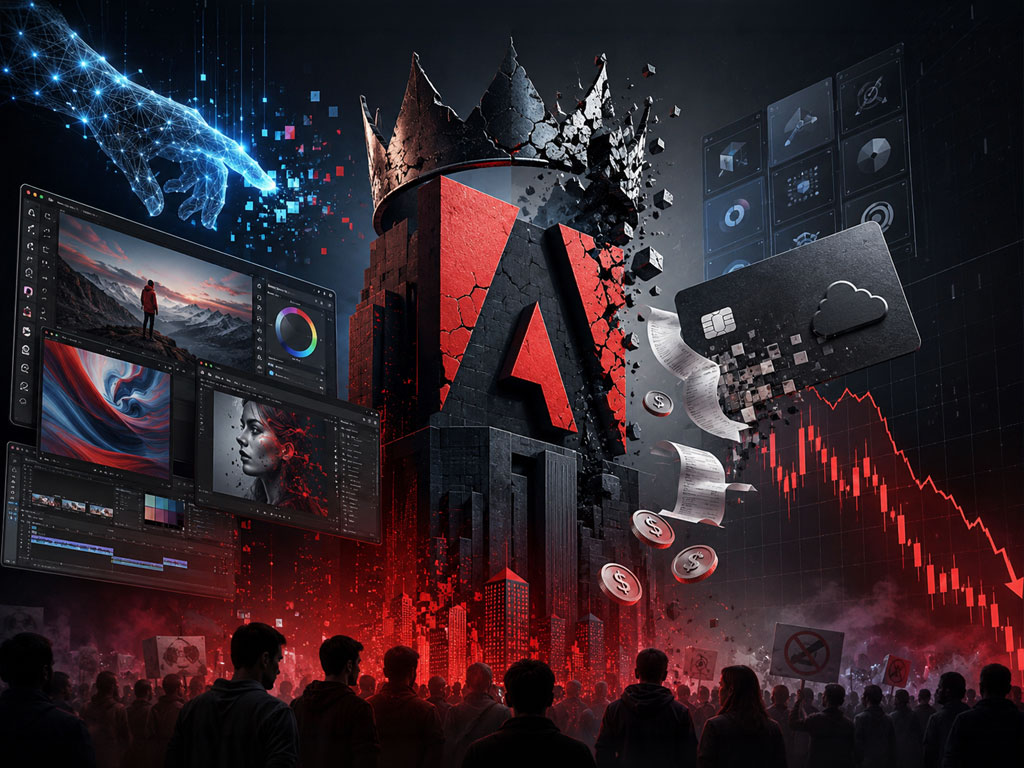
Adobe Creative Cloud faces pressure from subscription criticism, AI disruption and rivals including Canva, Affinity, Figma and DaVinci Resolve.
Adobe Creative Cloud transformed the way millions of designers, photographers and video editors access professional software. Today, however, Adobe faces growing pressure from frustrated customers, regulators, artificial intelligence and increasingly powerful competitors.
Anyone who has edited a photograph, created a poster or produced a video will probably recognise names such as Photoshop, Illustrator and Premiere Pro.
Together, those applications helped make Adobe one of the most influential companies in digital creativity.
Yet the relationship between Adobe and parts of its creative community has become increasingly strained.
Subscription costs, cancellation practices, changing product strategies and the rapid spread of generative AI have all fuelled criticism. Meanwhile, alternatives including Figma, Canva’s Affinity and Blackmagic Design’s DaVinci Resolve have become stronger competitors.
Adobe itself remains highly profitable. Its fiscal 2025 revenue reached a record $23.77 billion, up 11% from the previous year.
At the same time, Adobe’s share price has fallen dramatically from the highs reached during the technology boom.
That creates an unusual picture: record revenue alongside growing investor concern over what the next era of creative software could mean for Adobe.

Adobe Creative Cloud Changed How Creatives Paid
For years, Adobe sold major applications through traditional perpetual licences.
Users could buy software, install it and continue using that version without paying an ongoing subscription.
That changed as Adobe shifted its flagship products towards Creative Cloud subscriptions.
By 2013, Creative Cloud had become the centre of Adobe’s software strategy, replacing the traditional boxed-software model for newer versions of its professional applications.
For Adobe, the transition proved extremely successful.
Recurring subscriptions created predictable revenue and gave customers continuous access to software updates.
For many users, however, the model also created frustration because continued access to essential professional tools became dependent on recurring payments.
Adobe currently sells Creative Cloud plans offering applications including Photoshop, Illustrator, Premiere, After Effects, InDesign and Acrobat Pro, alongside Firefly AI features.
In the United States, Creative Cloud Pro has been listed at roughly $69.99 per month under standard annual, billed-monthly pricing, although promotional and regional prices can differ.
The controversy, however, has extended beyond monthly costs.
Cancellation terms have also attracted government scrutiny.
For certain annual plans paid monthly, customers cancelling outside the initial refund period have historically faced an early termination charge equal to 50% of the remaining contractual balance.
That practice became part of a federal case against Adobe.
US Government Action Over Adobe Subscriptions
The United States government sued Adobe in 2024, alleging that the company failed to clearly disclose important subscription terms and made cancellation unnecessarily difficult.
The case did not result in a $150 million customer compensation payment in 2024, as some accounts have suggested.
Instead, in March 2026, the U.S. Department of Justice announced a proposed resolution valued at $150 million.
Under that settlement, Adobe agreed to pay $75 million in civil penalties and provide another $75 million in free services to eligible customers.
The agreement also included requirements aimed at improving subscription disclosures and cancellation procedures.
The distinction matters.
Adobe was not simply ordered to hand $150 million directly to customers as compensation. The settlement combined government penalties with customer services.
Nevertheless, the action highlighted the scale of regulatory concern surrounding Adobe’s subscription practices.
From Photoshop to a Creative Software Giant
Adobe’s influence stretches far beyond subscriptions.
Photoshop emerged from work by brothers Thomas and John Knoll in the late 1980s. Adobe released Photoshop 1.0 commercially in 1990.
The program later became so culturally dominant that “Photoshop” entered everyday language as shorthand for digitally altering an image.
Adobe continued expanding its creative empire through acquisitions.
One of its biggest moves came in 2005, when Adobe acquired Macromedia in a deal valued at approximately $3.4 billion.
That acquisition brought products including Flash and Dreamweaver under Adobe’s control.
Macromedia’s FreeHand, once a significant competitor to Adobe Illustrator, later disappeared from active development.
Combined with products such as Photoshop, Illustrator, InDesign, Premiere Pro and After Effects, Adobe developed an ecosystem that became deeply embedded in professional creative industries.
For years, many designers and agencies found abandoning Adobe difficult because there were few comparable alternatives covering the same range of workflows.
That situation is now changing.
The $20 Billion Figma Deal That Collapsed
One of the clearest signs came from Adobe’s attempt to acquire collaborative design platform Figma.
Adobe announced the proposed acquisition in 2022 at approximately $20 billion.
The deal would have ranked among the largest software acquisitions ever completed.
However, competition regulators raised serious concerns.
Authorities in Europe and the United Kingdom scrutinised whether the transaction could reduce competition in digital design software.
Adobe and Figma ultimately abandoned the deal in December 2023 after concluding that they could not secure the necessary regulatory approvals.
Adobe then paid Figma a previously agreed $1 billion termination fee.
Instead of being absorbed into Adobe, Figma remained independent and continued competing in the design market.
For critics of Adobe’s market dominance, the failed acquisition became symbolic.
It showed that buying a rapidly growing challenger was no longer necessarily an available route for protecting Adobe’s position.
Canva, Affinity and DaVinci Resolve Challenge Adobe
Competition has also intensified elsewhere.
In March 2024, Canva acquired Affinity, the professional creative software company behind Affinity Photo, Designer and Publisher.
Canva later relaunched Affinity as a unified creative application.
By October 2025, Canva made the redesigned Affinity available free of charge, combining photo editing, vector design and page-layout capabilities within one platform.
By February 2026, Canva said the relaunched software had surpassed five million downloads since its October debut.
That represents a significant challenge in a market where many professional users have grown increasingly sensitive to recurring subscription costs.
Video editing presents another competitive front.
Blackmagic Design continues to offer a powerful free version of DaVinci Resolve.
The software combines video editing, colour correction, visual effects, motion graphics and audio production.
A more advanced paid version, DaVinci Resolve Studio, is also available.
For creators who once believed Premiere Pro, Photoshop or Illustrator were effectively unavoidable, these alternatives now provide increasingly credible choices.
Adobe Creative Cloud Meets the AI Revolution
Artificial intelligence may represent Adobe’s most complicated challenge.
Adobe has integrated its Firefly generative AI technology across its creative ecosystem, including Photoshop and other Creative Cloud applications.
Some users have criticised price increases connected with newer Creative Cloud packages and AI capabilities.
However, describing these changes as a universal 50% “AI tax” on all Adobe customers would be inaccurate.
Adobe has changed prices differently depending on the product, market and subscription plan.
Some plans have risen substantially, while others have changed more modestly or gained alternative pricing tiers.
A separate controversy erupted in 2024 following changes to Adobe’s Terms of Use.
The wording triggered widespread fears among creative professionals that Adobe might use customers’ private artwork, photographs and other files to train Firefly.
Adobe faced an intense backlash.
The company subsequently clarified its terms and stated explicitly that it does not train Firefly generative AI models on Creative Cloud customers’ personal content.
Adobe says Firefly is primarily trained on licensed material, including Adobe Stock, together with public-domain content where copyright has expired.
Therefore, claims that Adobe decided to train its AI on “every design and photograph” created by Creative Cloud customers are inaccurate.
The controversy was real, but Adobe’s stated policy is that customers’ private Creative Cloud content is not used to train Firefly.
AI Could Still Disrupt Adobe’s Core Business
That clarification does not remove the broader strategic challenge posed by AI.
Creative tasks that once demanded substantial expertise in Photoshop or Illustrator can increasingly be completed with simple prompts.
Images can be created in seconds.
Objects can be added or removed automatically.
Backgrounds can disappear almost instantly.
Video editing and production tools are evolving in the same direction.
Professional creative software is unlikely to disappear overnight.
However, AI is changing the value of technical skills that once formed a major barrier to entry.
That creates an unusual dilemma for Adobe.
The more powerful Firefly becomes, the easier Adobe itself makes tasks that previously required extensive experience with its professional software.
Meanwhile, competitors are making similar investments.
Canva has expanded its own AI-powered creative tools, while Blackmagic Design has introduced AI-assisted functions into newer versions of DaVinci Resolve.
Adobe therefore faces competition not only from traditional software rivals, but from an entirely new way of creating digital content.
Is Adobe Really Collapsing?
Calling Adobe’s current situation a “collapse” would go too far.
The company remains extremely profitable.
Its fiscal 2025 revenue reached a record $23.77 billion, demonstrating that millions of customers and businesses continue paying for Adobe products.
Creative Cloud also remains deeply embedded in professional design, publishing, photography and video workflows around the world.
However, Adobe’s declining share price, regulatory challenges, customer frustration and stronger competitors show that its dominance can no longer be regarded as untouchable.
The bigger threat may not be Adobe disappearing.
It may be Adobe losing something it possessed for years: customers who believed they had few realistic alternatives.
The subscription model worked spectacularly while switching costs were high.
That calculation changes when Affinity becomes free, DaVinci Resolve provides professional video editing without requiring a monthly subscription, Figma remains independent and AI enables complicated creative work to happen increasingly quickly.
Adobe helped define the modern digital creative industry.
Now that industry is changing around it.
And therein lies a broader lesson for technology companies.
Recurring subscriptions can generate enormous revenue. Market dominance can provide pricing power. Artificial intelligence can create entirely new products and revenue streams.
None of those things guarantees permanent customer loyalty.
Consumers will tolerate higher prices when they believe the value justifies them.
They will remain inside an ecosystem when leaving is difficult.
But when strong alternatives appear, companies must compete for that loyalty again.
Adobe is not dead, and its creative empire has not collapsed.
But after decades of extraordinary dominance, it now faces something far more unfamiliar.
For the first time in years, millions of creative professionals genuinely have somewhere else to go.