Judges retirement age debate intensifies after a Maha Nayaka letter urged the President to avoid changes that could threaten judicial independence.
The judges retirement age controversy has escalated into one of the government’s most sensitive constitutional battles, drawing opposition from lawyers, judges, religious leaders, international organisations and political parties.
With a commanding parliamentary majority, the government appears determined to pursue its stated intention of extending the retirement age of senior judges.
But the growing question is whether it has underestimated the scale of resistance.
Critics argue that the proposed constitutional change could affect judicial independence and disturb safeguards that have existed for years.
The Bar Association of Sri Lanka has strongly opposed the proposal.
It argues that changing the retirement arrangements of serving judges could raise serious questions over the independence of the judiciary.
The Judicial Services Association, representing Magistrates and District and High Court Judges, has also opposed what it describes as a unilateral move to extend judicial tenure.
The wider argument is not that constitutions can never change.
Constitutions are human creations and can be amended when circumstances demand it.
However, opponents argue that constitutional reform must not become an instrument through which political power interferes with independent institutions.

Judges Retirement Age Proposal Draws Broad Opposition
The political opposition has also rallied against the proposal.
Parties with sharply different ideological positions, including Tamil and Muslim political groups, have joined the wider opposition to the proposed change.
Their central argument is that the government has failed to demonstrate a sufficiently compelling need to alter the retirement arrangements of judges in a way that could affect sitting officeholders.
International legal organisations have also expressed concern.
The International Association of Judges warned against introducing judicial changes through measures that could appear arbitrary or coercive.
The Commonwealth Lawyers Association likewise raised concern over the speed and nature of the proposed amendment.
UN Special Rapporteur on the independence of judges and lawyers Margaret Satterthwaite also communicated concerns over the proposal.
She warned that changing judicial tenure during the service of existing judges could raise questions relating to executive and legislative interference.
She also referred to Sri Lanka’s obligations under international human rights standards, including the right to a hearing before an independent and impartial tribunal.
The concern was not that one specific judge had clearly been identified as the beneficiary.
Rather, the issue was whether a constitutional amendment could potentially alter the terms of office of judges already serving.
Opponents argue that such a change could create a damaging perception even if no improper motive existed.
That perception alone, they say, could affect confidence in the judiciary.
The dispute has therefore moved beyond the technical question of retirement ages.
It has become a wider debate over whether constitutional amendments affecting sitting judges should proceed without broad consultation.
Church of Ceylon Questions Government’s Justification
Religious organisations have also entered the debate.
The Church of Ceylon, representing the Anglican Church in Sri Lanka, expressed concern and disappointment over the Cabinet decision to proceed with the amendment.
In a media statement, the Church warned that the proposal “could undermine public confidence in the rule of law and the independence and impartiality of the judiciary.”
The government has argued that extending judicial tenure could help reduce the large backlog of cases.
However, the Church questioned that justification.
It pointed to vacancies that reportedly remain in the appellate courts and argued that those vacancies weaken the claim that extending retirement ages is the necessary response.
The Church stated:
“We can therefore only conclude that there is no good faith in the true purpose of this amendment.”
The statement added another influential voice to a dispute already involving lawyers, judges, opposition politicians and international organisations.
But the most politically sensitive intervention came from Sri Lanka’s Buddhist hierarchy.
Maha Nayaka Letter Becomes Centre of Political Dispute
On August 2, Bar Association President Rajeev Amarasuriya met the Malwatu Maha Nayaka Thera.
After the meeting, Amarasuriya told journalists that the Maha Nayaka Theras had already written to President Anura Kumara Dissanayake expressing concern over the government’s proposal.
That revelation immediately created political pressure.
Justice Minister Harshana Nanayakkara and Health and Mass Media Minister Nalinda Jayatissa travelled to Kandy the following day, August 3.
After meeting the Malwatu Maha Nayaka Thera, government representatives said concerns had arisen because of “misinformation” surrounding the proposed reforms.
They said the government had explained that the amendment formed part of a broader attempt to tackle delays and case backlogs within the judicial system.
The Justice Minister suggested that after receiving this explanation, the Maha Nayaka Thera understood the government’s policy.
However, the controversy did not end there.
The following day, the Opposition Leader asked in Parliament for the letter from the Maha Nayaka Theras to be presented to the House.
The Justice Minister said he did not have such a letter.
He told Parliament:
“I haven’t received any letter like the Bar Association says. The President hasn’t even informed me yet whether he received such a letter. Therefore, I don’t have a letter to present to Parliament.”
The existence and contents of the letter therefore became a political mystery.
For several days, questions remained over whether the President had actually received it and what the Buddhist leaders had said.
Government Eventually Confirms Letter Was Received
The dispute intensified as civil society groups and opposition politicians continued demanding answers.
Over the following weekend, representatives of the combined opposition met the Malwatu Maha Nayaka Thera directly.
According to the account provided, the Maha Nayaka Thera confirmed that the letter had indeed been sent to the President.
The government’s position then shifted.
On Tuesday, Media Minister Nalinda Jayatissa confirmed that President Anura Kumara Dissanayake had received the letter.
The confirmation came after days of uncertainty over its existence and whereabouts.
The Malwatu Maha Nayaka Thera also reportedly expressed disappointment that the President had not formally replied to the communication or at least acknowledged its receipt.
Then, on Wednesday, the Maha Nayaka Theras released the letter publicly.
Its contents significantly changed the political debate.
Rather than endorsing the government’s proposed constitutional change, the letter expressed clear concern about the judges retirement age amendment and urged the President not to proceed at this time.
That directly contradicted any public impression that the Buddhist leadership had fully accepted the government’s explanation.
What the Maha Nayaka Theras Told the President
The letter, dated July 31, addressed the President directly.
It stated:
“Honorable President,
“According to the provisions of the current Constitution, the retirement age of judges of the Court of Appeal and the Supreme Court is 63 and 65 years respectively. We believe that it is inappropriate for the government to take steps to extend those age limits at this time.
“We wish to emphasize that this could raise questions regarding the independence of the judiciary and the entire process of delivering justice. It is a generally accepted view that public confidence in the judiciary’s delivery of justice depends not only on the actual independence of the judiciary, but also on that independence being beyond doubt.
“Therefore, the Bar Association of Judges, legal experts, and civil society organizations have expressed their opposition, stating that this proposed constitutional amendment by the government raises serious questions about the security of the country’s judicial system, and that this precedent could lead to the complete destruction of the independence of the judicial system in the future.
“We acknowledge that a government working for the country’s sustainable development and social protection should be built on the principles of the seven noble virtues. We wish to emphasize that if enacting unenforced laws causes social unrest and adversely affects the stability of the state, it is the responsibility of the head of state to refrain from such actions and act in a manner that strengthens public confidence in the state.
“Especially against the backdrop of existing public approval regarding the independence of the judicial system, introducing such an amendment will promote negative perceptions of the government. We wish to point out that this could also raise questions regarding the independence of honorable judges.
“Honorable President, we recommend that you refrain from making any constitutional amendment that could raise questions about judicial independence at this time, and instead discuss and implement a formal work plan with all relevant parties to maintain the efficient functioning of judicial affairs.”
The letter therefore did not merely request clarification.
It explicitly recommended that the President refrain from proceeding with a constitutional amendment that could raise doubts about judicial independence.
Four Maha Nayaka Theras Signed the Letter
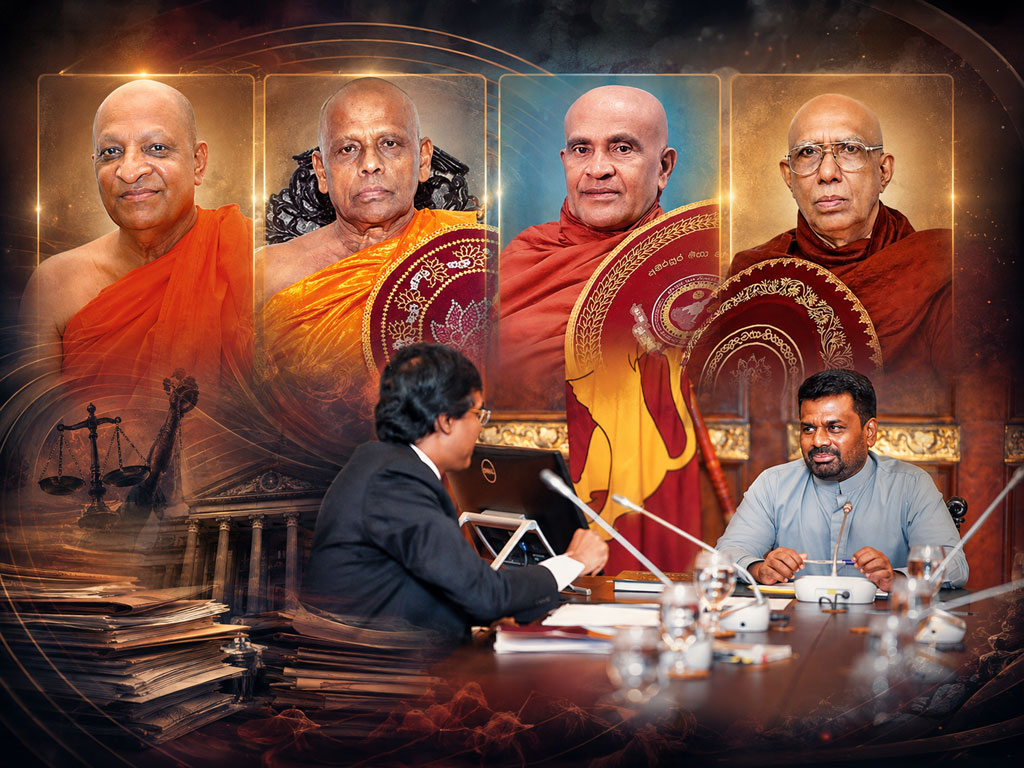
The communication carried the signatures of the Maha Nayaka Theras of the Malwatu and Asgiriya chapters of the Siyam Nikaya, as well as the Maha Nayaka Theras of the Ramanna Nikaya and Amarapura Nikaya.
Collectively, they represent some of the most influential Buddhist institutions in Sri Lanka.
The Constitution does not grant the Maha Nayaka Theras formal constitutional power.
Article 9 gives Buddhism the foremost place and places responsibility on the state to protect and foster the Buddha Sasana.
However, the Maha Nayaka Theras themselves do not hold executive or legislative authority.
Their influence is instead moral, religious and historical.
For generations, Sri Lankan political leaders have sought the counsel of leading Buddhist clergy.
That tradition gives their collective intervention significant political weight.
The government is therefore not legally bound by their advice.
But politically, ignoring a united warning from the country’s most senior Buddhist leaders carries obvious consequences.
The letter placed the government in precisely that position.
President Meets Bar Association as Positions Harden
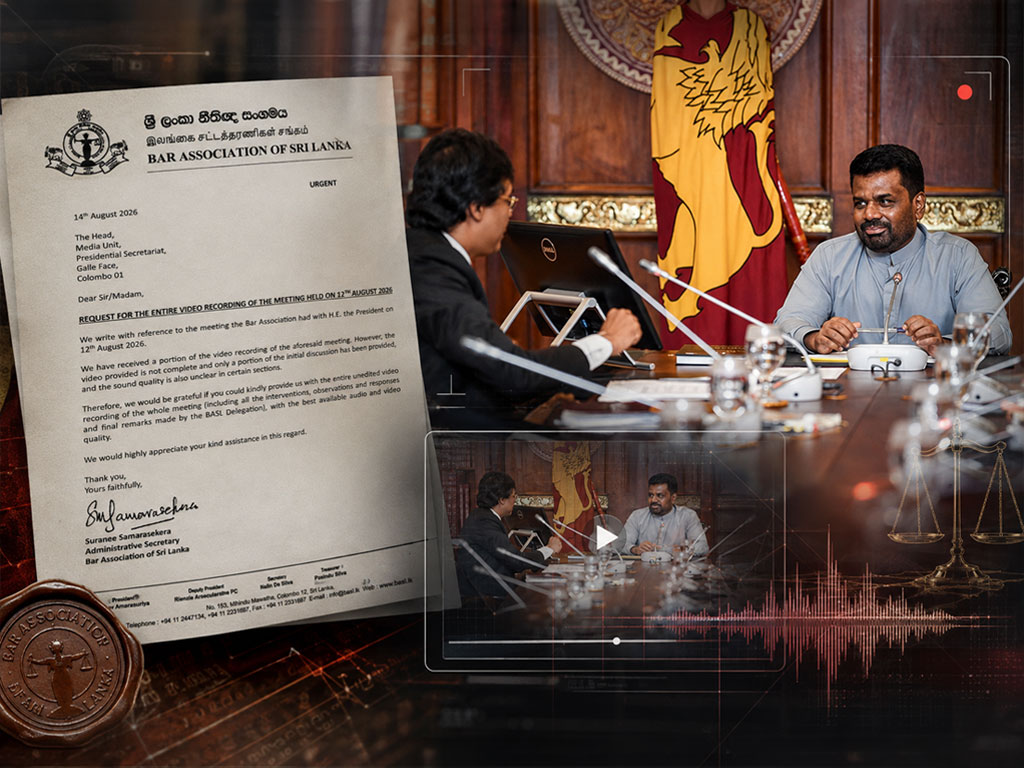
On the same day the Maha Nayaka Theras released their letter, President Anura Kumara Dissanayake met Bar Association President Rajeev Amarasuriya and members of the BASL Executive Committee.
The meeting had reportedly been requested by the Bar Association around four months earlier.
Despite the importance of the discussions, the meeting lasted less than an hour.
The two sides remained far apart.
The Bar Association presented its concerns over the proposed constitutional reform and its implications for judicial independence.
Professor Savithri Gunasekara also made a detailed presentation during the discussion.
However, the meeting reportedly ended without compromise.
The President remained committed to pursuing what he described as broader reform.
According to the account provided, his response to the concerns raised by the lawyers was:
“Risks must be taken to bring about a radical change.”
That remark has since become central to the political controversy.
The Bar Association’s concern is not simply whether reform requires political courage.
The deeper question is whether changing the tenure of sitting judges is the type of risk that should be taken without broader agreement.
‘Risks Must Be Taken for Radical Change’
The President’s statement deserves careful consideration.
Major reforms often involve political risk.
Governments sometimes need to challenge entrenched systems to produce meaningful change.
But the judiciary occupies a unique constitutional position.
Unlike ordinary government departments, courts must remain independent from the political branches of the state.
That is why even the appearance of executive influence can generate public concern.
The government argues that changes are necessary to improve the performance of the judicial system and reduce delays.
Opponents respond that those objectives could be pursued through other measures.
They point to vacancies, court capacity, judicial appointments and administrative reforms as alternatives that could address delays without changing the retirement ages of sitting judges.
The judges retirement age debate has therefore become a test of how far a government with a powerful parliamentary majority should go when altering institutions designed to remain independent of political authority.
The government may possess the parliamentary numbers required to advance reform.
But constitutional legitimacy involves more than arithmetic.
Public confidence also matters.
So does the confidence of judges, lawyers and institutions responsible for defending the rule of law.
Is This the Risk the Public Wants?
The central question now is whether the government has demonstrated enough public necessity for the proposed amendment.
Is extending judicial retirement ages genuinely the reform Sri Lankans are demanding?
Or would broader consultation produce a different solution?
Critics have even raised the possibility of seeking direct public approval through a referendum if the change is considered sufficiently fundamental.
The larger lesson is that political courage and constitutional caution are not opposites.
A government may sincerely believe radical reform is necessary.
Yet the willingness of a leader to take risks does not automatically make every proposed change beneficial.
When reform touches judicial independence, the standard must be particularly high.
The letter from the Maha Nayaka Theras, the concerns raised by the Bar Association, opposition from judicial organisations and warnings from international legal bodies now place the burden firmly on the government.
It must explain why this specific constitutional change is necessary, why alternatives are inadequate and how judicial independence will remain protected.
The President says great risks may be necessary for radical change.
The question now confronting Sri Lanka is more fundamental:
Whose risk is it, and who ultimately gets to decide whether it is worth taking?