By Dwayne Ferreira.
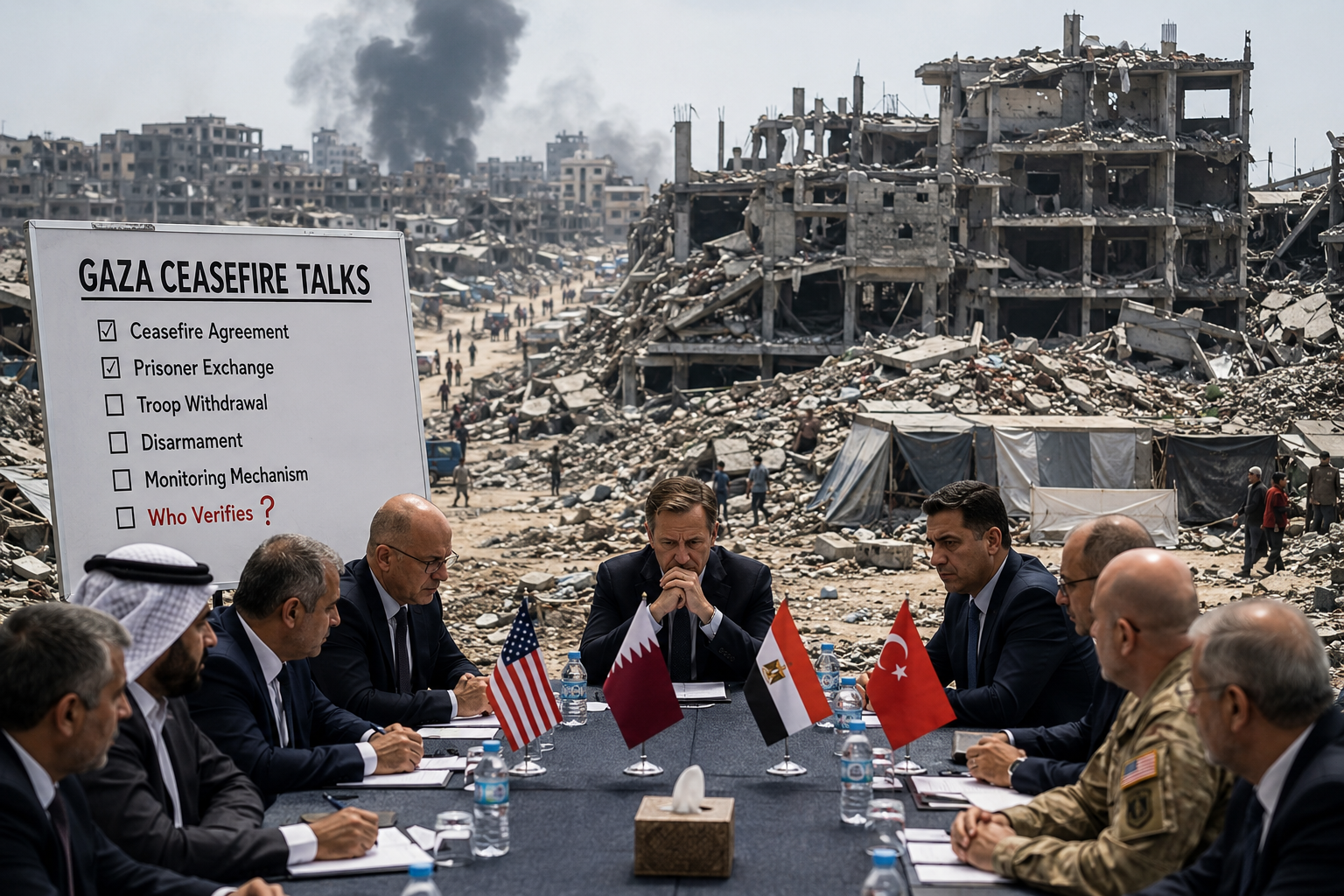
Gaza ceasefire monitoring remains the missing safeguard as repeated deals fail to define who verifies compliance and rules on breaches.
Gaza ceasefire monitoring remains the missing safeguard behind repeated breakdowns in negotiations, exposing a basic weakness in agreements that lack a neutral, pre-agreed body to verify compliance and rule on alleged breaches.
In late July, negotiators proposed a 15-point roadmap for Gaza. It outlined a phased process under which Hamas would surrender its weapons to a Palestinian technocratic committee, with an international body verifying the process. In return, Israeli forces would withdraw in stages.
However, Israel rejected the plan in early August. Later negotiations then shifted responsibility for overseeing disarmament to an American general. That change highlights a deeper problem running through Gaza agreements since early 2025: the parties never agreed in advance on who would certify compliance or decide when either side had violated the terms.

Gaza Ceasefire Monitoring Lacked an Enforcement Mechanism
Data from the University of Edinburgh’s Peace Agreement Database shows repeated attempts during 2025 to secure a lasting settlement. The January 2025 agreement set out prisoner exchanges and troop withdrawal corridors. Yet it provided no formal system for enforcing compliance.
The United States, Egypt and Qatar served as guarantors, but their role focused on continuing negotiations rather than formally determining violations. When the first phase expired on March 1 without a verification framework, hostilities resumed soon afterward.
In October 2025, authorities tried to address that weakness by establishing a monitoring centre run by US Central Command. Its role was to track the ceasefire and coordinate aid. Nevertheless, restrictions on aid continued.
A separate high-level declaration signed by the US, Egypt, Qatar and Turkey set out broad regional principles. However, neither Israel nor Hamas signed that declaration, leaving its commitments without direct enforceability.
By November 2025, the UN had endorsed a wider peace plan and created a transitional “Board of Peace.” The framework covered economic reconstruction and referred to Palestinian self-determination. But it also left important conditions unclear. Statehood depended on administrative reforms being “faithfully carried out,” without identifying who had the authority to decide when that standard had been met.
Why a Neutral Arbiter Matters
Recent changes to the 15-point roadmap show how fragile the process remains. The earlier promise of a phased Israeli withdrawal was reversed, making withdrawal dependent on full disarmament first. Monitoring also moved from a multilateral mechanism to a single party.
For Sri Lankans familiar with international monitors and third-party guarantors, the problem has a recognizable parallel. The 2002 Ceasefire Agreement and the Sri Lanka Monitoring Mission showed how central agreed monitoring terms can become in a contested peace process.
Any durable Gaza agreement therefore needs a neutral arbiter accepted by both sides before implementation begins. It also requires clear procedures for handling alleged breaches, direct regional participation in monitoring, and a governance structure that gives affected Palestinians a genuine voice in long-term political stability and recovery.
Without an impartial referee written directly into the agreement, future roadmaps risk returning to the same deadlock.