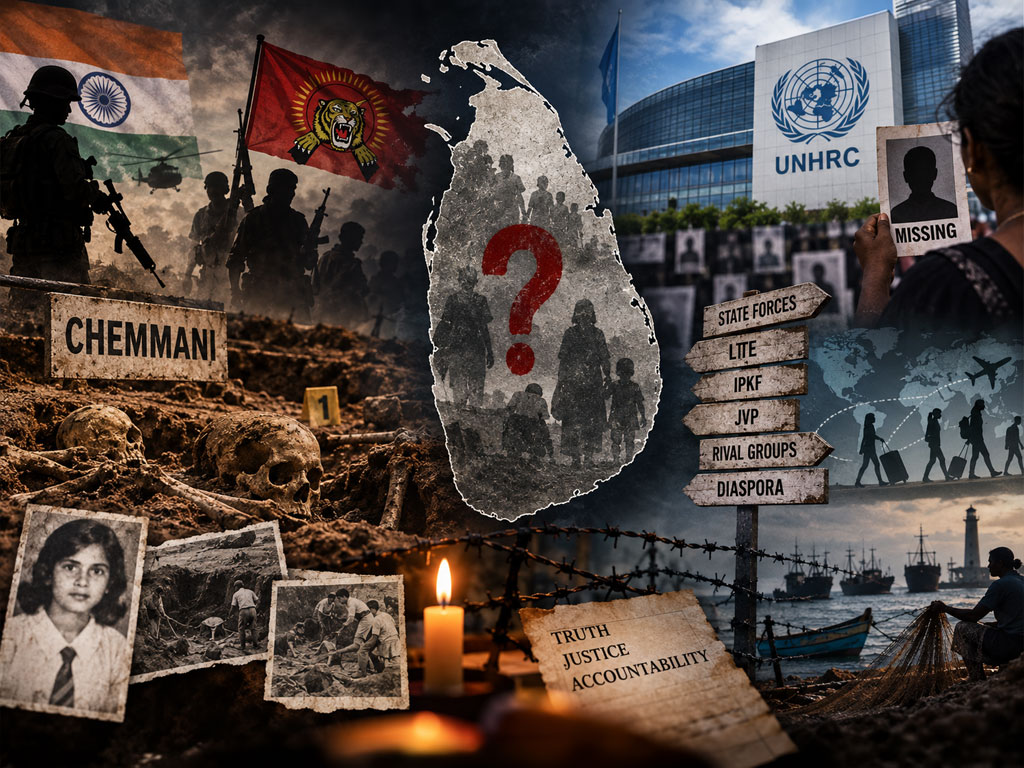
Sri Lanka disappearances span allegations involving state forces, the LTTE, IPKF and rival groups, raising unresolved questions over accountability.
Sri Lanka disappearances remain one of the country’s most painful unresolved issues, with demands for justice extending across allegations involving the state, LTTE, Indian Peace Keeping Force and rival militant groups.
The debate cannot be confined to one period, one organisation or one set of victims. As pressure mounts over mass graves and wartime accountability, the country’s missing-persons question demands examination of every actor that operated during decades of conflict.
President Ranasinghe Premadasa drew heavy criticism for arming the LTTE against the Indian Army. Yet, in hindsight, the writer argues that without that controversial decision, India’s proxy force could have become firmly established.
The article maintains that the Tamil National Army was formed to ensure the continuation of Varatharaja Perumal’s deeply unpopular provincial administration, which went as far as forcible conscription.
India, therefore, cannot absolve itself of responsibility for its role in Sri Lanka.
The writer links India’s destabilisation project to concerns held by then Prime Minister Indira Gandhi over developments in Tamil Nadu. That intervention, the article argues, contributed to enormous death and destruction.
J.N. Dixit, India’s High Commissioner in Colombo from 1985 to 1989 and later National Security Advisor from 2004 to 2005, addressed Indian involvement in his memoir, Makers of India’s Foreign Policy: Raja Ram Mohun to Yashwant Sinha.
The late diplomat placed responsibility for India’s intervention in Sri Lanka on decisions taken during Indira Gandhi’s administration.

Chemmani Returns to the Centre of Sri Lanka Disappearances
One case now dominating the accountability debate is Chemmani.
Krishanthy Kumaraswamy was raped and killed by soldiers on September 7, 1996. The same group later killed her mother, younger brother and a family friend who had gone searching for the teenager.
An excavation in 1999 led to the recovery of 15 sets of remains.
Thereafter, the issue remained largely dormant for about a quarter of a century.
Following the chance discovery of skeletal remains, the Jaffna Magistrate’s Court ordered a fresh excavation last year. Nearly 600 sets of human remains have since been found, including remains identified as belonging to children and infants.
Tamil media have described Chemmani as the largest mass grave discovered in Sri Lanka.
Whatever the circumstances surrounding individual remains, the government cannot remain silent over the discoveries.
The area, which had been under Security Forces Headquarters, Jaffna, continues to attract substantial attention locally and internationally. The Army will have to address the issue without further delay.
However, the writer insists that investigations cannot stop with allegations involving Sri Lankan security forces.
Atrocities allegedly committed by the Indian Army, the LTTE and more than half a dozen other militant organisations that later entered mainstream politics must also receive scrutiny.
That broader examination, the article argues, is essential if the country is genuinely seeking a complete accounting of those who disappeared during the conflict.
The issue of mass graves has previously produced allegations that did not withstand subsequent scientific examination.
The Army was once accused in relation to mass graves discovered in Mannar. However, investigations undertaken through the Office on Missing Persons, with international expertise, produced a different conclusion.
Bone fragments were sent to Beta Analytic, a specialised radiocarbon-dating laboratory in the United States.
The testing took place during the Yahapalana administration of 2015 to 2019.
The laboratory subsequently indicated that the tested samples dated to between 1499 and 1719 AD. The findings therefore placed those particular remains centuries before the modern conflict.
The writer argues that this effectively ended the allegations that those tested Mannar remains were connected to recent wartime disappearances.
India’s Role and the Tamil National Army Question
The formation of the Tamil National Army before the withdrawal of the Indian Army by March 1990 must also receive attention, according to the article.
After arming Tamil militant groups, New Delhi went further by facilitating the formation of a force intended to protect Varatharaja Perumal’s North-East provincial administration.
That episode forms part of the wider historical context often missing from current discussions about accountability.
The article argues that India armed multiple militant organisations as part of a policy that destabilised its smaller neighbour.
That history, it says, cannot simply disappear from contemporary human rights discussions.
One particularly controversial missing-person case involved Kathiravel Thayapararajah.
The University Teachers for Human Rights (Jaffna), Australian Government Refugee Review Tribunal, TamilNet and European Centre for Constitutional and Human Rights were among those that blamed Sri Lankan intelligence for his disappearance.
However, Indian media reported in May 2014 that Indian authorities had arrested Thayapararajah.
At the time, those reporting his arrest apparently did not realise he was the same person previously alleged to have been killed by Sri Lankan intelligence.
Indian police apprehended him at Arichamunai, off Dhanushkodi, after he reportedly arrived by boat from Sri Lanka.
He was with Uthayakala, described in the article as a female human smuggler, who claimed that Thayapararajah was her second husband.
The discovery exposed what the writer describes as a false narrative that had circulated for years.
Retired High Court Judge Maxwell Paranagama, who headed the Missing Persons Commission, also called for international cooperation to trace Sri Lankans living overseas under changed identities.
Paranagama told the writer that international organisations, including the ICRC, had declined at the time to help Sri Lanka identify individuals allegedly living abroad under different identities.
That question remains relevant because a person officially treated as missing may not necessarily be dead.
Chemmani Demands a Credible Investigation
Sri Lanka nevertheless has an obligation to investigate alleged war crimes, particularly the high-profile Chemmani mass grave.
The continuing discoveries cannot be dismissed simply because other allegations may have proved inaccurate.
International attention has intensified, and the country risks allowing speculation to fill the vacuum if authorities fail to establish facts through credible investigations.
The writer criticises what he regards as selective international scrutiny, particularly criticism directed at the Rajapaksa administrations.
However, regardless of political interpretations, Chemmani requires a serious evidentiary process.
CNN has reported on the issue, while the International Commission of Jurists called in July last year for what it described as a victim-centred investigation into the alleged mass graves, conducted according to international law and standards.
Tamil political parties have also repeatedly demanded tangible action against those responsible.
Chemmani first attracted major national and international attention in 1998 following the confession of a soldier implicated in the rape and murder of schoolgirl Krishanthy Kumaraswamy.
Since then, the location has become a powerful and painful symbol of Sri Lanka’s conflict.
Any credible investigation must determine who the victims were, when they died and how they came to be buried there.
It must also establish responsibility wherever the evidence leads.
At the same time, the article argues that scrutiny of Chemmani should form part of a broader national process that examines disappearances attributed to every armed actor rather than one side alone.
Such an approach would include state forces, the LTTE, the IPKF and rival Tamil militant groups.
Asylum Claims and People Once Listed as Missing
Another dimension concerns Sri Lankans who disappeared locally but later surfaced overseas.
Internationally acclaimed filmmaker Jacques Audiard directed Dheepan, a film about three Sri Lankans who form a false family to escape the war and obtain asylum in France.
Antonythasan Jesuthasan’s performance earned him a Best Actor nomination at the 2016 César Awards.
The article describes Jesuthasan as a former LTTE member who later achieved international recognition as an actor.
In a March 31, 2016 interview with Tom Seymour in The Guardian, Jesuthasan discussed his attempts to secure refugee status.
According to that interview, he showed Seymour scars on his forearm and said he had inflicted them himself while trying to convince officials of his refugee claim.
He said: “I did those to myself. I was 22, and I had spent years trying to come to the west.”
Jesuthasan further described trying to convince the UNHCR to accept his account.
The writer presents that admission as evidence that asylum claims involving Sri Lankans cannot always be accepted without verification.
However, the broader question extends beyond one individual.
The article argues that Sri Lanka’s Foreign Ministry failed to systematically challenge cases where individuals allegedly obtained asylum through inaccurate or misleading narratives.
Jesuthasan was born in Allaipiddy on Velanaitivu islet. He claimed that he fought the Sri Lanka Army in August 1990, later fled the country and eventually reached France.
Thayapararajah’s case presents another example cited by the writer.
He had worked on a Tamil Diaspora-funded project in Kilinochchi during Eelam War IV and remained in the Vanni during the conflict.
He disappeared in September 2009.
Sections of the media and several international NGOs subsequently accused the Directorate of Military Intelligence of killing him.
Former US Assistant Secretary of State for South Asian Affairs and one-time US Ambassador to Sri Lanka Robert O. Blake also inquired about the case.
His later arrest in India fundamentally altered the narrative surrounding that disappearance.
Foreign Identities Complicate the Missing-Persons Count
The issue of assumed identities also arose in the case of one-time senior JVP figure Kumar Gunaratnam.
His secret arrival in Sri Lanka as Australian citizen Noel Mudalige in early September 2011 highlighted how foreign passports could be issued to Sri Lankans under assumed identities.
The writer reported that the leader of the breakaway JVP faction, later known as the Frontline Socialist Party, entered Sri Lanka using Australian passport N 1016123 on September 4, 2011.
The Australian High Commission acted swiftly when Gunaratnam subsequently disappeared after entering the country.
The episode raised broader questions about whether people officially recorded in Sri Lanka under one identity may be living overseas under another.
The writer argues that Western governments have not provided sufficient assistance to establish the identities of Sri Lankans who may have secured foreign citizenship using assumed names.
If such cases exist within official lists of missing or forcibly disappeared persons, the accuracy of those lists becomes an important investigative issue.
That does not diminish genuine enforced disappearance cases.
Instead, it demonstrates why each individual case requires verification.
There have been several instances, according to the article, where people categorised as missing or dead later appeared overseas.
The writer again cites Jesuthasan, who became the lead actor in Dheepan, winner of the Palme d’Or at the 2015 Cannes Film Festival.
The point is not that every missing person is living abroad.
Rather, the article argues that proper international cooperation is required to separate genuine disappearances from cases involving migration, changed identities or false documentation.
IPKF Allegations Also Demand Examination
The Indian Peace Keeping Force period remains another major part of Sri Lanka’s unresolved disappearance story.
Thousands of LTTE cadres and civilians died during Indian military operations, including militants who had earlier received training in India.
The IPKF developed such a controversial reputation among sections of Sri Lankan society that critics referred to it as the “Indian People Killing Force.”
The article places the broader conflict within what it describes as an Indian destabilisation strategy initiated under Prime Minister Indira Gandhi.
More than a year after the Indian Army withdrew, the LTTE assassinated former Indian Prime Minister Rajiv Gandhi.
Velupillai Prabhakaran held Gandhi responsible for deploying the Indian Army in Sri Lanka.
Following the assassination, Indian authorities pursued the LTTE team linked to the operation, which involved a female suicide bomber.
The article argues that India’s earlier role in training and supporting Tamil militant organisations contributed substantially to the transformation of the separatist movement into a formidable military threat.
Several organisations received Indian support, including PLOTE, EPRLF and TELO.
Those groups were themselves accused of killings and human rights abuses during internecine fighting.
That leads to a difficult question: how many Sri Lankan Tamils disappeared while undergoing weapons training in India?
Did Indian authorities investigate disappearances or deaths linked to clashes among competing Tamil militant organisations operating there?
Such questions, the writer argues, must form part of any comprehensive reckoning.
The history also extends beyond Sri Lanka.
PLOTE members participated in the November 1988 attempt to overthrow Maldivian President Maumoon Abdul Gayoom.
India intervened militarily and restored the government.
However, the article stresses that the attackers came from a group that India had earlier trained and armed.
It also notes that two trawlers carrying the raiding party had departed northern Sri Lanka while the area was under Indian Army control.
The Maldives Raid and Missing PLOTE Cadres
In November 2011, the writer interviewed Maldivian businessman Abdullah Luthufee, who persuaded PLOTE leader Uma Maheswaran to participate in the operation against the Maldivian government.
The writer subsequently published several articles examining the attempted coup.
Some PLOTE cadres died when the Indian Navy intercepted and sank a vessel used by members fleeing the Maldives.
The article states that some of those men later appeared among people listed as missing during Sri Lanka’s conflict.
That example again demonstrates why the missing-persons issue cannot be examined through a single narrative.
India never accepted responsibility for the fact that a group it had previously trained and armed subsequently participated in the Maldives attack.
The operation produced Maldivian and militant deaths.
Indian airborne forces successfully intervened to protect President Gayoom, and international media widely praised India’s rapid response.
Yet the writer argues that two crucial points received insufficient attention.
First, PLOTE had benefited from Indian training and support.
Second, the raiding party left northern Sri Lanka while the area was under Indian military control.
These questions do not remove the responsibility of the attackers themselves.
They do, however, reinforce the article’s central argument that regional actors also have unresolved questions to answer.
LTTE Responsibility Cannot Be Removed From the Record
The Tamil community must also confront the scale of LTTE casualties and the organisation’s own conduct, the writer argues.
The LTTE developed considerable firepower and eventually possessed conventional military capabilities, including a small air wing.
It directly challenged Sri Lankan government forces and secured major battlefield victories over several years.
However, the organisation did not anticipate the sustained military offensive that eventually ended the war in May 2009.
The article argues that disappearances became particularly prominent in campaigns pursued by sections of the Tamil Diaspora and Tamil-speaking political parties following the LTTE’s military defeat.
Accountability demands, however, cannot exclude abuses attributed to the LTTE.
Under Velupillai Prabhakaran, the organisation killed members of rival Tamil militant groups.
It assassinated President Ranasinghe Premadasa, nearly assassinated President Chandrika Bandaranaike Kumaratunga and attempted to kill President Mahinda Rajapaksa.
Its recruitment and deployment of children also remains a major accountability issue.
How many forcibly recruited children died during fighting?
The article further questions the political responsibility of the now-defunct Tamil National Alliance, led by the Ilankai Thamil Arasu Kadchi, for recognising the LTTE in 2001 as the sole representative of Tamil-speaking people.
These questions form part of the writer’s argument that accountability must be universal rather than selectively applied.
Amnesty Recorded Disappearances During the IPKF Period
In September 1990, several months after the Indian Army withdrew from Sri Lanka, Amnesty International documented 43 disappearance cases.
According to the London-based organisation, most occurred in the Jaffna peninsula following renewed fighting.
The Indian Army had launched Operation Pawan after relations with the LTTE collapsed following the Indo-Lanka Accord signed on July 29, 1987.
During the Indian deployment from July 1987 to March 1990, Sri Lankan forces were largely confined to barracks in the North and East.
Amnesty International accused Indian forces of torture, extrajudicial executions and disappearances.
The intensity of the fighting was also reflected in Indian losses.
Nearly 1,500 Indian officers and soldiers died, while approximately 3,000 were injured during the deployment.
Indian troops carried out reprisals following LTTE attacks in both provinces and also faced allegations of sexual violence.
One of the most serious episodes cited by the article occurred at Valvettithurai in August 1989.
Indian soldiers were accused of killing civilians, torturing detainees, committing sexual violence and systematically destroying homes and businesses while the town remained under curfew.
In October 2025, the International Truth and Justice Project, together with the Valvettithurai Citizens’ Committee, submitted a reparations claim to Sri Lanka’s Office for Reparations.
The organisations requested US$15 million, equivalent to LKR 4.5 billion, for victims of the 1989 violence.
The claim concerned an episode in which at least 66 civilians were reported killed and another 34 injured.
The article notes that such a comprehensive compensation claim over alleged IPKF violence had not previously been pursued.
The ICRC, JVP Violence and Another Missing Generation
Sri Lanka disappearances also stretch beyond the North-East conflict.
The International Committee of the Red Cross arrived in Sri Lanka in 1989 during the second Janatha Vimukthi Peramuna insurgency and the state counter-insurgency campaign.
At that time, President Ranasinghe Premadasa was engaged in direct negotiations with the LTTE.
The ICRC could not have anticipated the scale of violence that would follow across different parts of the country.
Within weeks of its arrival, the JVP was crushed through a brutal counter-insurgency operation.
The JVP itself had engaged in severe violence.
The state’s response was equally devastating, and most of the Marxist movement’s senior leadership was killed.
Somawansa Amarasinghe survived and escaped with Indian assistance in February 1990. He remained abroad until late 2001.
The ICRC began its deployment in mid-October 1989.
JVP leader Rohana Wijeweera was captured during the second week of November at Ulapane. He was killed in custody, with accounts alleging that his body was burned at the Borella cemetery.
By the time the ICRC arrived, the JVP insurgency was already nearing collapse.
The UNP government did not routinely return the bodies of slain JVP members to their families.
As a result, many people officially categorised as missing during that period were believed to have been killed.
The country then faced another outbreak of war in the North and East.
Following the Indian Army’s departure in late March 1990, the LTTE resumed large-scale hostilities in June.
The renewed war followed a 14-month truce between President Premadasa and LTTE leader Prabhakaran that lasted from May 1989 until June 1990.
The ICRC subsequently opened offices in the conflict region.
Accountability Must Include Every Actor
The Sri Lankan military and law enforcement authorities committed excesses during the war, and those allegations require proper investigation.
At the same time, the article argues that scrutiny should also extend to abuses committed by every other armed organisation involved.
The writer notes that some campaigners demanding justice for missing and disappeared persons give comparatively little attention to disappearances during the Indian military deployment from July 1987 to March 1990.
The same concern applies to LTTE abuses, rival militant killings and the JVP-era disappearances in the South.
A credible national accountability process should not protect any institution simply because its actions complicate a preferred political narrative.
Nor should evidence concerning abuses by one actor be used to excuse crimes attributed to another.
Sri Lanka must earnestly address accountability and take meaningful steps to compensate families of innocent victims.
That principle should apply whether responsibility rests with state forces, the LTTE, the IPKF, the JVP, rival Tamil militant organisations or other actors.
The unresolved question is therefore not simply how many people disappeared.
It is also who disappeared them, when, under whose authority and whether every allegation has received the same investigative seriousness.
The Long Road for Justice Continues
The continuing search for answers was highlighted on August 30 when Ana Lorena Delgadillo Pérez, representing the Working Group on Enforced or Involuntary Disappearances, joined Yogarasa Kanagarajini of the Association of Relatives of Enforced Disappearances.
They opened an exhibition at the Thanthai Selva Auditorium in Jaffna.
The exhibition, titled Long Road for Justice, coincided with the International Day for Victims of Enforced Disappearances.
Pérez later addressed a conference at the same venue, where Sri Lanka’s responsibility for resolving disappearance cases was emphasised.
Civil society activist Sunanda Deshapriya also examined the issue in an article titled Sri Lanka’s Disappeared: Where Do We Go from Here?, published by Jaffna Monitor.
His article focused heavily on disappearances connected to the North-East war.
The ICRC’s Colombo office separately issued a statement for the International Day of the Disappeared.
Asked about the scale of the problem, Ruwanthi Jayasundare, Head of Communications, said the organisation maintained a caseload of 15,000 registered tracing requests covering 1983 to 2009.
She added that the actual number of missing persons was believed to be significantly higher.
Those figures underline the scale of the national challenge.
But numbers alone cannot provide justice.
Sri Lanka needs credible investigations into Chemmani and every other legitimate disappearance allegation. It also needs international cooperation where individuals may be living overseas under different identities.
At the same time, India, the LTTE’s surviving political history, former militant movements and Sri Lankan state institutions cannot be excluded from the historical record.
The country’s missing-persons tragedy spans different governments, regions, ethnic communities and armed groups.
Resolving Sri Lanka disappearances therefore requires more than selectively confronting one chapter of the conflict.
The families of the missing deserve evidence, answers and accountability wherever responsibility ultimately lies.