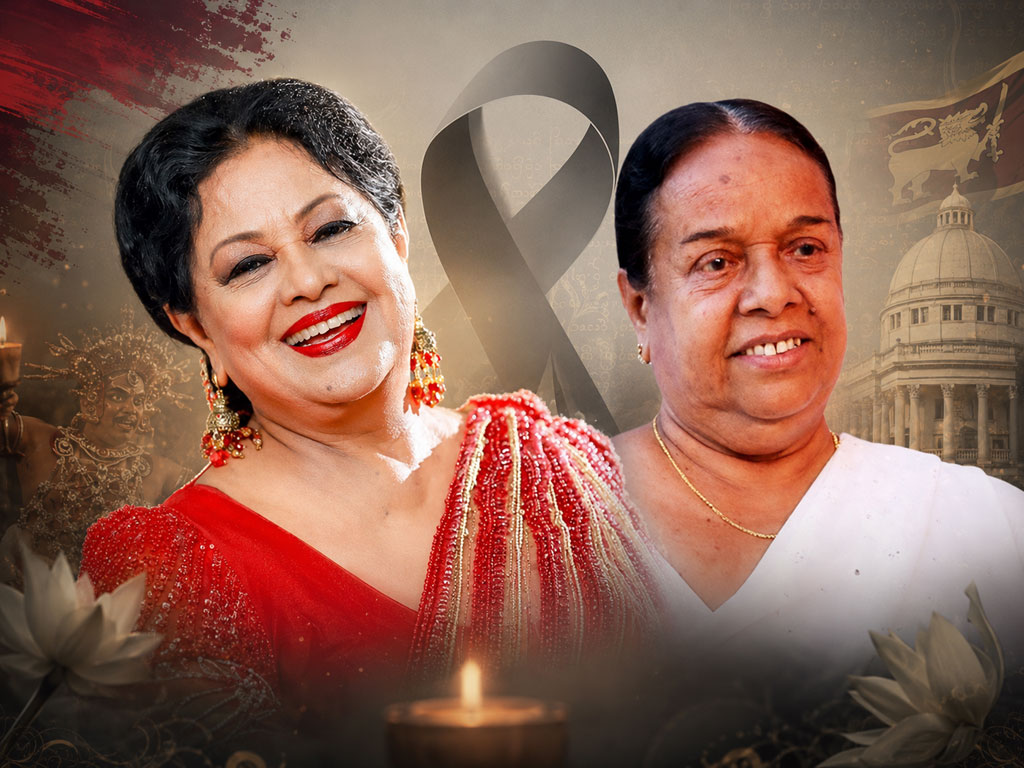
National mourning period rules face scrutiny after three days were declared for Nanda Malini, raising questions over consistency in state honors.
Sri Lanka’s national mourning period for Nanda Malini has reopened an uncomfortable question: what criteria determine who receives official state mourning, and for how long?
Only months have passed since the death of Malini Fonseka, widely celebrated as the Queen of Sinhala Cinema. Now, Nanda Malini, known to generations as the “National Voice,” has also passed away.
Her death came just one day before the cremation ceremonies of Rambukana Siddhartha Thero.
Siddhartha Thero may not have carried a grand public title. Yet among Buddhist monks who contributed lyrics to Sinhala song, many regard him as one of the most important figures.

The Government has declared a three-day national mourning period following the death of Nanda Malini.
Given her extraordinary talent and social influence, even those who disagreed with some of her views or actions may accept that honour, if not enthusiastically, then at least neutrally.
However, the declaration inevitably raises another question.
What Determines a National Mourning Period?
What standards does the state use when deciding whether to declare one day, three days or any period of national mourning?
That issue becomes more striking when comparing figures honoured during the same Government.
Why did Malini Fonseka, the “Queen of Cinema,” not receive even a single day of national mourning, while Nanda Malini receives three?
Such a contrast naturally encourages speculation.
Was one cultural icon viewed less favourably by the Government while another enjoyed greater recognition?
There is no clear public answer to that question.
The timing has also drawn attention because the three-day mourning period coincides with the Kandy Esala Perahera festival.
However, questions about national honours are not unique to the present administration.
Sri Lanka has previously lost major cultural figures without an obvious or consistent system governing how the state recognises their passing.
Musician Sunil Santha, Kalasuri Latha Walpola, known as the Nightingale of Sinhala Song, and actor and multi-talented artist Jackson Anthony are among those who come to mind when considering such inconsistencies.
Clearer Criteria Could Protect the Honour Itself
There appears to be no widely understood answer to what qualifications a person must possess before the Government declares a national mourning period.
Likewise, the public has little clarity on what determines whether that period lasts one day or several days.
That uncertainty allows political interpretations to emerge whenever one prominent figure receives an honour that another did not.
State recognition should ideally rise above political preference, personal loyalty or partisan calculation.
The more consistently such honours are granted, the more meaningful they become.
By keeping political favour and hostility out of these decisions as far as possible, the Government would protect not only the dignity of the honour itself, but also the dignity of those chosen to receive it.