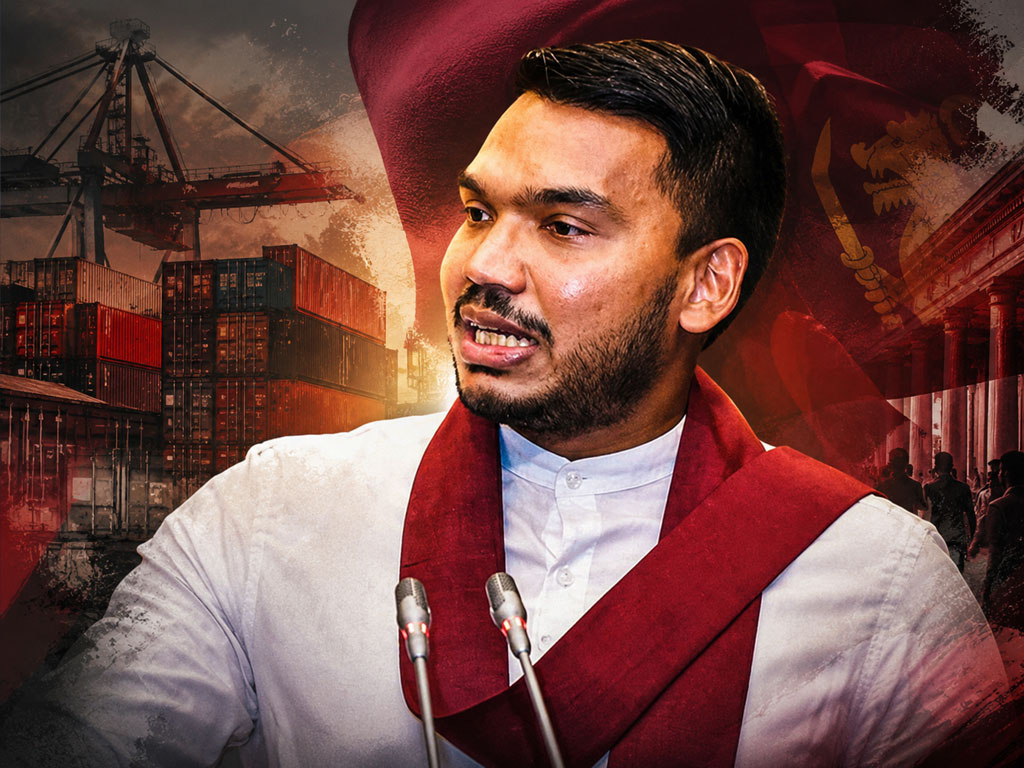
Namal Rajapaksa alleges Presidential Secretary containers were released improperly and challenges President Anura Kumara Dissanayake to act.
Sri Lanka Podujana Peramuna National Organiser Namal Rajapaksa has raised fresh allegations over the Presidential Secretary containers controversy, challenging President Anura Kumara Dissanayake to act against his own Secretary if he is serious about fighting corruption.
Rajapaksa claimed that the Presidential Secretary had been linked to the release of containers from the Colombo Port and alleged that the President was attempting to conceal the matter.
“The President talks about catching the corrupt. Now the President has the opportunity to show his sincerity by taking action against his Secretary,” Rajapaksa said.
“The Presidential Secretary was caught releasing containers from the port. But the President is hiding it. If the President is honest, let us see. We are watching to see what you will do to the Secretary now,” he added.
Rajapaksa made the remarks while addressing a political meeting in Kuliyapitiya.
He used the speech to launch a broader attack on the government, accusing it of abandoning its election promises and attempting to maintain power through what he described as lies, fraud, corruption and repression.

Namal Rajapaksa Attacks Government Over Broken Promises
Rajapaksa said those involved in JVP politics had gone into villages during the election campaign, discussed the problems faced by ordinary people and presented themselves as a political movement willing to fight for them.
However, he claimed that the government had given people “unlimited hopes” and gone from door to door before the election, only to abandon those commitments after coming to power.
According to Rajapaksa, the government was now attempting to survive through further deception, corruption and repression instead of delivering on its promises.
He warned the administration that Sri Lankans could not easily be intimidated.
“The people of this country cannot be stopped by repression. The people of these villages cannot be stopped,” he said.
Rajapaksa noted that people in many communities had already endured decades of conflict and political instability.
He referred to those who had lived through 30 years of LTTE terrorism and the violence and unrest associated with the 1988/89 period.
“You are people who have faced every challenge in this country since 88/89. You had the strength to overcome every one of those challenges,” he told the gathering.
Therefore, he argued, people living in rural communities would not remain silent because of government pressure.
Rajapaksa said the government would also fail if it believed it could suppress concerns raised by farmers, graduates and young people.
He said individuals speaking about those issues could include members of the Maha Sangha, opposition MPs, civil society representatives and journalists.
He accused the government of believing that it could use the police to frighten its critics.
“The government is wrong if it thinks it can intimidate by showing the police,” Rajapaksa said.
Farmers, Graduates and Businesses Under Pressure
Turning to economic conditions, Rajapaksa said farmers were facing severe difficulties while consumers in urban areas were also struggling.
He pointed to the gap between paddy and rice prices, claiming farmers received low prices for their harvest while consumers continued to pay high prices for rice.
Rajapaksa also mocked earlier government campaign promises.
“They said they didn’t come to power to do things in one stroke. Now I don’t even know if the pen’s ink has run out. The ink is finished. Signatures don’t work. It’s the router that works. It’s erased!” he said.
“They came saying they would protect the farmer with one stroke of the pen. Did they protect him? No. They said they would give jobs to graduates. Did they? No.”
Rajapaksa also referred to political exchanges in Parliament, including comments about promises concerning vehicles.
“They said they would give a car for 120,000,” he said.
He then referred to a government parliamentarian asking about him while he was absent from the chamber.
“I saw that gentleman asking in Parliament, ‘Where is Ravana Power’s monk?’ I said, ‘He’s here.’ He doesn’t ask when I’m here. He waits until I leave and asks.”
“He waits until I leave and asks, ‘Where is Namal?’ Well, I’ve gone. When I’m here, no!”
Rajapaksa urged the government to move away from what he called repression and instead focus on addressing the problems facing ordinary Sri Lankans.
He said several young business owners he had recently met were struggling to operate under the current tax environment.
According to him, the country faced an “unlimited tax burden,” while electricity tariffs and fuel prices were also placing further pressure on households and businesses.
Rajapaksa alleged that the government was forcing the public to bear financial losses caused by what he described as administrative incompetence.
He went further, alleging that taxes were also being increased to recover losses resulting from government corruption.
Presidential Secretary Containers Allegation Takes Centre Stage
Rajapaksa then returned to the Presidential Secretary containers allegation, saying the President’s anti-corruption credentials should now be tested by the government’s response.
“What is the government doing to cover the losses caused to the country by its thefts? By increasing taxes and recovering that from the people,” he alleged.
“The President talks about catching the corrupt, about sincerity. Now the President has the opportunity to show his sincerity by taking action against the Presidential Secretary.”
Rajapaksa again alleged that the Presidential Secretary had been involved in releasing containers from the port and accused the President of concealing the matter.
“If the President is honest, let us see. We are watching to see what you will do to the Secretary now,” he said.
Rajapaksa also raised allegations concerning the Ministry of Finance and what he described as repeated hacking incidents.
He said a political appointee had been placed in the Ministry of Finance before financial and information systems began experiencing problems.
“From the day that Secretary was brought in and placed in the Ministry of Finance, a hacker keeps breaking into the Ministry of Finance. Hack every day,” he said.
“The postal system is hacked, the Ministry of Finance is hacked. When asked, ‘Where is the money?’ no one who brought it is found.”
Rajapaksa claimed the public was ultimately being forced to cover the losses through higher taxes.
“A hacker who came from nowhere. The people pay. But who knows about this hacking?” he asked.
He further alleged that after a Member of Parliament resigned and a party member received an appointment as Secretary to the Ministry of Finance, money began disappearing from private-sector banks.
Rajapaksa claimed investigators had failed to identify the masterminds behind those incidents.
“The government needs to investigate these, not hide them,” he said.
Rajapaksa Questions Who Could Release 323 Containers
Rajapaksa accused the government of attempting to blame him and the opposition whenever problems arose.
He joked that even a dispute involving two security guards could eventually be blamed on Namal Rajapaksa.
“If paddy prices go down, they say paddy prices have gone down as if Namal played a game. Everything is like this,” he said.
He urged the government to abandon what he described as fear-mongering and begin governing.
Rajapaksa then questioned how an opposition politician could have the authority to release containers from the port.
“We are in the opposition. Can we release 323 containers from the port? Can we release two containers from the port?” he asked.
“How can we release the containers that the Presidential Secretary released?”
Rajapaksa said that even when his party was in government, it had not released containers in the manner he was alleging.
“Now that we are in opposition, how can we release containers? The culture of releasing containers was introduced by the JVP, from the port,” he claimed.
The release of hundreds of containers from Colombo Port without mandatory physical inspection has already become the subject of a Parliamentary Select Committee investigation. Parliament’s official description of the inquiry states that 323 containers were released without undergoing mandatory physical inspection and that an earlier Treasury inquiry found the method used was contrary to accepted procedures.
Lamborghinis, Political Narratives and the SLPP’s Future
Rajapaksa also accused the government of spreading false narratives against his family.
He referred to reports of Lamborghinis arriving at Hambantota Port and joked that, had his father been President at the time, critics would have claimed all 14 vehicles belonged to him.
“I saw that some Lamborghinis had come to the Hambantota port. If my father had been President, all 14 of those Lamborghinis would have been mine,” he said.
“Right now, Anura’s boss is President. I’m not saying it’s his, it’s not his. I don’t even know whose it is, but it’s not Anura’s boss’s.”
Rajapaksa said he would not falsely claim the vehicles belonged to President Anura Kumara Dissanayake or members of his family.
“Even if Anura’s boss says, ‘I saw Namal boy bringing 14, 18 Lamborghinis,’ I have never seen it. I don’t lie,” he said.
“So I say these 14 Lamborghinis are not President Anura Kumara’s, nor his children’s.”
Rajapaksa alleged that political opponents had previously created such narratives through hatred and jealousy and then used them to influence public opinion.
However, he said the country’s political future should not depend on anger or hatred.
“We don’t need hatred. We don’t need to do politics with jealousy and anger. Let us go with a policy,” he told the audience.
“We need to build a country that clearly suits your child.”
Rajapaksa concluded by arguing that the SLPP itself must modernise, embrace technology and respond to changes taking place globally.
He said Sri Lanka should protect its culture, religion and faith while simultaneously attracting technology, international markets and investors.
“We believe in modernity. We believe this country needs to change in line with new trends in the world,” Rajapaksa said.
He described the Sri Lanka Podujana Peramuna as a political movement prepared to lead what he called the major economic, social and political transformation required by a new generation.
“The political force of the new generation, ready for the massive economic, social and political transformation required for that, is the Sri Lanka Podujana Peramuna,” Rajapaksa said.