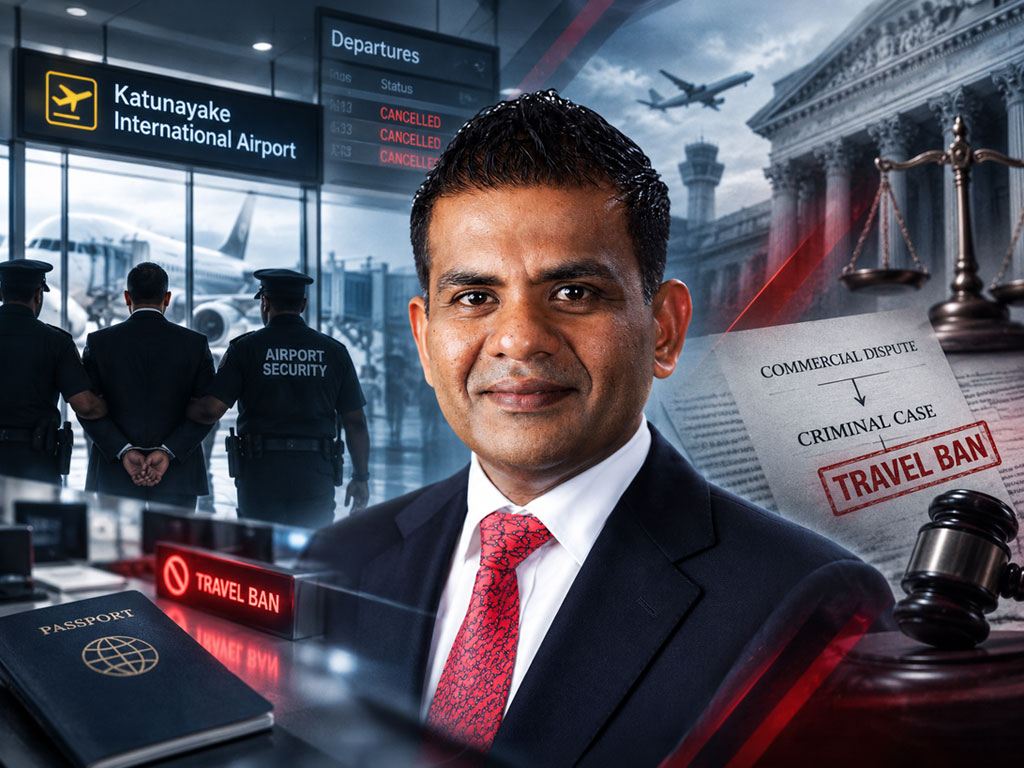
Hisham Jamaldeen airport detention highlights how commercial disputes, court travel bans and settlement procedures can affect corporate executives.
The Hisham Jamaldeen airport detention at Bandaranaike International Airport has drawn attention to how commercial disputes can escalate into criminal proceedings and travel restrictions.
Mohamed Hisham Jamaldeen is an Executive Director of Lanka Realty Investments PLC, a company listed on the Colombo Stock Exchange. He is also a Director of its subsidiary, Mulberry Holdings.
Immigration officials detained him at Katunayake after a foreign travel ban issued by court remained active in the immigration system.
The incident has since raised wider questions for Sri Lanka’s corporate sector about commercial disputes, criminal complaints and the legal effect of court orders.

Hisham Jamaldeen Airport Detention Followed Contract Dispute
The case originated from an alleged payment default of approximately Rs. 32.8 million.
The dispute concerned a sub-contract awarded to Omni Engineering & Trading Solutions in connection with a Rs. 3.6 billion housing project undertaken by Mulberry Holdings in Colombo 10.
Under the original agreement, the dispute was expected to proceed through commercial arbitration.
However, the matter later reached the Colombo Crimes Division on allegations that a financial fraud involving approximately Rs. 30 million to Rs. 36 million had occurred.
The Maligakanda Magistrate’s Court subsequently issued a foreign travel ban on August 24 and communicated the order to the immigration authorities.
Jamaldeen was reportedly unaware that the restriction remained active.
On September 2, immigration officials detained him when he arrived at Bandaranaike International Airport to travel to London.
The following day, parties appearing before court agreed to settle the payment dispute under an agreement valued at Rs. 25 million.
Following that development, the Magistrate took steps to permanently revoke the foreign travel ban and grant bail.
When Commercial Disputes Enter the Criminal Process
The case has significance beyond the detention of a corporate executive.
It highlights a wider concern over how contractual disagreements can move from civil or commercial proceedings into criminal investigations.
Commercial disputes can take considerable time to resolve through litigation or arbitration.
Against that background, some business parties may pursue complaints alleging criminal breach of trust or fraud as part of efforts to recover disputed contractual payments.
That shift can dramatically alter the consequences for the people and companies involved.
For senior executives of listed companies, court orders and travel restrictions may have implications beyond the immediate case.
They can affect business operations, corporate reputation and investor confidence.
The Hisham Jamaldeen airport detention therefore illustrates how quickly a contractual dispute can develop into a broader corporate governance and legal issue.
Settlement Does Not Automatically Cancel a Court Order
One of the most important lessons from the case concerns the difference between a private settlement and an active judicial order.
Resolving a payment or contractual disagreement between two parties does not automatically cancel an order previously issued by a court.
Even if parties reach an agreement privately or through arbitration, the judicial restriction remains effective until the court formally revokes it.
The necessary process includes several steps.
First, a lawyer must formally inform the relevant Magistrate’s Court of the settlement through a motion.
The complainant must then confirm the settlement before court.
After considering the matter, the Magistrate must issue a fresh order revoking the earlier travel restriction.
Finally, the Court Registrar’s office must formally communicate that decision to the Controller of Immigration so the relevant system can be updated.
Until those steps are completed, the travel ban remains active.
That means an executive may still face detention at an airport even after the underlying commercial disagreement appears to have been resolved.
A Warning for Corporate Legal Teams
The case also carries a practical message for companies whose senior executives frequently travel abroad.
International investment meetings, negotiations and financial transactions often require corporate leaders to cross borders at short notice.
As a result, proper coordination between company secretaries, in-house legal advisers and lawyers handling criminal proceedings becomes critical.
Legal analysts stress that companies should not assume a case has ended simply because parties signed a settlement.
They should also verify whether any active court orders, “B” records, warrants or travel restrictions remain in force.
Failure to complete that final procedural check can create unexpected legal and operational problems.
The central lesson from the Hisham Jamaldeen airport detention is therefore straightforward: a private settlement may resolve the commercial dispute, but only a formal court order can remove a judicial restriction.
Until the court revokes that order and authorities update the relevant system, the restriction remains legally effective.