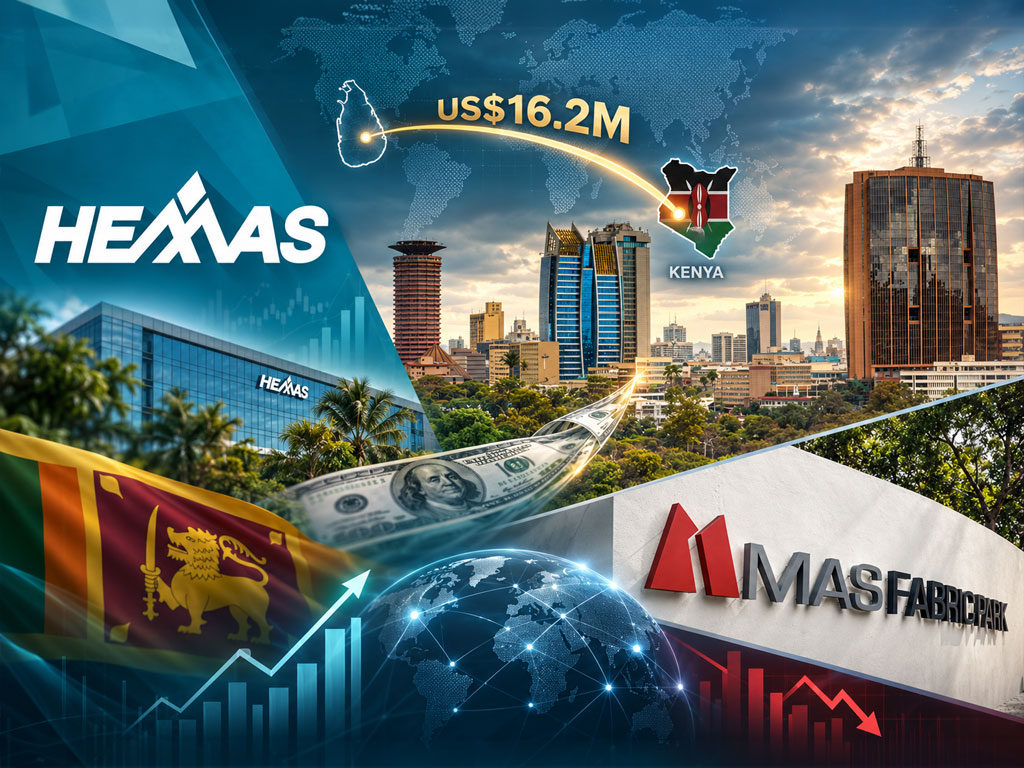
Hemas Kenya investment of US$16.2 million raises questions over overseas expansion, capital outflows and whether profits will return to Sri Lanka.
The Hemas Kenya investment of US$16.2 million has opened a wider debate over whether Sri Lankan corporate expansion abroad represents strategic growth or capital flight.
Hemas Holdings PLC, one of Sri Lanka’s leading diversified conglomerates, has acquired a 75% stake in Twiga Stationers & Printers Limited, a major Kenyan stationery manufacturer.
The acquisition was completed through Atlas Axillia Company, a wholly-owned Hemas subsidiary.
The deal represents the first full international acquisition in the Hemas Group’s more than seven-decade corporate history.
Atlas Axillia became part of Hemas in 2018 when the group first acquired a 75.1% stake. Hemas later purchased the remaining 24.9%.
Hemas has now selected Atlas Axillia as the vehicle to take its manufacturing expertise beyond Sri Lanka.

Hemas Kenya Investment Opens Door to East Africa
The acquisition gives Hemas a manufacturing and distribution platform in Kenya and potentially across the wider East African region.
Kenya has a GDP exceeding US$136 billion and a population of more than 54 million.
The country also serves as a gateway to the East African Community, which has a consumer base exceeding 330 million people.
Twiga is a long-established manufacturer of stationery and educational products in Kenya.
Its brands include Kasuku, CrownBird and Envoy.
According to Hemas investor information, Twiga controls approximately 55% of Kenya’s stationery market.
About 80% of its sales are generated within Kenya.
The remaining 20% is distributed across more than 10 African countries.
For Hemas, that network offers immediate access to a large regional consumer base.
It also allows Atlas Axillia to expand beyond Sri Lanka without having to build a completely new distribution system from the ground up.
An 11-Month Deal Across Two Jurisdictions
The Hemas Kenya investment followed an 11-month process involving regulatory approvals in both Sri Lanka and Kenya.
The initial agreement was reached on September 25, 2025.
At that stage, Hemas and Twiga signed a conditional share purchase and sale agreement.
In January 2026, the Competition Authority of Kenya approved the transaction.
The Kenyan regulator concluded that the acquisition did not breach competition rules.
Hemas also obtained approval from the Foreign Exchange Department of the Central Bank of Sri Lanka for the overseas investment.
The company completed the transaction on August 17, 2026, after meeting all legal conditions.
Hemas then formally disclosed the acquisition to the Colombo Stock Exchange.
The regulatory process indicates that the investment was not an immediate or informal movement of funds.
Instead, it passed through multiple approvals before completion.
Capital Outflow or Strategic Market Expansion?
The larger debate begins with what a US$16.2 million overseas investment means for Sri Lanka’s economy.
Economic analysts argue that foreign investment by Sri Lankan companies can create short-term pressure when the country is rebuilding foreign exchange reserves.
A capital outflow of US$16.2 million, while modest compared with national reserves, still represents dollars leaving the domestic financial system.
That becomes more sensitive during a recovery period.
The issue is particularly relevant because another major Sri Lankan company, MAS Holdings, is also making a large overseas investment.
MAS Holdings, owned by the Amalean family, is reportedly investing nearly US$93 million in the Indian state of Tamil Nadu while restructuring some manufacturing operations in Sri Lanka.
However, the two investments are not identical.
The Hemas Kenya investment is primarily market-seeking.
Its main purpose is to gain access to Kenya and the broader East African market.
The investment does not, according to the information provided, involve shifting existing Sri Lankan manufacturing capacity out of the country.
Instead, Hemas is using Twiga’s established production and distribution base to expand internationally.
How the MAS Investment Differs
The MAS Holdings investment in India is described differently.
That investment is more closely associated with efficiency-seeking and resource-seeking objectives.
Some local apparel units are being restructured, while parts of production are being shifted toward higher value-added textile processing.
Tamil Nadu offers advantages such as 21-day fast-track government approvals and a large integrated supply chain.
That creates a different economic impact.
Hemas is entering a foreign market to expand sales.
MAS, by contrast, is also taking advantage of production efficiencies and industrial infrastructure outside Sri Lanka.
These distinctions matter when evaluating whether overseas investment should be viewed as capital flight.
Not every dollar invested abroad has the same economic effect.
Will Overseas Profits Return to Sri Lanka?
Supporters of outward investment argue that capital naturally moves toward markets offering higher returns and greater policy stability.
In the long term, successful overseas operations can produce dividend income that flows back to Sri Lanka.
If those profits are repatriated, overseas expansion can strengthen the country’s current account and increase the foreign earnings of Sri Lankan companies.
That is the strongest economic argument in favour of outward investment.
However, questions remain about how consistently those returns come back.
The article’s source material raises concerns that some funds taken abroad for investment may ultimately remain in overseas banking systems.
It specifically refers to money being held in financial centres such as Singapore.
Only part of those funds may then be deployed into actual projects.
The same concern applies to investments in countries with strict procedures governing profit repatriation.
South Africa is cited as one example where moving funds back out can involve complex rules.
As a result, the key economic question is not simply whether Sri Lankan companies invest abroad.
It is whether profits, dividends and capital gains from those investments eventually return to Sri Lanka.
Sri Lanka Must Compete for Its Own Capital
The Hemas Kenya investment also highlights a broader policy lesson.
Capital cannot be retained effectively through restrictions alone.
If Sri Lankan companies believe foreign markets offer faster approvals, stronger infrastructure, larger supply chains and more predictable policies, they will naturally look abroad.
Regulatory barriers may slow that process, but they cannot remove the underlying incentive.
Sri Lanka therefore faces a strategic challenge.
It must create a domestic environment that gives companies strong reasons to continue investing at home.
That means faster approvals, stable policies, efficient one-stop investment systems and predictable regulations.
Foreign countries are already competing aggressively for capital.
Sri Lanka must do the same.
The Hemas Kenya investment therefore cannot be judged only as money leaving the country.
It is also a test of whether Sri Lanka can create conditions that make domestic investment equally attractive.
If overseas expansion generates profits that return to Sri Lanka, it could strengthen local companies and the wider economy.
If capital leaves permanently, however, the long-term impact becomes very different.
The true answer will depend not on the size of the investment alone, but on what happens to the earnings it generates.