By Roy Denish.
Palekanda Tank project faces a government probe over rising costs, stalled work and allegations of illicit excavation in Moneragala.
For nearly six years, the sun-baked agricultural heartland of Moneragala has borne the silent, grinding brunt of a stalled state infrastructure venture that has systematically dismantled the livelihoods of hundreds of farming families. What began quietly as a standard rural development project has now metastasized into a high-stakes political scandal, sending shockwaves through the legislature and exposing the vulnerable underbelly of state-funded rural contracts.

The controversy erupted on the floor of Parliament when Moneragala District National People’s Power MP Sarath Kumara forced the issue into the national spotlight, demanding answers for a landscape scarred by inaction. In response to mounting pressure, Deputy Irrigation Minister Aravinda Senarath made a stunning concession before the House, confirming that a formal government probe will be launched to investigate whether former State Minister of Water Supply and Irrigation Sasheendra Rajapaksa was personally linked to the heavy ground disturbance and partial demolition of the Palekanda Tank bund.
The roots of the scandal trace back to May 2020, when the previous administration initiated the Palekanda Tank rehabilitation project within the Galgamuwa Grama Niladhari Division of the Medulla Divisional Secretariat. At its inception, the venture was pitched as an economic lifeline for local agrarian communities, backed by an initial estimated budget of Rs. 82.2 million. Yet, as the months dragged on, the financial trajectory shifted dramatically, with the total projected cost more than doubling to a staggering Rs. 167.26 million.
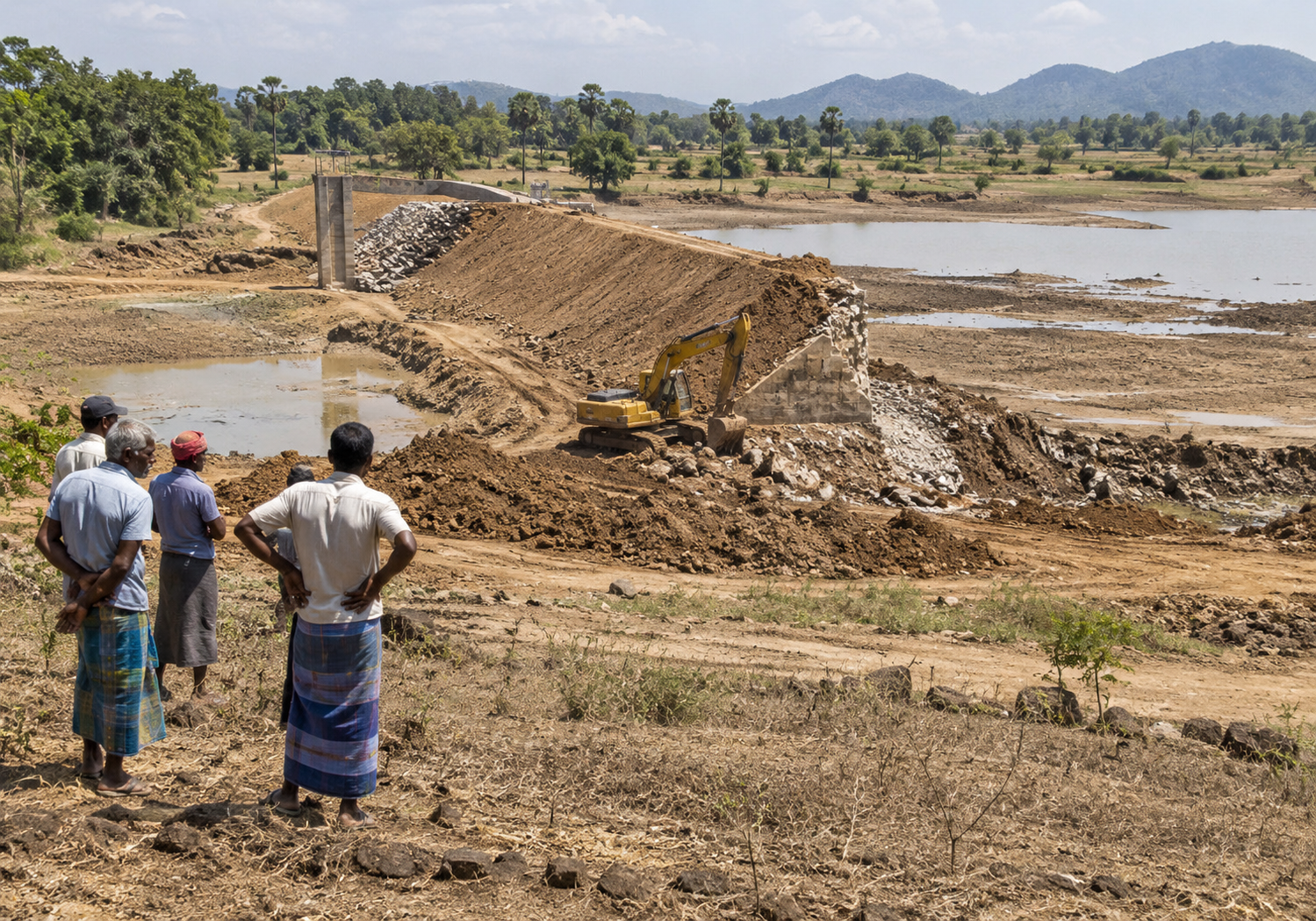
Official state expenditure reports indicate that Rs. 70.5 million has already been channelled into the venture, with technocrats insisting that the project is roughly 80 percent complete on paper. Bureaucratic summaries boast that the surplus weir, known locally as the Pitawana, has reached 95 percent completion, while the left sluice gate stands at 90 percent. However, these sanitized metrics clash violently with the desolate reality confronting anyone who visits the actual site.
During parliamentary proceedings, MP Kumara dismantled the official narrative by pointing out that a physical inspection of the reservoir reveals a stark, undeniable mismatch between the tens of millions spent and the negligible work completed on the ground. Critical structural components, such as the right sluice gate, have never even broken ground. More alarmingly, the core of the project—the tank bund itself—remains half-finished and structurally compromised, leaving a gaping void where a functional barrier should stand.
Behind the facade of bureaucratic delays and economic excuses lies a much darker, more insidious narrative whispered among the villagers who depend on the tank. Local residents have long harboured deep suspicions that the heavy excavation machinery and unauthorized ground alterations permitted under the banner of “development” were actually used for an entirely different purpose: clandestine treasure hunting, or nidhan excavations, allegedly shielded by formidable political patronage. In a country with a long history of archaeological sites falling prey to illicit fortune seekers, the alleged manipulation of state tenders to excavate ancient tank bunds would represent a particularly egregious breach of public trust.
For the farming community, the human cost of this administrative and alleged criminal neglect has been devastating. Deprived of the reservoir that traditionally fed their paddy fields and sustained their families through dry seasons, generations of agrarian workers have watched their incomes dry up alongside the receding water table. While state representatives previously relied on the convenient shield of the national economic crisis to explain why the 2022 completion deadline came and went without resolution, that excuse has worn paper-thin.
The mounting public fury and parliamentary inquiry have finally forced the hand of the newly positioned administration, prompting a dual-track commitment from the ministry. Authorities have pledged to thoroughly investigate the alleged irregularities, financial leakages, and illicit excavations that turned a public utility into a site of suspicion, while concurrently vowing to restart the stalled works. Officials have promised that construction machinery will return to the site to complete the remaining infrastructure by the end of next year. Whether this renewed political will can successfully restore both the fractured reservoir and public faith in state accountability remains the defining question hanging over Moneragala.