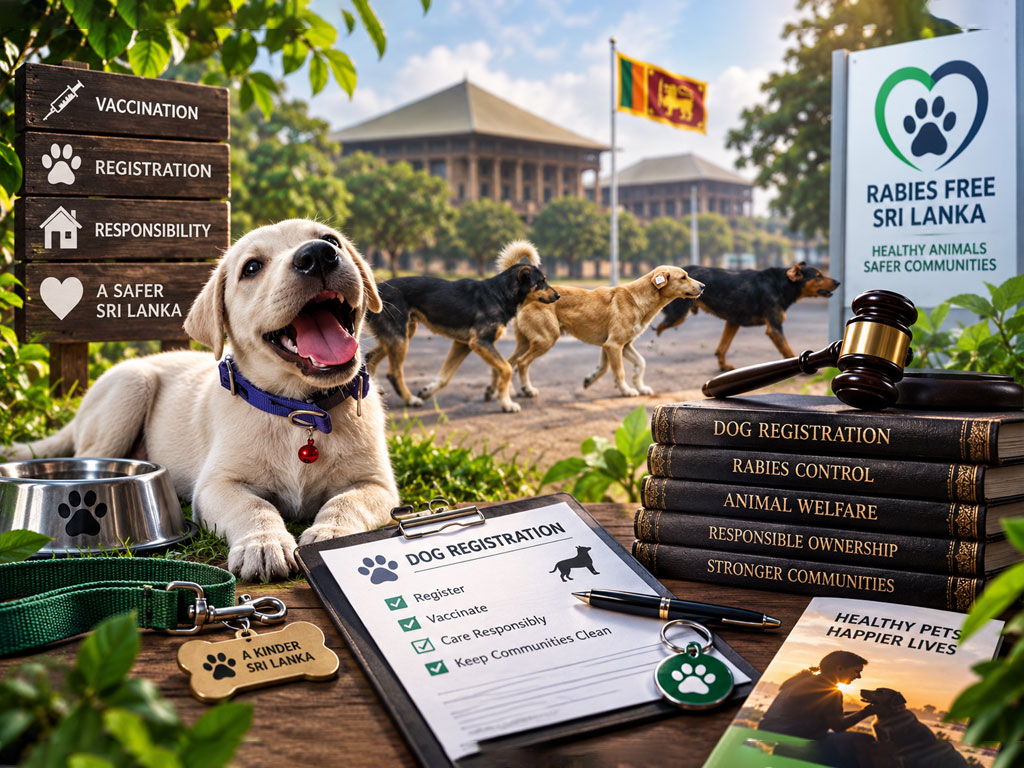
Sri Lanka’s dog registration bill targets rabies, irresponsible ownership, stray dogs, breeding and accountability through stronger regulation.
Sri Lanka’s new dog registration bill is more than a public health measure. It also challenges a culture of irresponsible pet ownership hidden behind claims of animal compassion.
Keeping pets, particularly dogs and cats, remains extremely popular and emotionally sensitive within Sri Lankan society. However, behind some of these supposedly “sensitive” attitudes lies an uncomfortable social reality.
The government’s recently gazetted “Rabies Eradication and Dog Registration Bill” seeks to address that problem. It introduces measures aimed at stronger responsibility, public health protection and better management of dogs.
The legislation therefore represents more than an attempt to combat rabies. It also seeks to impose discipline where voluntary responsibility has often failed.

When animal compassion ends at the neighbour’s gate
Many people keep dogs for companionship, emotional satisfaction or security. Some also present themselves as highly sensitive animal lovers. Yet their conduct can sometimes contradict that image.
Some owners protect their own dogs while beating another person’s dog or a stray animal with a club.
Another problem involves cleanliness. Owners may keep their homes and gardens spotless while allowing their dogs’ faeces and waste to remain in neighbouring gardens, on roads or in public spaces.
An even more serious problem emerges when animals become difficult to care for.
When a dog grows old, develops paralysis or becomes expensive to maintain, some owners secretly abandon the animal. Temples and main roads often become the places where these animals are left.
Such behaviour raises a fundamental question about what responsible pet ownership actually means.
A legal framework such as the dog registration bill can therefore help establish accountability where appeals to compassion alone have failed.
Dog registration bill brings practical controls
The proposed legislation introduces several direct measures aimed at addressing social problems and public health risks.
- Compulsory registration and owner responsibility:
Annual registration and vaccination of dogs over six weeks old would establish clear legal ownership and responsibility. This could become an important mechanism for discouraging owners from abandoning animals on the streets. The proposed Rs. 2,000 fine would also support enforcement. - Humane management of stray dogs:
Instead of killing stray dogs, the proposal places responsibility on local government institutions to manage them humanely. This includes sterilization through the CNVR method, marking the animals and releasing them again. Authorities would also care for them during that process. This represents a more humane approach to population management. - Regulating commercial dog breeding:
The proposed licensing system would regulate commercial breeding operations and so-called “puppy mills.” Such businesses can exploit animals for profit while providing inadequate or minimal facilities. Stronger regulation would therefore represent an important advance for animal welfare. - Import regulation:
The proposed requirement to place imported dogs under a 30-day quarantine seeks to prevent deadly diseases, including rabies, from entering Sri Lanka. From a national health-security perspective, such controls are particularly important.
Responsible ownership must last a dog’s lifetime
Is your dog frequently falling ill? It is essential to understand the diseases that dogs commonly contract. Identifying such illnesses in time can be crucial to protecting an animal’s life.
However, keeping a pet involves far more than providing food and water.
Dog ownership can represent a commitment lasting 10 to 15 years. Owners must fulfil that responsibility without making their animals a burden on neighbours, public spaces or wider society.
A significant section of society has still not developed enough self-discipline to meet those obligations without legal intervention. That is precisely why enforceable rules become necessary.
The government and relevant authorities therefore deserve recognition for creating a legal framework aimed at irresponsible ownership. Those who dump their pets’ waste in neighbouring properties cannot reasonably claim responsible animal compassion.
Likewise, owners who abandon animals on main roads after they become old or sick should face accountability.
The ultimate test, however, will be implementation. The dog registration bill cannot remain merely a law on paper.
Local government institutions must enforce its provisions effectively and consistently. Owners must understand that keeping a dog creates responsibilities toward the animal, neighbours and the wider community.
Strict and practical implementation could help Sri Lanka move closer to becoming a society free from rabies while creating safer conditions in which both people and animals can live.