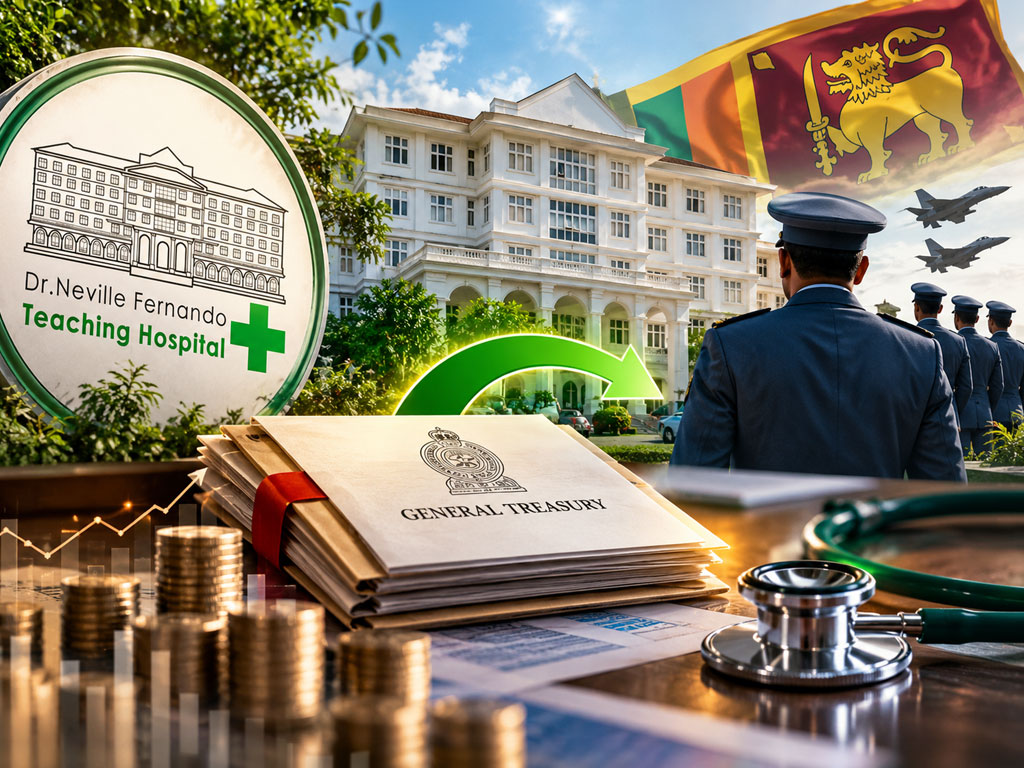
Neville Fernando Teaching Hospital will become Treasury-owned after years of state funding, reviving questions over billions spent before full ownership.
COLOMBO — The Government’s decision to take full ownership of the Dr. Neville Fernando Teaching Hospital (NFTH) has brought renewed attention to billions of rupees in public expenditure on the Malabe facility during years in which its ownership remained unresolved.
Cabinet approved a new structure on September 22 under which the hospital and its assets will be transferred to a company wholly owned by the General Treasury. The Sri Lanka Air Force will assume responsibility for administration and day-to-day operations.
Under the approved framework, an 11-member Board of Directors will be appointed by the Secretary to the Treasury on the recommendation of the Defence Secretary.
The Treasury is expected to finance staff salaries and operational expenses from 2026 to 2028, after which the hospital is intended to operate on a self-financing basis. Both free and fee-paying inpatient and outpatient services are planned, while the Health Ministry will provide medicines, medical supplies and other consumables for free healthcare services at an estimated annual cost of Rs. 125 million.
The latest decision provides a clearer ownership structure after years of uncertainty surrounding a hospital that has received substantial state funding since its administration was transferred to the Health Ministry in 2017.
It also revives a central accountability question: how much public money was committed to NFTH before the State secured full ownership of the hospital and its assets?

From SAITM Hospital to State Administration
NFTH began operating in Malabe in 2013 as the teaching hospital associated with the South Asian Institute of Technology and Medicine (SAITM).
SAITM’s medical programme subsequently became the subject of a prolonged national dispute involving students, medical professionals, regulators and successive governments over standards, recognition and the future of private medical education.
Amid that controversy, the Government announced in 2017 that NFTH would be brought under state administration.
The hospital was ceremonially handed over on July 17, 2017, and its administrative operations were transferred to the Health Ministry with effect from August 1 following a Cabinet decision taken on June 27.
Yet the arrangement did not immediately give the Government unencumbered ownership of the facility.
A statement issued by NFTH at the time said mortgage rights would remain with the Bank of Ceylon until SAITM repaid outstanding loans over the following 10 years, after which ownership titles would vest with the Government.
The hospital’s land was owned by the Urban Development Authority and was to be subleased to the Health Ministry for a nominal annual rent.
Those arrangements later became the subject of scrutiny before a Presidential Commission of Inquiry.
The 10-Year Ownership Question
In 2019, then Health Secretary Wasantha Perera appeared before the Presidential Commission investigating alleged fraud and corruption at state institutions between January 2015 and December 2018.
The inquiry was examining a complaint over the use of public money to maintain NFTH despite questions about whether the hospital had been legally transferred to the Government.
Evidence presented to the Commission indicated that the relevant Cabinet paper provided for the hospital to remain under SAITM ownership for 10 years before it could be fully transferred to the State.
That produced an unusual arrangement: the Government was administering and financing a hospital whose final transfer of ownership had not yet been completed.
The issue remained unresolved years later. Reporting in 2021 indicated that the transfer of the hospital’s assets was still in progress.
This distinction between administration and ownership is important when examining the public expenditure that followed.
Billions in Public Money
The financial commitment was substantial.
Audit-related reporting has stated that approximately Rs. 2.18 billion was paid by the Health Ministry to NFTH without a formal agreement governing those payments.
Separate controversy surrounded the hospital’s Bank of Ceylon borrowing.
Contemporary statements from SAITM in 2017 said the institution had obtained a Rs. 2 billion loan for construction and equipment and was repaying approximately Rs. 500 million annually. Other subsequent accounts have cited different figures for the borrowing, making it unsafe to combine the loan and government expenditure into a single definitive taxpayer-loss figure without the underlying financial records.
State support nevertheless continued.
By December 2024, Health and Mass Media Minister Dr. Nalinda Jayatissa said the Government was spending approximately Rs. 40 million every month on NFTH staff salaries.
At the time, he said the Government did not intend to operate NFTH simply as a conventional state hospital and was considering a different model that could incorporate health tourism and other services.
That direction has now evolved into the Treasury-owned structure approved by Cabinet.
Treasury to Fund Hospital Until 2028
The September 2026 decision represents a significant change in the hospital’s governance.
Instead of continuing the previous administrative arrangement, NFTH and its assets are to be transferred to a state enterprise established under the Companies Act, with the Treasury owning 100% of its shares.
The Air Force will manage the institution’s administrative and operational functions.
Public financing will not end immediately.
Treasury funding will cover salaries and operational expenses between 2026 and 2028. The hospital is expected to become self-financing thereafter.
Government plans also envisage a mixed service model, with both free and fee-paying treatment.
For free services, the Health Ministry is expected to provide pharmaceuticals, medical supplies and other consumables valued at approximately Rs. 125 million annually.
The arrangement therefore establishes state ownership but also creates a new test: whether NFTH can move from recurring Treasury support towards the financially sustainable model envisaged by the Government.
SAITM Students Absorbed Into KDU
NFTH’s financial history cannot be separated from the wider SAITM crisis.
The dispute over SAITM left hundreds of medical students facing uncertainty about completing their education and obtaining recognised qualifications.
The Government eventually turned to General Sir John Kotelawala Defence University (KDU) as part of the solution.
KDU has confirmed that 864 civilian students registered for SAITM’s MBBS programme were absorbed into the university as the Government sought to resolve the national controversy.
That intervention addressed the students’ academic future, but the hospital itself remained a separate administrative and financial issue.
The Government continued operating NFTH while questions over its ownership structure, financing and long-term purpose persisted.
What Remains to Be Accounted For
Cabinet’s latest decision may finally resolve the ownership question, but it does not by itself settle the historical accounting.
A definitive assessment would require a consolidated record showing how much the Treasury and Health Ministry spent on NFTH from 2017 to 2026, including salaries, operational expenditure, capital expenditure, medical supplies and any payments connected with outstanding liabilities.
It would also require separating expenditure on healthcare delivered to the public from any amounts that could properly be classified as losses or payments benefiting private interests.
That distinction matters.
Billions of rupees in public expenditure do not automatically amount to billions of rupees “lost”, particularly where the hospital remained operational, employed staff and treated patients.
At the same time, the documented expenditure and prolonged uncertainty over legal ownership raise legitimate questions about how the 2017 arrangement was structured, what financial safeguards were imposed and why full state ownership took years to resolve.
No evidence reviewed for this article establishes criminal wrongdoing by any individual involved in the arrangements.
Nor does the Cabinet’s 2026 decision identify any “perpetrators” or announce action against former officials.
If the Government intends to examine earlier decisions, that would require a separate audit, administrative inquiry or investigation capable of determining whether public funds were merely spent under an unusual ownership arrangement or whether any expenditure involved financial loss, misconduct or breaches of law.
For taxpayers, that accounting remains the unresolved part of the NFTH story.
The State may now be acquiring full ownership. The next question is whether it will establish, with equal clarity, precisely how much public money was spent during the nine years that preceded it.