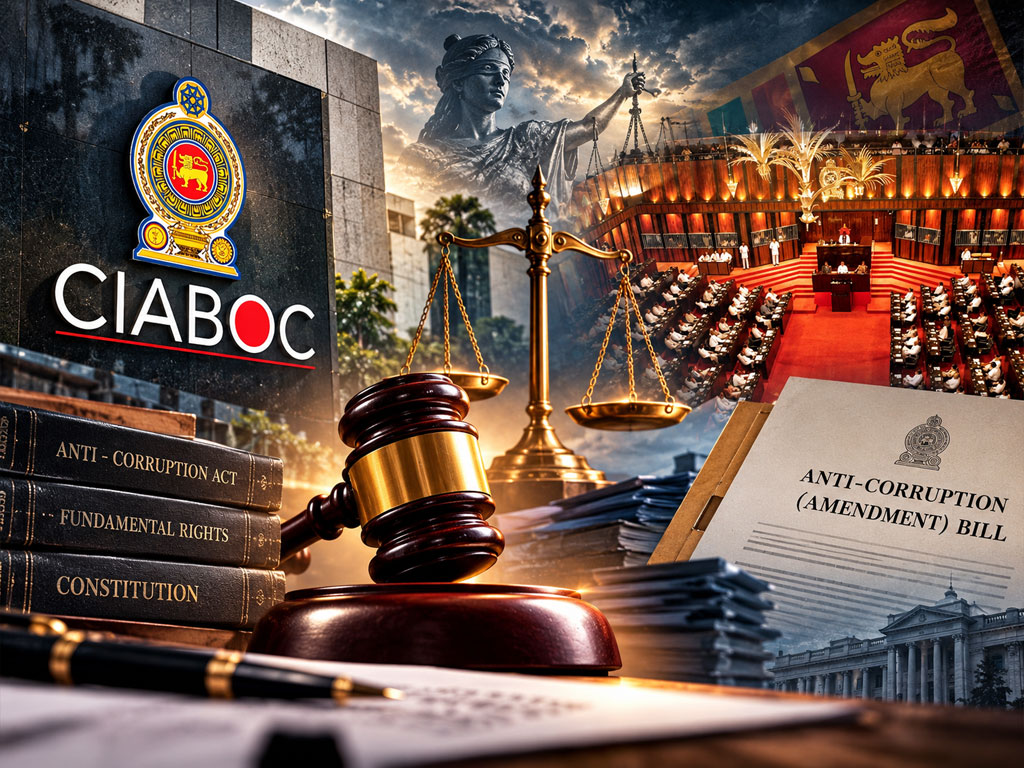
The Anti-Corruption Amendment Bill tests how far Sri Lanka can strengthen investigators without weakening judicial oversight and fundamental rights.
Sri Lanka’s attempt to strengthen the Commission to Investigate Allegations of Bribery or Corruption has exposed a fundamental constitutional question: how much power should an anti-corruption agency possess before investigative authority begins to intrude on judicial power?
That question lies at the heart of the Supreme Court’s determination on the Anti-Corruption (Amendment) Bill, announced to Parliament by Speaker Dr. Jagath Wickramaratne on September 22.
The Bill, published in the Gazette on July 27 and placed on Parliament’s Order Paper on August 19, proposed substantial changes to the Anti-Corruption Act No. 9 of 2023.

Fifteen petitions were filed challenging its constitutionality. Petitioners included Transparency International Sri Lanka (TISL), the Centre for Policy Alternatives (CPA), former Minister Prof. G.L. Peiris and media-related organisations. The Supreme Court heard arguments before a three-judge bench comprising Justices Shiran Gooneratne, Mahinda Samayawardhena and Sampath Wijeratne.
At the centre of the dispute were proposed changes affecting bail and the authority exercised by the Director General of the Bribery Commission.
The wider debate, however, extends beyond one clause. Sri Lanka faces the difficult task of giving investigators sufficient authority to pursue sophisticated financial crime while preserving constitutional safeguards over personal liberty and judicial independence.
Why Stronger Investigative Powers Are Attractive
There is a practical argument for giving anti-corruption investigators substantial powers.
Complex corruption cases rarely resemble conventional crimes. Money may pass through companies, nominees, bank accounts and multiple jurisdictions. Assets can be transferred quickly, documents destroyed and witnesses potentially influenced.
Investigators therefore need the ability to secure evidence, trace financial transactions and prevent suspects from frustrating legitimate investigations.
Speed also matters.
Lengthy proceedings and repeated delays can weaken complex financial investigations. By the time investigators obtain access to relevant evidence, money may have moved and documentary trails may have become harder to reconstruct.
That explains why anti-corruption agencies internationally are often granted powers beyond those available to ordinary administrative bodies.
The constitutional question is not whether those agencies should be powerful.
It is which powers should remain subject to independent judicial control.
Supreme Court Scrutiny of Bail Provisions
Petitioners challenging the Bill focused heavily on the proposed changes to bail.
TISL argued that the amendment seeking to repeal and replace Section 149 of the existing Act would effectively make remand the norm and bail the exception. It contended that the provision was vague, excessively broad and insufficiently constrained by safeguards.
CPA separately challenged Clauses 11 and 17, arguing that provisions of the Bill were inconsistent with constitutional protections, including Articles 3, 4, 10, 12, 13, 14A and 14(1)(a). It asked the Supreme Court to determine that the relevant provisions required approval by the people at a referendum.
The Supreme Court proceedings therefore placed the separation between investigative and judicial authority squarely before the country’s highest court.
This distinction is particularly important where personal liberty is involved.
An investigative agency necessarily forms a view about whether a suspect may have committed an offence. A court performs a different function. It independently assesses whether the legal requirements for detention, bail and other restrictions on liberty have been satisfied.
Giving an investigator greater authority to investigate corruption is consequently different from transferring to that investigator a function traditionally exercised by a judge.
Asset Declarations Also Came Under Challenge
Bail was not the only controversial feature of the amendments.
TISL challenged several other provisions, including restrictions on how redacted asset declarations could be used by members of the public.
According to the organisation, the proposed legislation could criminalise uses of publicly obtained asset declaration information outside specified statutory purposes, with penalties including a fine of up to Rs. 100,000, imprisonment for up to one year, or both. TISL argued that this could have a chilling effect on journalism, civic scrutiny and freedom of expression.
Other proposed changes attracted criticism over their potential effect on the scope of asset declarations and public accountability.
Those objections illustrate the broader challenge confronting legislators.
Anti-corruption legislation must protect investigations from interference, but it also determines how much information citizens, journalists and civil society organisations can use to scrutinise public officials.
Strengthening one side of that equation can weaken another if safeguards are not carefully designed.
What Other Anti-Corruption Agencies Can Do
International comparisons provide useful context, although there is no single model followed by every jurisdiction.
Singapore’s Corrupt Practices Investigation Bureau, for example, has substantial investigative authority. Under Singapore’s Prevention of Corruption Act, CPIB officers can arrest suspects, search premises and seize evidence without a warrant where the statutory requirements are met.
That demonstrates that effective anti-corruption systems can give investigators unusually strong operational powers.
Hong Kong provides another instructive example, but its framework is more nuanced than simply separating every detention decision from the anti-corruption agency.
The Independent Commission Against Corruption has statutory powers of arrest, detention and bail. Hong Kong’s ICAC says an arrested person may be detained for up to 48 hours for further investigation, and the agency may itself grant bail under the relevant provisions of the ICAC Ordinance.
Its anti-corruption legislation also provides extensive powers to examine financial transactions, require information about assets and income, restrain property and detain travel documents.
The lesson from Hong Kong is therefore not that an anti-corruption agency can never exercise powers touching on detention or bail.
Rather, such powers depend on the precise statutory framework, their duration, safeguards and the availability of judicial supervision.
Strong Investigators and Independent Courts Are Not Opposites
The international experience points towards an important distinction.
Effective anti-corruption enforcement can require intrusive investigative powers. Authorities may need rapid access to financial records, the ability to preserve assets, powers of arrest and mechanisms preventing suspects from fleeing a jurisdiction.
Those powers do not necessarily require removing courts from decisions affecting prolonged detention or other substantial restrictions on liberty.
This is where the Sri Lankan debate becomes particularly significant.
Supporters of stronger enforcement can reasonably argue that conventional procedures sometimes make complicated corruption investigations slower and more difficult.
Civil liberties advocates can equally point to the danger of allowing an executive investigative official to determine whether someone remains deprived of liberty.
Both concerns can exist simultaneously.
The challenge for Parliament is to construct a framework that allows investigators to act quickly without eliminating the independent institution responsible for deciding whether the State has sufficient legal grounds to continue restricting an individual’s freedom.
The Constitutional Boundary
Sri Lanka’s Constitution makes that boundary especially important because judicial power and personal liberty are not merely questions of administrative efficiency.
They form part of the constitutional structure governing how state power may be exercised.
The Supreme Court determination therefore should not be understood as answering whether Sri Lanka needs stronger anti-corruption enforcement. The more precise issue is whether particular mechanisms chosen by Parliament comply with constitutional limits.
Fifteen petitioners challenged the Bill before the Court, and Parliament’s official business record confirms that the Speaker announced the Supreme Court determination on the Anti-Corruption (Amendment) Bill on September 22.
The proceedings themselves demonstrate the constitutional checks built into the legislative process: Parliament may propose legislation, affected parties may challenge its constitutionality, and the Supreme Court determines whether particular provisions can be enacted through the proposed legislative procedure.
Fighting Corruption Without Weakening Safeguards
Sri Lanka’s corruption problem creates understandable pressure for tougher enforcement.
Yet the strength of an anti-corruption system cannot be measured solely by how easily investigators can arrest, detain or prosecute suspects.
It also depends on whether investigations withstand judicial scrutiny, evidence is lawfully obtained, defendants receive due process and prosecutions ultimately produce sustainable outcomes in court.
International models show that strong anti-corruption agencies and meaningful legal safeguards can coexist. They also show considerable variation in where individual countries draw the boundary.
For Sri Lanka, the policy question is therefore not a choice between fighting corruption and protecting constitutional rights.
It is how to do both.
As Parliament considers the future of the Anti-Corruption (Amendment) Bill following the Supreme Court’s determination, the next test will be whether legislators can strengthen CIABOC’s ability to investigate sophisticated financial crime while keeping decisions that fundamentally affect personal liberty within constitutionally permissible limits.