
The Port City director appointment faces scrutiny over recruitment qualifications and claims that commercial and legal functions have been combined.
Questions have emerged over the appointment of Radhika Obeysekera as Director, Commercial and Operations of the Colombo Port City Economic Commission (CPCEC), with concerns focusing on whether her qualifications met the requirements advertised for the post and claims that she has subsequently assumed legal responsibilities within the Commission.
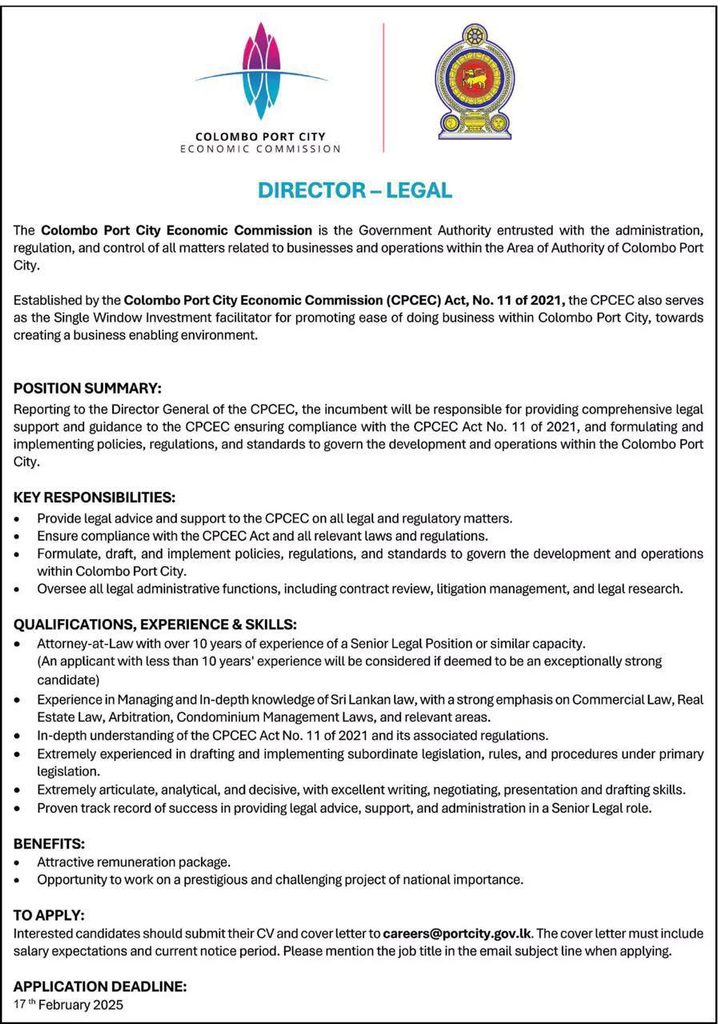
The controversy centres on a recruitment notice issued by the CPCEC in February 2025.
For the position of Director, Commercial and Operations, the Commission stipulated a master’s degree in business administration or an equivalent qualification, together with a minimum of 10 years’ experience leading commercial operations at a strategic or senior level in a similar capacity.
The advertisement also required a proven record of achieving commercial and operational objectives, leadership and communication skills, knowledge of commercial and operational best practices, and the ability to develop and implement commercial strategies.
Questions have now been raised over whether Obeysekera’s academic and professional background satisfied those criteria at the time of her appointment.

Qualifications Under Scrutiny
The material supplied to The Morning Telegraph states that Obeysekera holds an LLB from the University of London and a diploma in marketing. It questions whether those qualifications satisfy the master’s degree or equivalent requirement specified in the Commission’s recruitment notice.
The Morning Telegraph has not independently verified a complete record of Obeysekera’s academic qualifications and therefore cannot conclude from the material presently available that she failed to meet the advertised criteria.
Her professional background also requires context.
Before joining the Commission in her present capacity, Obeysekera had worked in investment promotion and marketing connected with Port City Colombo. Public reporting from December 2023 identified her as CHEC Port City Colombo’s Director of Investment Promotions and Marketing.
The recruitment notice for the Commission position, however, specifically required at least 10 years of experience leading commercial operations at a strategic or senior level in a similar capacity.
Whether the Commission regarded Obeysekera’s previous professional experience and qualifications as equivalent to those requirements, and on what basis, is therefore central to the questions now being raised.
Legal Director Position Also Questioned
Separate concerns surround the Commission’s legal function.
Applications were called in February 2025 for both Director, Commercial and Operations and Director Legal, with the same closing date of February 17.
According to the source material, the Director Legal position subsequently remained vacant for an extended period, while Obeysekera was assigned responsibilities associated with the legal division.
A recent report has similarly alleged that she is discharging duties associated with the Director Legal position despite having been recruited for the commercial and operations role.
That distinction matters because the two positions were advertised separately and carried different responsibilities and qualification requirements.
The previous Director Legal and Corporate Affairs, Vindhya Weerasekera, had publicly represented the Commission in that capacity before the 2025 recruitment exercise.
The source material describes her as having 26 years of senior legal experience and a master’s degree in international trade law. Those particular qualifications have not been independently verified by The Morning Telegraph.
Questions are consequently being raised about why a permanent Legal Director was not appointed and what formal authority governs the current allocation of the Commission’s legal responsibilities.
Concerns Over Commercial and Legal Oversight
The source submission goes further, arguing that combining commercial and legal responsibilities creates a potential governance problem.
Commercial decisions within Port City can involve investment, leases, operational matters and relationships with investors. Legal functions, by contrast, may involve regulatory compliance, legal advice and scrutiny of those decisions.
An independent legal function can therefore provide an important layer of institutional oversight.
The source alleges that placing both areas under the authority of the same officer could weaken that separation.
No evidence provided to The Morning Telegraph establishes that Obeysekera has improperly approved her own commercial decisions or that any particular transaction has been unlawfully authorised.
The governance question is narrower: whether the Commission has maintained adequate separation between its commercial decision-making and legal oversight functions, and whether the current arrangement complies with its approved administrative structure.
Those are questions the CPCEC can clarify by disclosing the formal delegation of responsibilities, the recruitment criteria applied to the appointment and the present status of the Director Legal position.
Rasamanickam Raises Port City Issues in Parliament
Port City governance has also been raised in Parliament by Opposition MP Shanakiyan Rajaputhiran Rasamanickam.
Official parliamentary records confirm that Rasamanickam raised a question under Standing Order 27(2) in July concerning “issues regarding Port City”.
A government response was subsequently delivered in Parliament on behalf of the Minister of Finance, Planning and Economic Development.
The source material for this article says Rasamanickam also questioned the absence of proper legal supervision at the Commission and raised concerns about remuneration and the disclosure of individual salary information.
Those more specific assertions require the relevant parliamentary transcript or official response before they can be reproduced as established parliamentary findings.
Questions surrounding remuneration should likewise be distinguished from evidence of wrongdoing. A refusal or failure to disclose individual salary information does not, by itself, establish financial misconduct.
What can legitimately be asked is what disclosure obligations apply to the Commission and whether its remuneration arrangements are subject to the appropriate statutory, audit and parliamentary oversight mechanisms.
Port City Is Governed by Sri Lankan Law
The controversy has also revived politically charged claims that Colombo Port City operates as a “separate state”.
Legally, it does not.
The Colombo Port City Economic Commission was established under Act No. 11 of 2021 as the authority responsible for administering, regulating and controlling business and operations within the Colombo Port City Area of Authority.
The Commission’s broad statutory powers and special regulatory framework have long generated debate about transparency, accountability and oversight.
Those debates should not be confused with the proposition that Port City lies outside Sri Lankan sovereignty or that Sri Lankan law does not apply there.
The relevant question is whether appointments and administrative arrangements within the Commission comply with the legislation, recruitment procedures and governance standards applicable to it.
Questions the Commission Can Answer
The controversy can be substantially clarified through disclosure of a relatively straightforward set of facts.
First, what academic qualifications and professional experience were accepted when Obeysekera was appointed Director, Commercial and Operations?
Second, did the Commission determine that those qualifications constituted an equivalent to the master’s degree specified in the advertisement, and if so, on what basis?
Third, what is the current status of the Director Legal position?
Fourth, has Obeysekera formally been delegated legal responsibilities, and what is the legal or administrative instrument authorising that arrangement?
Finally, what safeguards exist to ensure independent legal scrutiny of commercial decisions taken by the Commission?
Until those questions are answered, it would be premature to describe the appointment as fraudulent, corrupt or illegal.
The discrepancy being alleged between the advertised criteria and the appointment nevertheless warrants a clear response from the CPCEC, particularly given the scale of investment and regulatory authority entrusted to the Commission.
Disclosure of the recruitment decision, the qualifications accepted and the formal allocation of legal responsibilities would provide the clearest means of resolving the controversy.
SOURCE:- HARI DESHAYA