
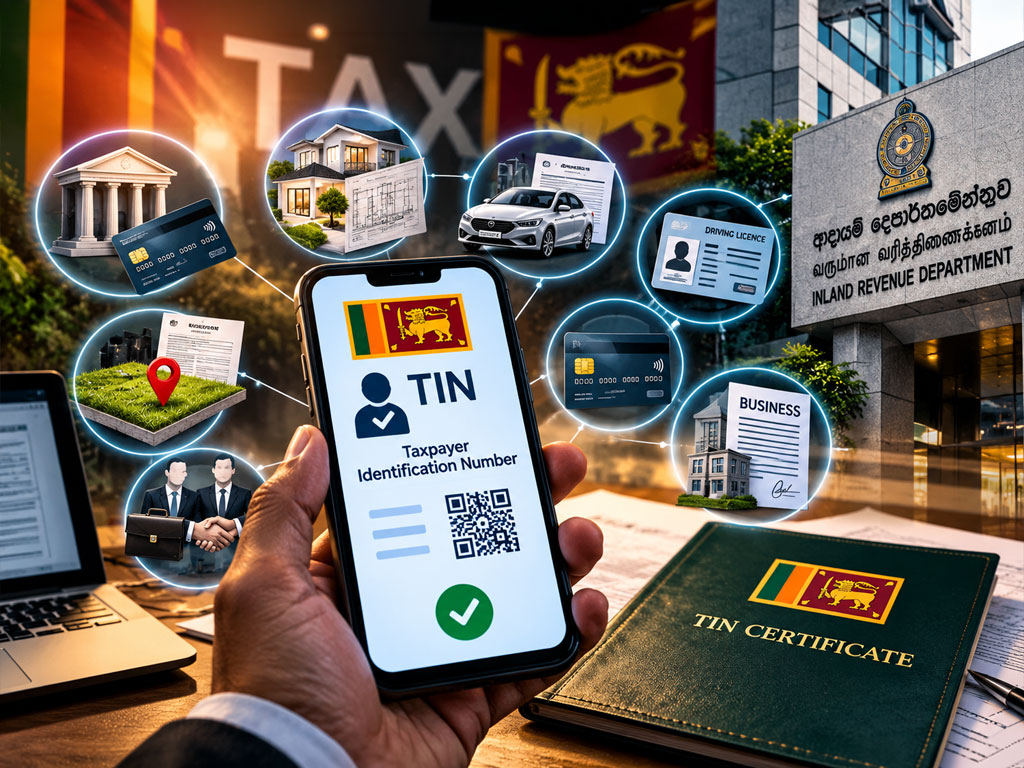
A TIN certificate in Sri Lanka becomes mandatory for eight key transactions from November 1, including bank accounts, vehicles and land.
COLOMBO — Sri Lankans who need to open a bank account, obtain a credit card, register land or complete several other specified transactions will have to produce a valid Taxpayer Identification Number certificate from November 1, 2026.
The Inland Revenue Department (IRD) has announced that the requirement will apply to eight financial, property, business and administrative transactions under provisions introduced through the Inland Revenue (Amendment) Act, No. 11 of 2026.
Officials responsible for processing these transactions have been instructed to ensure that the individual concerned submits a valid TIN Certificate before the transaction is processed or completed.

Who Must Obtain a TIN?
Obtaining a Taxpayer Identification Number, commonly known as a TIN, is already mandatory for resident individuals who were aged 18 or above as of December 31, 2023.
The requirement also applies to resident individuals who turn 18 on or after January 1, 2024, once they reach that age.
This requirement stems from Extraordinary Gazette Notification No. 2334/21 of May 31, 2023, issued under Section 102(3) of the Inland Revenue Act, No. 24 of 2017, as amended.
The November 1 change goes a step further. Individuals covered by the law will need to produce a valid TIN Certificate when carrying out specified transactions.
Eight Transactions Requiring a TIN From November 1
From November 1, 2026, a valid TIN Certificate must be submitted for the following:
- Opening an account at a bank or financial institution
- Obtaining approval for a building plan
- Registering a motor vehicle
- Renewing a motor vehicle license
- Registering land or title to land
- Registering a business
- Transferring shares in a company incorporated in Sri Lanka, with the requirement applying to both the transferor and transferee
- Obtaining a credit card
The requirement means the relevant institution or responsible officer must ensure that a valid TIN Certificate has been submitted before processing or completing one of these transactions.
It does not mean that every government, banking or commercial transaction in Sri Lanka will require a TIN Certificate from November 1. The requirement applies to the transactions specified by the IRD.
What Should You Do Before November 1?
Anyone planning to carry out one of the eight specified transactions who does not already have a TIN should obtain one through the Inland Revenue Department.
Applications can be submitted online through the IRD’s e-Services platform.
People who have already registered for a TIN should ensure that their number is valid and that they have access to their TIN Certificate before approaching the relevant bank, financial institution, government office or other responsible authority.
The IRD also provides an online facility through which individuals can verify their TIN.
- If you have not already obtained a TIN number, obtain a TIN number.
This can be applied for through the Inland Revenue Department’s e-service: access here. - Confirm that you have a valid TIN certificate.
To verify the TIN number: access here.
Importantly, the Commissioner General of Inland Revenue has clarified that a person who does not have the formal certificate may use a printout of the successful online verification result, provided it clearly displays both the person’s National Identity Card number and TIN. That printout can be accepted as an alternative to the official TIN Certificate for the specified transactions.
Having a TIN Does Not Automatically Mean Paying Tax
A Taxpayer Identification Number is an identification number used by the Inland Revenue Department for tax administration.
The requirement for resident adults to obtain a TIN should therefore not be confused with a declaration that every TIN holder automatically has an income-tax liability.
Whether an individual is liable to pay a particular tax depends on the applicable tax law and that person’s circumstances.
For those planning to open a bank account, apply for a credit card, register a vehicle, deal with land, register a business, obtain building-plan approval or transfer company shares, however, the practical deadline is clear: from November 1, the relevant transaction cannot be processed or completed without submission of a valid TIN Certificate or an accepted verification document.




I don’t have a tin number. How do i get one. More over i am a dependent now i have no permanent income
I don’t have a tin number. How do i get one. More over i am a dependent now i have no permanent income
My phone nbrs are 0777707143
And 0777341777