By Roy Denish
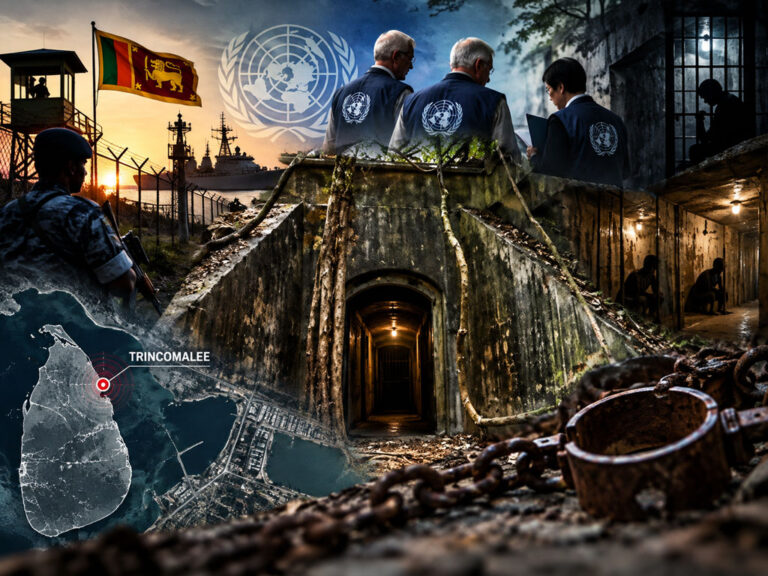
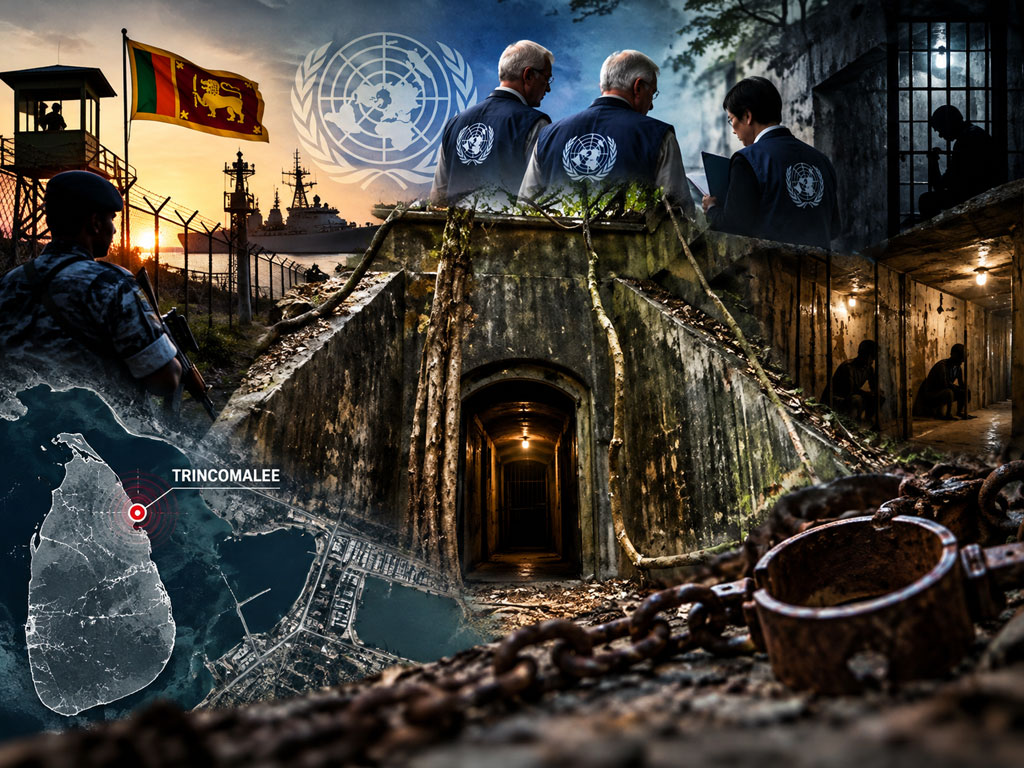
When we, as a three-member delegation of the United Nations Working Group on Enforced or Involuntary Disappearances, inspected the sprawling Trincomalee Naval Base, we uncovered direct physical evidence of the clandestine operations housed within the Gunsite underground bunker complex.
Accompanied by senior law enforcement officials, we focused our inspection on an underground installation composed of twelve concrete cells converted from colonial-era munitions storage bunkers cut deep into a hilltop.

Inside these pitch-black, sunless chambers, we identified clear physical indicators of systematic human rights abuses, including visible bloodstains and structural modifications designed for prolonged unlawful detention.
Wall inscriptions and scratch marks we documented suggested that the facility remained actively managed and utilized for detaining individuals well past the conclusion of the civil war.
We concluded that the site functioned as a systematic torture and interrogation center where victims abducted by intelligence-linked factions were subjected to severe physical violence, psychological trauma, and enforced disappearances without legal record.
We, the visiting experts consisting of Ariel Dulitzky, Bernard Duhaime, and Tae-Ung Baik, noted that while the visible structure contained only a dozen individual cells, the cumulative impact of testimonies and logistical footprints suggested that scores of victims had cycled through the black site over the years.
Former detainees and confidential informants recounted to us harrowing narratives of intense interrogation, physical beatings, and extortion schemes where families were forced to pay exorbitant ransoms under the threat of permanent disappearance.
We emphasized that a clandestine facility of this magnitude, located deep within a high-security military zone, could not have operated without the tacit knowledge or complicity of broader administrative structures.
Consequently, in our comprehensive evaluation, we urged state authorities to launch transparent, unhindered judicial inquiries, dismantle lingering cultures of impunity, preserve forensic integrity across all suspected mass graves and underground facilities, and ensure absolute accountability for the victims and families who spent decades searching for the truth behind these wartime atrocities.