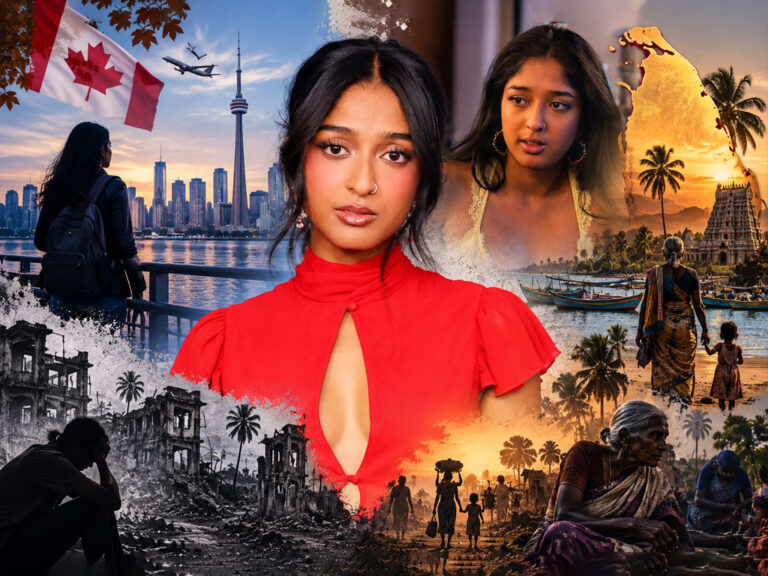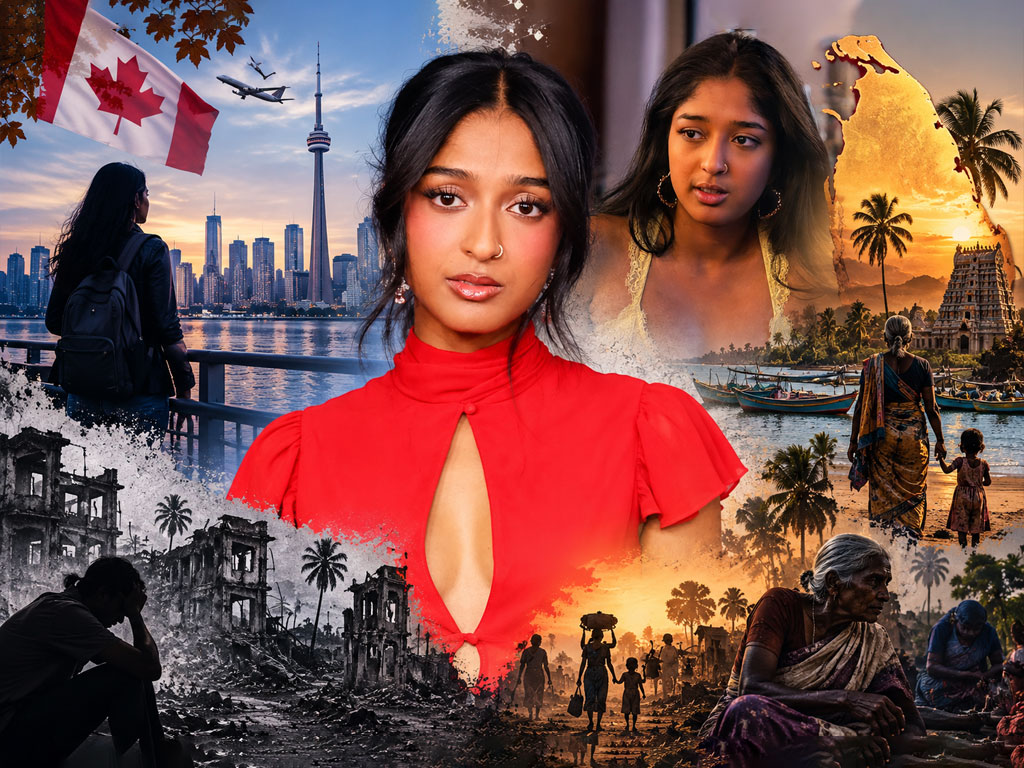
Maitreyi Ramakrishnan Tamil identity remarks prompt a wider examination of diaspora politics, wartime trauma and economic hardship in Sri Lanka’s North.
“The past is never dead. It’s not even past.”
— William Faulkner
“Identity is not a mirror showing us who we truly are, but an ideological veil that conceals the real contradictions and tragedies existing in society.”
— Slavoj Žižek
Canadian Tamil actress Maitreyi Ramakrishnan’s recent expressions of pride in her Eelam Tamil identity have revived a difficult question in Sri Lanka’s post-war political discourse: how should cultural identity be understood alongside the economic hardship and psychological suffering that continue to shape life in the country’s North?
Ramakrishnan, whose parents fled Sri Lanka’s civil war, has consistently distinguished her Canadian nationality from her Tamil cultural identity.

In a 2019 interview with Toronto’s NOW magazine, she explained:
“My identity is not being Sri Lankan. It is not my country. My country is Canada. But my culture is definitely Tamil culture.”
More recently, in an interview involving comedian Hasan Minhaj, she described herself as a proud Eelam Tamil woman, while also declaring, “I am Tamil as f***.”
Her commitment to that identity extended into the Netflix film Best of the Best, where she advocated dialogue identifying her character as Tamil while acknowledging her family’s Sri Lankan origins.
These statements can be understood as expressions of cultural belonging shaped by displacement. They also invite a broader political and philosophical examination of what identity represents when viewed from the relative security of Western society.
Within capitalist consumer culture, identity can acquire symbolic and commercial value. Cultural belonging may become part of an individual’s public image, particularly in entertainment industries where representation carries considerable significance.
That does not invalidate Ramakrishnan’s identity or her family’s history. It does, however, raise a question about the distance between diaspora representation and the everyday conditions confronting communities in Sri Lanka’s former conflict areas.
Beyond Identity: The Economic Reality of the North
For many residents of the Northern Province, the consequences of war extend far beyond questions of cultural recognition.
University of Jaffna academic Dr. Ahilan Kadirgamar has examined the economic vulnerabilities of post-war communities, including rural indebtedness and the consequences of microfinance lending.
The original analysis refers to approximately 240,000 female-headed households affected by the war, particularly families that lost male breadwinners. That figure requires confirmation of its geographical coverage and the period to which it applies.
For households struggling with debt, insecure livelihoods and limited access to financial assistance, cultural recognition alone cannot resolve immediate economic pressures.
The contrast is particularly visible between internationally prominent diaspora figures and rural families whose circumstances may be shaped by debt obligations rather than access to overseas remittances.
From a political-economic perspective, celebrating identity without confronting these material conditions risks overlooking the social inequalities that persist beneath public discussions of belonging.
The psychological consequences of conflict are equally important.
Psychiatrist Professor Daya Somasundaram has written extensively about collective trauma and the effects of prolonged violence on communities, families and social relationships.
Sri Lanka’s civil war left lasting psychological and social injuries. Those experiences cannot be reduced to a single diagnosis or assumed to affect every survivor in the same way.
Nevertheless, economic insecurity, disrupted relationships and unresolved wartime experiences remain important considerations in understanding post-war recovery.
Rajani Thiranagama and the Difficult History Within
The book The Broken Palmyra, written by academics associated with the University of Jaffna, offers another perspective on the conflict’s devastating consequences.
Among its authors was Dr. Rajani Thiranagama, whose work examined violence, authoritarianism and the suffering of civilians, including abuses committed within Tamil militant movements.
The original commentary attributes the following words to her:
“The depression that cripples us is not caused only by the violence and authoritarianism that came from outside; even more than that, it is the destructive violence born from within the womb of our own society.”
The wording requires verification against the published text before it can be treated as a confirmed direct quotation.
Thiranagama was assassinated in 1989. Her killing remains central to discussions of political violence and the suppression of dissent during the conflict.
Her work challenged attempts to understand the war exclusively through violence inflicted by external forces. It also examined coercion and abuses within the communities and political movements claiming to represent Tamil interests.
Acknowledging those internal tragedies does not diminish the suffering caused by state violence or the experiences of displaced Tamil families. Rather, it requires a historical account capable of examining abuses by different actors without overlooking their victims.
What Should Tomorrow’s Tamil Identity Represent?
Ramakrishnan’s public statements reflect an identity formed through family history, migration and cultural continuity.
For many members of the Tamil diaspora, such expressions are connected to displacement and the experience of belonging to a community whose history extends beyond national borders.
Yet recognition of that history need not exclude scrutiny of economic inequality, political authoritarianism or the social conditions facing people who remained in Sri Lanka.
The central challenge is to connect cultural identity with the practical demands of post-war recovery.
That includes addressing indebtedness, strengthening livelihoods, recognising psychological trauma and creating space for historical reflection without denying the experiences of others.
An identity that brings pride to one community may also carry painful associations for another. Reconciliation requires room for those different experiences rather than an expectation that everyone interpret the past identically.
Tomorrow’s Maitreyi Ramakrishnans, whether in Sri Lanka or abroad, will inherit a history shaped by displacement, conflict and competing memories.
The question is whether future discussions of identity can also make space for economic security, intellectual freedom and the everyday needs of those still living with the consequences of war.