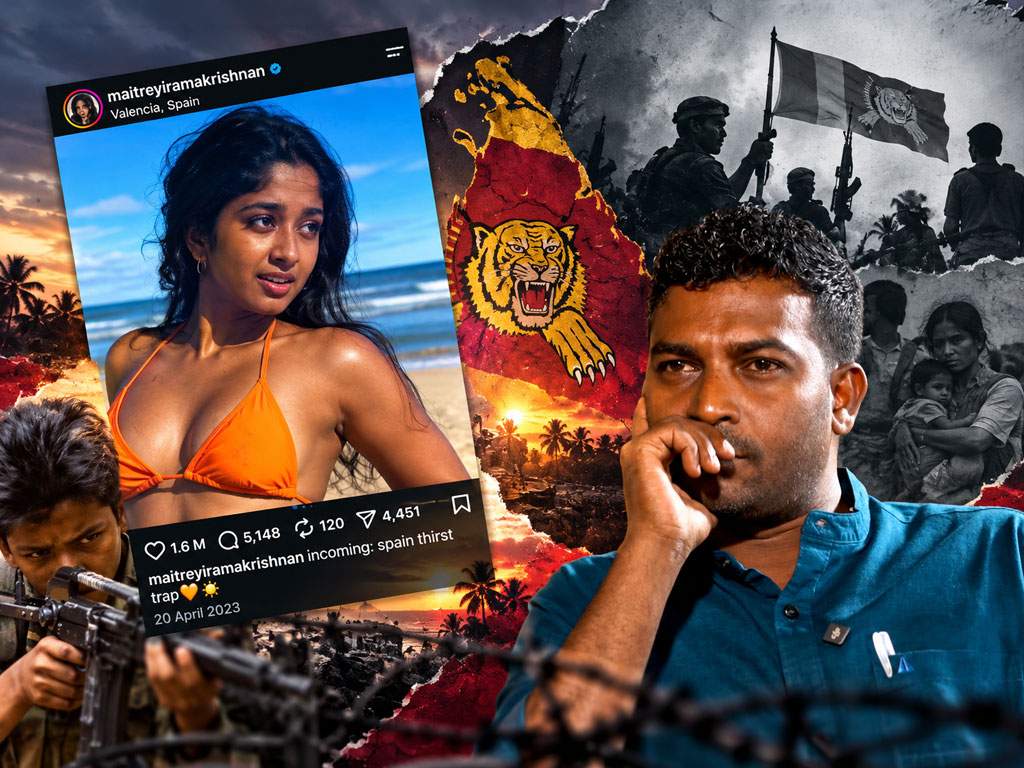
Maitreyi Ramakrishnan’s Tamil Eelam remarks draw criticism from activist Arun Siddharth, who says the LTTE-era experience should not be romanticized.
Sri Lankan social activist Arun Siddharth has criticised Canadian actress Maitreyi Ramakrishnan over her public identification as a “Tamil Eelam woman”, arguing that discussion of the identity should not overlook the experiences of Tamil civilians who lived under the Liberation Tigers of Tamil Eelam (LTTE).
Siddharth’s intervention follows remarks by Ramakrishnan in which she spoke about her Tamil identity, her family and cultural history, while acknowledging that she does not speak Tamil fluently.
“I don’t speak Tamil fluently, but I love who I am as a Tamil Eelam woman. I love my family and my cultural history,” Ramakrishnan said.
Her remarks have generated sharply contrasting reactions online. Some critics have challenged her use of the term “Tamil Eelam”, while Tamil organisations and supporters have defended her right to identify as Eelam Tamil.
Siddharth’s criticism goes further, drawing a distinction between celebrating Tamil cultural identity and, in his view, romanticising the political and social order that existed in areas controlled by the LTTE.

Siddharth Points to Life Under LTTE Control
In a note addressed to Ramakrishnan, Siddharth contrasted the actress’s freedom of personal expression with what he described as restrictions experienced by women living under LTTE control during Sri Lanka’s civil conflict.
“If you had actually lived under the rule of the LTTE, you would have been shot dead for photographs like the ones you have posted on Instagram,” Siddharth wrote.
He referred specifically to photographs in which Ramakrishnan appears in a bikini, as well as publicly shared kissing photographs and videos. According to Siddharth, such forms of personal expression would not have been accepted under what he described as the LTTE’s strict social and moral rules.
His claims about the consequences Ramakrishnan would hypothetically have faced represent Siddharth’s account and argument; the source material does not independently establish that a person would necessarily have been killed for such photographs.
Siddharth nevertheless maintains that women living in LTTE-controlled areas did not enjoy the same freedom to dress or express themselves publicly and that those experiences should form part of any discussion about the history associated with “Tamil Eelam”.
“The irony is that you say you love Tamil Eelam while you cannot even speak Tamil fluently,” he wrote.
His argument distinguishes between pride in Tamil ethnicity, family and culture and support for, or romanticisation of, the LTTE and its former administration.
‘Tamil Eelam’ Identity at the Centre of Wider Debate
Ramakrishnan’s identification as Eelam Tamil is not new.
The Canadian actress, whose parents left Sri Lanka during the civil conflict, has previously spoken publicly about her Eelam Tamil heritage. In a 2023 conversation published by Vogue India, she and musician Priya Ragu discussed their shared Eelam Tamil background.
More recently, while promoting her film “Best of the Best”, Ramakrishnan again spoke about her identity and said she did not consider an inability to speak Tamil fluently to diminish her connection to Tamil culture.
Her remarks have since become the subject of a broader and increasingly contentious debate about identity, diaspora experience and Sri Lanka’s conflict-era history.
Supporters of Ramakrishnan have argued that identifying as Eelam Tamil should not automatically be interpreted as an endorsement of the LTTE. Tamil student organisations in Britain and Canada have publicly defended her identification and her right to describe herself on her own terms.
That distinction is important. Ramakrishnan’s statement quoted in the source expresses pride in being a “Tamil Eelam woman”, her family and cultural history; it does not, by itself, state support for the LTTE.
Siddharth’s argument, by contrast, is that references to Tamil Eelam should not become detached from the experiences of civilians who lived in territory administered by the organisation.
Activist Invokes War and Personal Freedom
Siddharth also invoked American writer Henry Miller in making his case, quoting the line: “Everybody says sex is obscene. The only true obscenity is war.”
He used the quotation to draw a contrast between what he characterised as restrictions on personal expression under the LTTE and the organisation’s pursuit of armed conflict.
The LTTE fought for an independent Tamil state in Sri Lanka’s north and east during the country’s decades-long civil conflict. Its conventional military forces were defeated by the Sri Lankan armed forces in May 2009.
The organisation has been designated or proscribed as a terrorist organisation in a number of jurisdictions. The United States designated the LTTE as a Foreign Terrorist Organization in 1997, while the United Kingdom proscribed it in 2001.
Siddharth urged Ramakrishnan to examine what he regards as the lived social realities of the period rather than what he described as a romanticised version of Tamil Eelam.
“You can be proud of being Tamil. You can love your family. You can celebrate your cultural heritage,” he wrote. “But you should not romanticise a terrorist regime and erase the suffering and restrictions experienced by the very Tamil people who lived under it.”
Siddharth framed his criticism as being informed by personal experience, describing himself as a Sri Lankan Tamil who lived through the period and witnessed what he regards as its realities.
His intervention ultimately rests on a distinction between cultural and ethnic identity, which he says should be freely celebrated, and the political legacy of the LTTE, which he argues should not be separated from the experiences of civilians who lived under its authority.
The wider debate surrounding Ramakrishnan’s comments, however, demonstrates that the terms “Eelam Tamil” and “Tamil Eelam” carry different cultural, historical and political meanings for different participants. Her statement of identity should therefore be distinguished from claims about support for the LTTE unless such support is independently established.