Easter Sunday mastermind claims remain contested after 15 convictions, as questions continue over evidence, intelligence failures and accountability.
A massacre became a political battleground, and seven years later the argument over whether a hidden hand stood behind the Easter Sunday attacks remains unresolved.
Sri Lanka’s latest Easter Sunday verdict has established one important part of the criminal record. Fifteen of the 24 accused tried over the 2019 attacks were convicted, while nine were acquitted. The prosecution had brought 23,270 charges and called 2,309 witnesses during proceedings that lasted nearly five years.
That judgment does not, however, settle every question surrounding the attacks. Nor does it establish that allegations of a wider political conspiracy are either true or false.
What it does is sharpen a question that should apply equally to politicians, clergy, investigators, intelligence officials and commentators: what evidence supports each allegation?
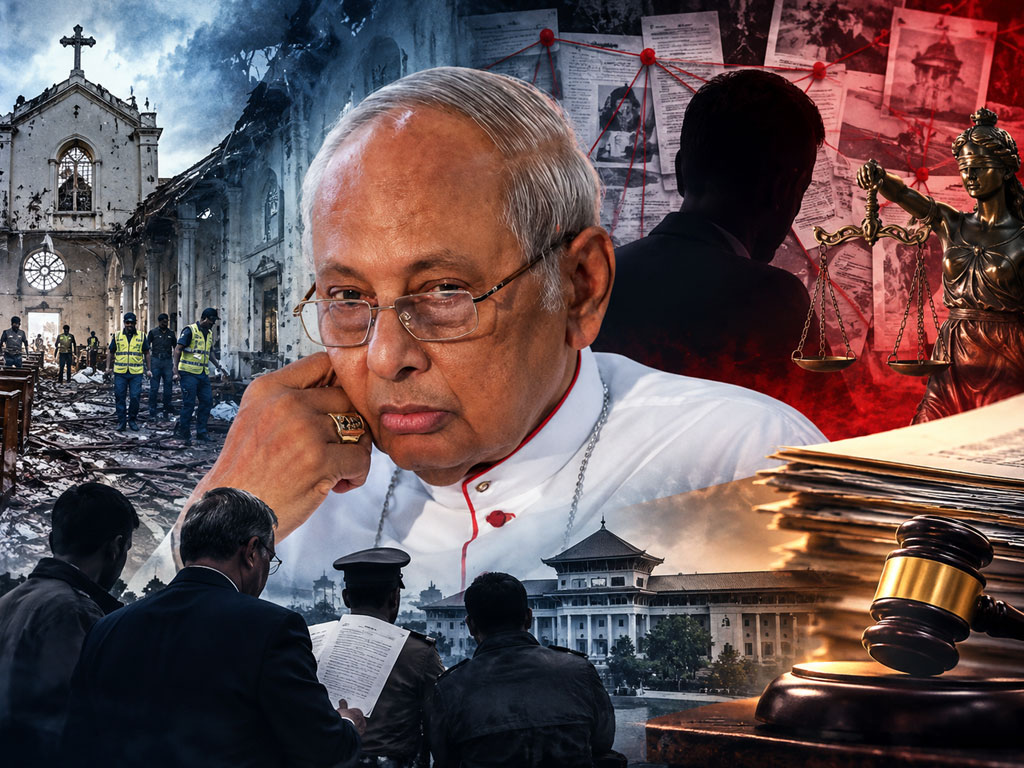
For years, Cardinal Malcolm Ranjith has been one of the country’s most prominent voices demanding further investigation. Addressing the United Nations Human Rights Council in 2022, he said subsequent investigations indicated that the massacre was part of a “grand political plot”.
That was a serious claim. It is also one that requires serious evidence.
If there are documents, communications, financial records, witnesses or operational links establishing a wider conspiracy, those materials should be tested by investigators and, where appropriate, by a court. Repetition alone cannot establish a criminal connection.
The same evidentiary standard should apply to everyone making allegations about the attacks.

Sallay Investigation Adds Another Layer
That principle has become particularly relevant in the continuing investigation involving former State Intelligence Service Director Major General Suresh Sallay.
Sallay was arrested by the Criminal Investigation Department in February 2026 in connection with the Easter Sunday investigation and remains detained under the Prevention of Terrorism Act. His detention and the allegations being investigated do not amount to a conviction.
Recent court proceedings have included serious allegations by investigators concerning information allegedly available within sections of military intelligence before the attacks. Those allegations remain matters for investigation and judicial scrutiny.
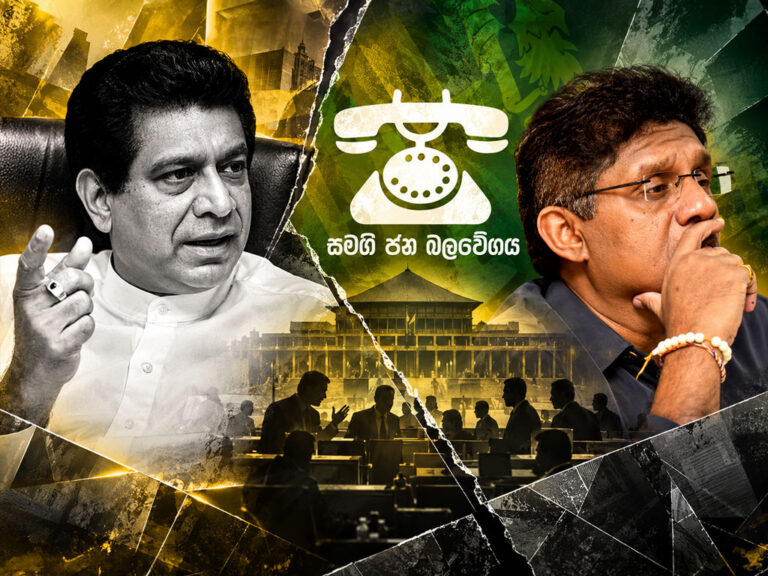
Separately, the CID has sought statements from 10 Opposition MPs, including Opposition Leader Sajith Premadasa, over statements made in Parliament linking Sallay to the attacks.
According to reports, the Attorney General’s Department authorised investigators to request the statements, with the CID seeking information about the sources on which the MPs based their allegations.
Because the statements were made under parliamentary privilege, cooperation by the MPs is voluntary.
The development illustrates a broader problem surrounding the Easter debate. Claims made in Parliament, television interviews, press conferences and on social media can circulate for years, but repetition is not independent corroboration.
Asking for the underlying source is therefore not an unreasonable exercise. It is fundamental to determining whether an allegation can be substantiated.
That standard cannot depend on who makes the claim.
If an MP alleges that Sallay was involved, the evidence should be examined. If Church representatives allege a wider political conspiracy, the basis for that claim should be scrutinised. If investigators allege that someone had prior knowledge, the evidence establishing what that person knew, when they knew it and what they did with that information should be tested.
Intelligence Failures Are Already Part of the Record
There is another dimension to the Easter Sunday attacks that does not depend on speculation about a hidden mastermind: the documented failure to act adequately on intelligence warnings.
In January 2023, Sri Lanka’s Supreme Court found that former President Maithripala Sirisena and several senior security officials had violated the fundamental rights of victims by failing to take appropriate action despite intelligence concerning an imminent attack.
More recently, former Defence Secretary Hemasiri Fernando and former Inspector General of Police Pujith Jayasundara were convicted in separate criminal proceedings over their failure to prevent the attacks despite prior intelligence.
These findings demonstrate why the handling of pre-attack intelligence remains a legitimate area of scrutiny.
They do not, by themselves, establish a broader political conspiracy.
Questions have also been raised at different stages about what investigators knew concerning Zahran Hashim and his network before April 21, 2019, what investigative steps were taken and whether information was adequately shared among agencies.
Those questions require documentary answers.
What information was available? Who received it? When was it received? What assessment followed? Which agencies were informed? What operational measures were taken?
Those questions are less dramatic than searching for an unidentified mastermind, but they are capable of being tested against records, testimony and investigative material.
Claims Against Investigators Require the Same Caution
The original debate has also drawn former senior CID officers Ravi Seneviratne and Shani Abeysekara into allegations concerning the handling of intelligence before the attacks.
Here, an important recent judicial development cannot be ignored.
On September 15, 2026, the Supreme Court ruled that the fundamental rights of Seneviratne and Abeysekara had been violated in connection with an investigation arising from allegations that they had deliberately concealed intelligence relating to the Easter attacks for political reasons.
The Court found that a complaint against them had been made maliciously and for political motives, according to reports of the judgment, and ordered that they should not be arrested or subjected to further investigation on the basis of that complaint.
That ruling does not answer every historical question about every investigative decision made before Easter Sunday. But it is highly relevant when allegations of deliberate suppression are repeated against the two former CID officers.
The evidentiary standard must remain consistent: an allegation against an intelligence officer, police investigator, politician or member of the clergy does not become fact merely because it has been repeatedly asserted.
Cardinal’s ‘Grand Political Plot’ Claim
Cardinal Ranjith’s public campaign has kept the demand for justice for Easter victims firmly in national and international attention.
His 2022 UNHRC statement was unequivocal. He said the initial impression that the massacre was purely the work of Islamic extremists had been overtaken by subsequent investigations indicating a “grand political plot”.
The question now is what evidence establishes that proposition.
A criminal trial resulting in 15 convictions does not prevent investigators from pursuing other suspects or theories if credible evidence emerges. Equally, the existence of unresolved questions does not prove that a particular conspiracy theory is correct.
That distinction matters.
Father Cyril Gamini Fernando, Father Jude Krishantha and political figures who have publicly discussed alleged hidden actors are entitled to raise questions and provide information to investigators. Serious accusations against identifiable individuals, however, should ultimately be capable of evidentiary examination.
A press conference is not a judicial finding. Neither is a television documentary, parliamentary speech or political statement.
Questions About Church Funding Need Evidence Too
The source article also raises questions about whether Church institutions received financial assistance connected with Easter victims, legal proceedings, investigations, international advocacy or campaigns for justice.
No evidence supplied with the article establishes financial misconduct by Cardinal Ranjith or the Catholic Church.
Accordingly, it would be improper to imply that such misconduct occurred.
A narrower transparency question can nevertheless be asked: where institutions receive funds specifically for victims, litigation, advocacy or related programmes, what public or audited accounting exists for those funds?
Any examination of that question should begin with documented funding, accounts and applicable reporting obligations rather than assumptions of wrongdoing.
Transparency should be reciprocal. Institutions demanding disclosure and accountability from government can themselves explain the financial and organisational basis of major public campaigns where a legitimate public interest exists.
But questions are not evidence, and they should not be presented as accusations without documentary support.
What the Verdict Does and Does Not Establish
The September verdict provides a significant judicial finding: 15 defendants were convicted and nine acquitted after one of the country’s largest criminal trials.
Reports differ on some sentencing details. News First reported that each of the 15 convicted defendants received 220 years’ rigorous imprisonment and that their movable and immovable property would be confiscated by the State. Other reporting has described lengthy sentences more generally.
What the verdict does not establish is that every unanswered question about Easter Sunday has disappeared.
Investigators remain free to pursue credible evidence concerning other individuals. The ongoing Sallay investigation itself demonstrates that authorities continue to examine allegations beyond those decided in the principal trial.
But further allegations should bring evidence capable of scrutiny.
If evidence establishes a wider conspiracy, it should be pursued regardless of the political consequences.
If evidence establishes prior knowledge by particular officials, that evidence should be tested.
If investigators or security agencies failed in their duties, responsibility should be determined from the record.
If allegations against Sallay are substantiated, they should be established through the legal process. If they are not substantiated, he remains entitled to the presumption of innocence.
The same principle applies to everyone whose name enters the Easter Sunday debate.
Seven years after the attacks, victims and their families are entitled to more than competing political narratives. The latest convictions are an important part of the judicial record, but continuing investigations mean the broader story is not necessarily complete.
The next stage should therefore turn less on who can make the most forceful allegation and more on what can actually be demonstrated.
Evidence should decide that question.
SOURCE:- SRI LANKA GUARDIAN