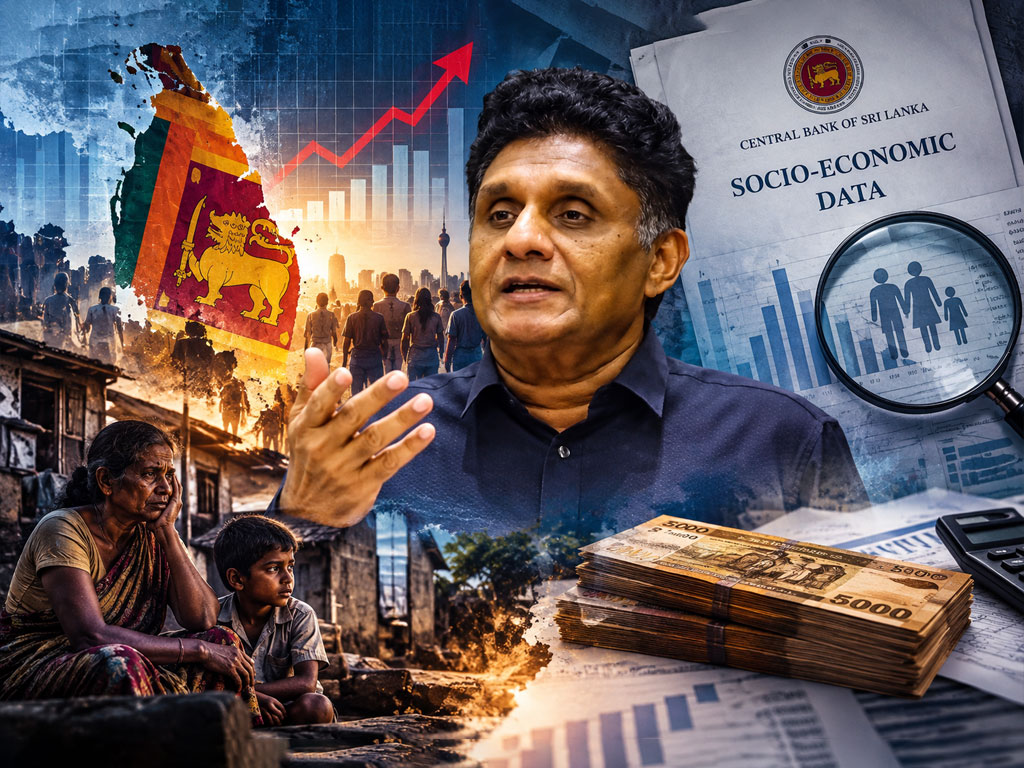
Sajith Premadasa questions outdated Sri Lanka poverty data, warning that reliance on old household surveys could affect budget planning and welfare.
Opposition Leader Sajith Premadasa has warned that relying on outdated poverty statistics could prevent the upcoming national budget from accurately reflecting the economic difficulties faced by Sri Lankan households.
Speaking at a political meeting in Colombo, Premadasa questioned the poverty indicators contained in the latest socio-economic data publication issued by the Central Bank of Sri Lanka, which draws on statistics from the Department of Census and Statistics.
He argued that reliable, up-to-date information was essential for identifying household financial pressures and directing government assistance towards those most in need.

Concerns Over Outdated Household Surveys
Premadasa noted that although the 104-page publication contains recent information in several sections, its poverty and living-conditions indicators continue to rely on household surveys conducted in 2016 and 2019.
According to the Opposition Leader, Sri Lanka has yet to present a comprehensive new household income and expenditure survey adequately reflecting changes following the severe economic crisis of 2022.
He warned that outdated information could undermine the effectiveness of welfare programmes, including Aswesuma, by making it harder to identify eligible households and assess their present circumstances.
International Poverty Measures and Living Costs
Premadasa also referred to international poverty measurements, arguing that a substantial proportion of Sri Lankans remain exposed to economic hardship.
– National poverty line: The Department of Census and Statistics places the monthly cost of meeting one person’s basic needs at approximately Rs. 17,500, equivalent to about USD 58.
– International poverty benchmark: Premadasa referred to the World Bank’s upper-middle-income poverty threshold of USD 8.30 per person per day, approximately Rs. 2,700, suggesting that more than 60% of Sri Lankans could fall below that benchmark.
– Food security: He cited international agency reports indicating that approximately one in three households had experienced varying degrees of food insecurity following the economic crisis.
The Opposition Leader maintained that comparisons based on older human development and household statistics could fail to capture current living conditions. He also expressed his willingness to participate in a public debate on the matter.
How Sri Lanka Measures Poverty
Sri Lanka’s official poverty assessments are based on the Household Income and Expenditure Survey (HIES), traditionally conducted every three years by the Department of Census and Statistics.
The Covid-19 pandemic and the subsequent economic crisis disrupted the survey cycle, delaying the publication of comprehensive findings after 2019.
World Bank estimates cited in the discussion indicate that poverty measured against the USD 4.20-per-day benchmark rose to approximately 25% following the economic crisis, with projections suggesting a gradual decline towards 20%.
Premadasa’s central argument is that budget allocations and welfare decisions should reflect the financial circumstances households face today rather than relying predominantly on surveys conducted before the country’s economic upheaval.