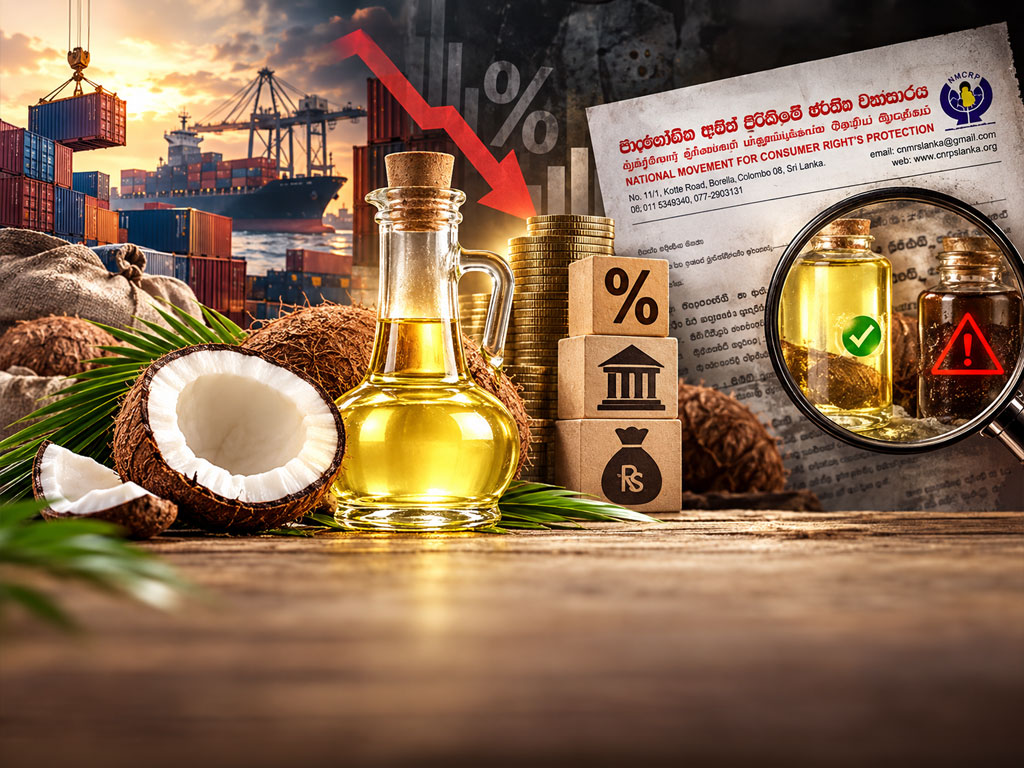
Sri Lanka’s coconut oil industry faces pressure from import dependence, tax changes, adulteration concerns and limited domestic production.
COLOMBO — Sri Lanka’s coconut oil market is caught between a chronic shortage of domestic edible-oil production, heavy dependence on imports and a tax structure that local producers and consumer groups fear could alter competition in favour of cheaper imported oils.
The debate has intensified following warnings from the National Movement for Consumer Rights Protection, whose Chairman Ranjith Vithanage has raised concerns about the Government’s decision to replace the Special Commodity Levy on imported coconut oil and palm oil with the general VAT and Social Security Contribution Levy structure.
The 2026 Budget officially proposed removing the Special Commodity Levy, previously set at Rs. 150 per kilogram on imported coconut oil and Rs. 275 per kilogram on palm oil, and subjecting both to the general tax framework from April 2026.
Government policy describes the change as an attempt to establish equal tax treatment between imported oils and locally produced oils, which were already subject to VAT and SSCL.
Industry participants and consumer advocates, however, argue that because coconut oil has a considerably higher international price than palm oil, percentage-based taxes could produce very different effective tax burdens and potentially change the economics of the domestic edible-oil market.

A Large Gap Between Demand and Local Supply
At the heart of the problem is a structural shortage.
Sri Lanka consumes roughly 220,000 to 240,000 metric tonnes of edible oils annually, while domestic production supplies only a fraction of that requirement.
Industry estimates published in 2025 placed annual coconut-oil consumption at about 240,000 metric tonnes, compared with local production of approximately 40,000 tonnes.
That leaves the country dependent on imports to bridge much of the gap.
Coconut availability itself presents another challenge. Historically, around 1.8 billion nuts have been absorbed annually by domestic consumption, with the balance allocated to coconut oil, desiccated coconut, virgin coconut oil, coconut milk, cream, exports and other industries. Official and academic material has estimated household and culinary use at roughly 65 to 70 per cent of national coconut production in some years.
That structure limits the volume of locally harvested coconuts available to traditional oil mills, particularly when export demand for other coconut-based products is strong.
Tax Reform Changes the Competitive Equation
Until April 2026, imported coconut oil and palm oil were principally subjected to fixed Special Commodity Levies.
The Budget replaced those levies with VAT and SSCL.
Under the proposal, imported coconut and palm oil became subject to 18 per cent VAT and 2.5 per cent SSCL from April 1, according to analyses of the Budget measures.
A percentage-based system matters because palm oil is generally substantially cheaper on international markets than coconut oil.
The Sunday Times reported earlier this year that industry calculations placed imported coconut oil at around USD 2,280 per metric tonne compared with about USD 1,090 for palm oil at the time. Based on those prices, industry representatives estimated that the overall tax burden could be considerably higher for coconut oil than for palm oil under the revised regime.
That does not by itself establish that the tax policy deliberately favours particular importers.
It does, however, justify examination of whether the final effective tax burden creates unintended competitive advantages between different edible oils.
For local coconut-oil producers facing electricity, labour, raw-material and processing costs, the ability to compete against lower-priced imported alternatives becomes particularly important.
Consumer Groups Raise Adulteration Concerns
Price disparities also create another risk: adulteration.
Sri Lanka already prohibits coconut oil from being blended with other oils and marketed as coconut oil. Consumer Affairs Authority Direction No. 77, introduced in May 2021, states that coconut oil must not be blended with another oil.
Vithanage and the National Movement for Consumer Rights Protection have repeatedly warned that cheaper oils could be mixed with coconut oil and sold to consumers as a higher-value product.
In January, the organisation said the tax changes could increase the possibility of adulterated products entering the domestic market and warned that cheaper substitute oils might become more widely available.
The consumer organisation had previously urged authorities to permit only bottled and properly labelled coconut oil, arguing that traceability and labelling would make suppliers more accountable.
Concerns over adulteration are not merely theoretical.
Researchers associated with Sri Lanka’s Industrial Technology Institute have developed Fourier Transform Near-Infrared spectroscopy techniques capable of distinguishing coconut oil adulterated with cheaper fats and oils.
Research involving ITI scientists has demonstrated that FT-NIR can identify palm olein adulteration in virgin and copra coconut oils, while more recent work has expanded similar techniques to other adulterants.
The specific allegations in the supplied commentary concerning the use of chlorine, hydrochloric acid and particular contaminants in illicitly processed oils require direct laboratory or enforcement evidence before they should be stated as established facts.
Regulation Alone Cannot Close the Supply Gap
Stronger labelling, testing and enforcement can protect consumers, but they cannot solve Sri Lanka’s fundamental edible-oil deficit.
If domestic production covers only a relatively small portion of demand, some form of importation remains necessary unless local production expands dramatically or consumption patterns change.
That makes a blanket debate over “imports versus local production” too narrow.
The policy challenge is to determine how imports can fill the unavoidable supply deficit without undermining viable domestic producers or creating incentives for adulteration and mislabelling.
Four Areas for Policy Attention
Several measures could address different parts of the problem:
- Review the effective tax burden: Authorities could examine how VAT, SSCL and other import charges affect coconut oil and palm oil after international market prices are taken into account, rather than considering nominal tax rates alone.
- Strengthen supply-chain monitoring: Better coordination among Sri Lanka Customs, the Consumer Affairs Authority and food-safety regulators could improve traceability from importation to wholesale and retail distribution.
- Expand rapid testing: FT-NIR and other analytical techniques could provide faster screening for adulterated coconut oil before suspicious products reach consumers.
- Develop alternative domestic oils: Rice-bran oil and other locally viable edible-oil sources could help diversify supply and reduce dependence on imported oils, provided they are commercially and technically sustainable.
Protecting Both Consumers and Producers
The future of Sri Lanka’s coconut-oil industry cannot be addressed through tariffs alone.
Consumers need affordable edible oils, but they also need confidence that a bottle labelled coconut oil contains what it claims to contain.
Local producers require a competitive environment in which legitimate production is not undermined by adulteration or tax distortions. Importers, meanwhile, remain necessary to fill a substantial national supply deficit and should operate within transparent quality, taxation and traceability rules.
The central policy question is therefore not whether Sri Lanka should simply protect local coconut oil or favour imported substitutes.
It is whether the country can design a market in which imports fill genuine shortages, domestic producers can compete fairly, and consumers can trust the product they take home.