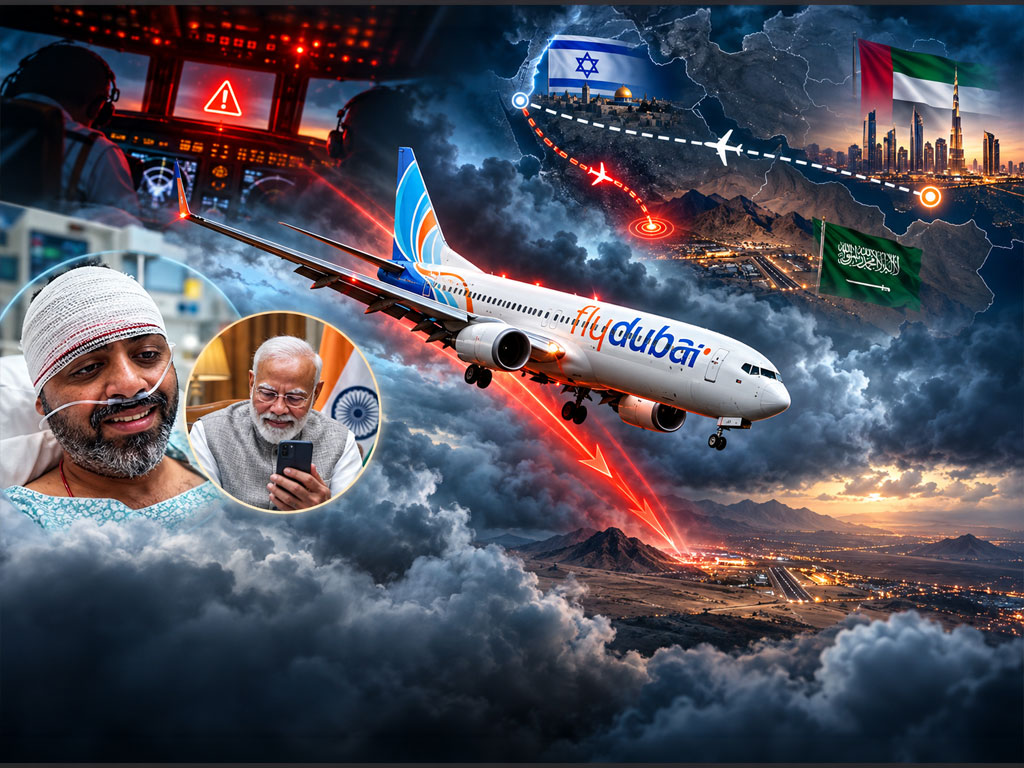
The flydubai FZ1073 cockpit attack sent the jet plunging thousands of feet before crew, passengers and off-duty pilots regained control.
DUBAI — A violent attack inside the cockpit of flydubai Flight FZ1073 sent a Boeing 737 MAX 8 plunging thousands of feet over Saudi Arabia before an injured captain, passengers, crew and two off-duty pilots helped prevent what authorities now describe as an attempted terrorist act.
Three days after the September 30 incident, the United Arab Emirates provided its clearest official account yet.
UAE Attorney-General Dr. Hamad Saif Al Shamsi said on October 3 that investigators had established that the co-pilot began carrying out a planned terrorist act during the flight, attacking the captain with a crash axe and attempting to seize control of the aircraft. The investigation remains underway to establish the full motive, circumstances and any links to other individuals or organisations.
That finding materially changes the early picture of an incident initially described simply as a violent confrontation between pilots.
What happened aboard FZ1073 now presents one of the most disturbing aviation-security questions in recent years: what happens when the threat that reinforced cockpit security was designed to keep out originates from inside the flight deck itself?

A Crisis at 34,000 Feet
Flight FZ1073 departed Dubai International Airport for Ben Gurion International Airport in Tel Aviv on September 30 and climbed normally to approximately 34,000 feet.
Flightradar24 records show the aircraft operating the flight was flydubai Boeing 737 MAX 8 A6-FKF. At about 05:21 UTC, the aircraft began a series of violent altitude changes while flying over the region.
The flight first transmitted squawk code 7700, the international transponder code for a general emergency. It subsequently transmitted 7500, used to indicate unlawful interference, before reverting to 7700.
Reuters reported that the aircraft lost more than 16,000 feet during two rapid descents occurring within just over 30 seconds. Earlier accounts based on initial tracking data had placed the loss at nearly 14,000 feet in under 30 seconds, illustrating how quickly information developed after the incident.
Inside the cockpit, the situation was considerably more serious than first reports suggested.
According to the UAE Attorney-General, the co-pilot attacked Captain Smit Machchhar using a crash axe, an emergency tool carried aboard aircraft, and attempted to take control of the flight controls.
The original reports that the captain had been stabbed with a knife have therefore been superseded by the UAE’s official statement identifying the weapon as a crash axe.
Captain Machchhar Reaches the Cockpit Door
Captain Machchhar suffered serious injuries during the assault but remained capable of taking an action that became critical to the survival of those aboard.
He managed to unlock the cockpit door.
That allowed assistance to reach the flight deck at a moment when the aircraft had already undergone violent altitude changes.
Reuters reported that passengers and crew entered the cockpit and restrained the co-pilot. A passenger with aviation knowledge initially helped stabilise the aircraft before two off-duty flydubai pilots travelling on the flight assumed control.
Their presence proved extraordinarily important.
Off-duty pilots travelling as passengers, often known operationally as deadheading or positioning pilots depending on the circumstances of their travel, can be moving between airports as part of an airline’s crew scheduling system. In this case, two qualified pilots were available when both operating pilots had become casualties of the cockpit confrontation.
Flydubai’s own account said the aircraft was successfully secured by its crew travelling aboard the flight before being diverted to Saudi Arabia.
Emergency Diversion to Tabuk
With control restored, the aircraft was diverted to Tabuk in northwestern Saudi Arabia.
It landed safely at Tabuk Airport, ending a crisis that had begun thousands of feet above the region with more than 170 people aboard.
Flydubai initially confirmed only that FZ1073 had experienced an incident while travelling from Dubai to Tel Aviv and that everyone aboard was safe and accounted for.
A subsequent airline statement acknowledged that an altercation had occurred in the flight deck. Flydubai said replacement aircraft were sent to Tabuk for the passengers and crew while authorities investigated what had happened.
The UAE General Civil Aviation Authority separately confirmed that the flight had suffered a security incident that required an emergency diversion and that crew members had been injured and taken to hospital in Saudi Arabia.
Passengers later continued to Tel Aviv aboard a replacement aircraft.
Flydubai subsequently suspended its flights to and from Israel while the investigation continued.
Captain Smit Machchhar Emerges as Central Figure
The actions of Indian Captain Smit Machchhar have since attracted international attention.
Reuters reported that Machchhar had accumulated almost 9,750 flying hours during a career spanning roughly 15 years. He had spent more than a decade with SpiceJet before joining flydubai in 2022.
His decision to unlock the cockpit while seriously injured created the opportunity for others aboard the aircraft to intervene.
Indian Prime Minister Narendra Modi publicly praised Machchhar on October 1, calling him a hero and saying his actions had helped avert a major tragedy.
A day later, Modi spoke with the captain by video call while Machchhar was recovering. India’s Prime Minister’s Office said Modi praised his courage, composure and rapid decision-making during the emergency.
During that conversation, Machchhar described how events unfolded and how he had concentrated on protecting the people aboard.
Flydubai later confirmed that the captain had returned to the UAE after receiving medical assessment and care in Saudi Arabia.
UAE Calls It an Attempted Terrorist Act
The most important development came on October 3.
The UAE Attorney-General said investigators had concluded that the co-pilot had begun executing a plan to carry out a terrorist act, assaulted the captain with the crash axe and attempted to seize the aircraft’s controls.
The investigation has not ended.
Authorities are continuing technical examinations and the analysis of physical and digital evidence to determine the complete circumstances, motive and any connections surrounding the attack.
Media reports have identified the co-pilot as Omani national Hammam al-Hammami, although the UAE Attorney-General’s October 3 statement did not identify him by name. Reuters reported that investigators were examining indications of radicalisation while seeking to determine whether he acted alone or had outside links.
Israeli Prime Minister Benjamin Netanyahu said Israeli information indicated that the co-pilot had undergone radical Islamist indoctrination. That was an attributed Israeli assessment, not the final conclusion of the UAE investigation, which remains underway.
No evidence establishing Iranian involvement had been confirmed in the Reuters reporting reviewed for this article.
Why the Crash Axe Was in the Cockpit
Perhaps the most striking security question concerns the weapon itself.
The crash axe was not necessarily something smuggled through passenger security.
Such tools are carried aboard commercial aircraft for emergencies, including situations in which crew may need to break through panels or other aircraft structures after a fire or accident.
That creates a difficult security problem.
Equipment intended to protect an aircraft and its occupants can become dangerous if someone who already has authorised cockpit access turns it into a weapon.
The FZ1073 attack therefore differs fundamentally from the security model that dominated aviation following the September 11, 2001 attacks in the United States.
After 9/11, reinforced cockpit doors and stricter access procedures were introduced worldwide to make it dramatically more difficult for passengers or hijackers to force their way onto the flight deck.
FZ1073 demonstrates the reverse problem.
The reinforced door was keeping people out while the threat was already inside.
Captain Machchhar’s ability to unlock that door allowed assistance to enter. Had he been unable to do so, the sequence of events could have been very different.
The Insider-Threat Question
The case now extends beyond the security of a single cockpit tool.
Investigators and airlines will have to examine what the incident reveals about insider threats involving personnel who already possess legitimate access to safety-critical areas of an aircraft.
The questions include the effectiveness of pilot screening and recurrent security assessments, procedures governing access to emergency equipment, communication between regulators and airlines, behavioural warning systems and the ability of other crew members to respond when one pilot becomes a threat to the flight.
Such questions should not be confused with speculation about an individual’s medical or psychological condition. The UAE investigation has not published a final finding explaining the co-pilot’s complete motive.
What is established is that the Attorney-General now describes the event as a planned attempted terrorist act.
Technology Could Not Solve This Emergency Alone
Modern commercial aircraft incorporate sophisticated navigation, flight-control, communications and warning systems.
None of those systems eliminates the human factor.
FZ1073 survived because several layers of human response worked in succession.
An injured captain managed to open the cockpit.
Crew members and passengers intervened.
The attacker was restrained.
A passenger reportedly assisted during the initial recovery of the aircraft.
Two qualified off-duty flydubai pilots were available to take control.
Air traffic controllers handled an aircraft transmitting emergency and unlawful-interference codes.
Saudi authorities provided an airport where the flight could make an emergency landing.
No single element appears to have been sufficient on its own.
What Remains Unanswered
The UAE’s October 3 announcement answers one of the largest early questions by officially describing the attack as an attempted terrorist act.
Several crucial issues remain unresolved:
- What was the full motive behind the attack?
- Did the co-pilot act entirely alone?
- Were there warning signs before the flight?
- Did any organisation or individual assist or influence him?
- Should cockpit access to crash axes and similar emergency equipment be reconsidered?
- Could crew-screening systems have identified a risk earlier?
- Should procedures for responding to an internal cockpit threat be changed?
- What lessons should airlines and regulators draw from the intervention of off-duty pilots and passengers?
Investigators are continuing to analyse technical, physical and digital evidence before issuing final findings.
A Disaster Avoided, but a Security Problem Exposed
FZ1073 ultimately landed safely.
That fact should not obscure how close the flight came to an entirely different outcome.
The aircraft experienced extreme altitude changes while a violent struggle unfolded inside its cockpit. Its captain was seriously injured. The person normally expected to assist him was, according to the UAE investigation, attempting to take control of the aircraft as part of a terrorist act.
Yet the safety system did not collapse completely.
Instead, Captain Machchhar, other flydubai crew members, passengers and two additional pilots aboard the aircraft collectively created a path back to control.
The episode leaves the aviation industry confronting a security problem that reinforced doors and passenger screening alone cannot solve.
Aircraft can be protected from an external intrusion and still remain vulnerable to someone already authorised to sit behind the cockpit door.
The final investigative report will determine much more about why the attack occurred and whether warning signs were missed.
For global aviation, however, the broader question is already clear: after decades spent strengthening the cockpit against threats from outside, how should airlines protect an aircraft when the threat begins within?