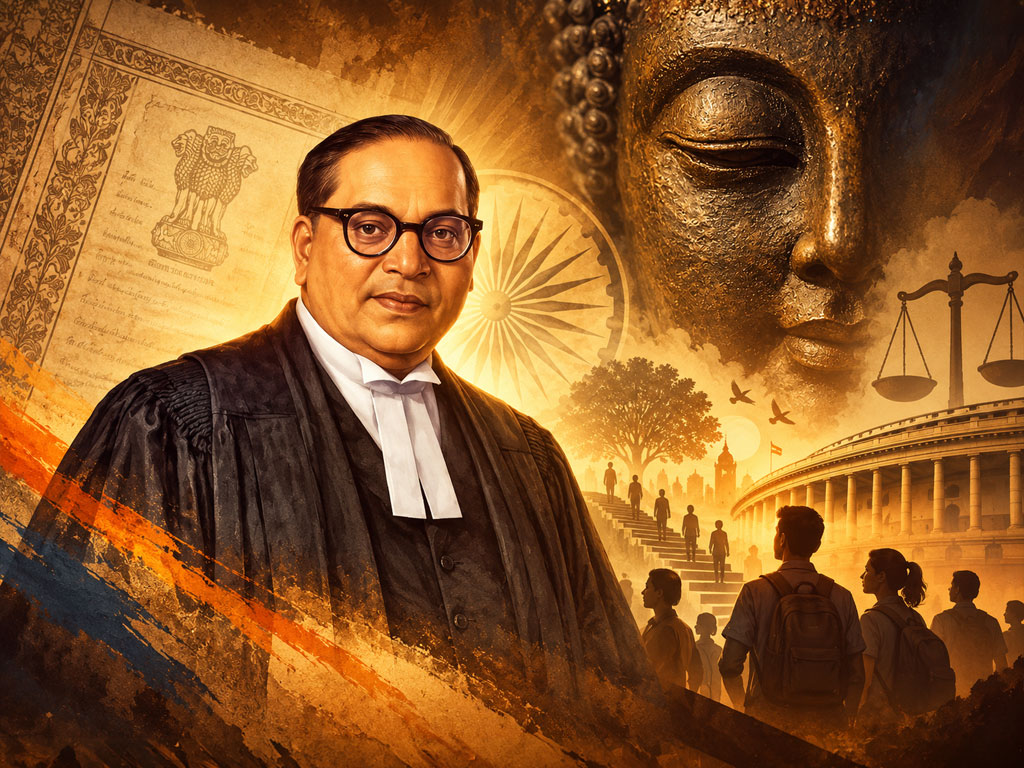
The B. R. Ambedkar legacy offers enduring lessons in education, equality, constitutionalism, Buddhism and social responsibility for young people.
By Most Venerable Professor Kandegoda Wimaladhamma Anunayake Thero
True leadership is rarely shaped by comfort and privilege alone.
Some of history’s most influential leaders emerged from societies that denied them equality, dignity and opportunity, yet transformed those experiences into a lifelong commitment to changing the conditions that had oppressed them.
Few South Asian figures illustrate that journey more powerfully than Dr. Bhimrao Ramji Ambedkar.
Before becoming one of the principal architects of independent India’s constitutional order, Ambedkar grew up confronting caste discrimination that affected even the most basic aspects of childhood and education.
Born in 1891 into the Mahar community, then treated as “untouchable” under the prevailing caste hierarchy, he experienced forms of exclusion that would later shape his intellectual and political mission.
Instead of allowing those conditions to define the limits of his life, Ambedkar turned education, disciplined scholarship and legal reform into instruments for challenging entrenched inequality.
For younger generations across South Asia, his life remains a reminder that adversity need not determine destiny.

Education as an Instrument of Liberation
Ambedkar recognised early that knowledge could offer something discrimination sought to deny him: independence of thought.
His academic journey ultimately took him far beyond India.
After studying at the University of Bombay, he received a Baroda State Scholarship and travelled to Columbia University in New York, where he completed postgraduate studies and later received a PhD in economics.
He subsequently studied at the London School of Economics, completing further postgraduate work and a doctorate, while also pursuing legal training at Gray’s Inn.
The London School of Economics records that Ambedkar completed a master’s degree and PhD there, while Columbia University confirms his doctorate in economics and later honorary degree. He was also called to the Bar at Gray’s Inn.
His academic achievements were extraordinary, particularly when viewed against the discrimination he had confronted in India.
Yet Ambedkar did not treat education simply as a source of personal status.
For him, knowledge was a means of understanding social structures, questioning inherited assumptions and equipping disadvantaged communities to demand equality.
His enduring call to “Educate, Agitate, Organise” expressed that belief.
Education was the beginning because a society capable of thinking critically is more difficult to manipulate. Organisation allowed isolated individuals to develop collective strength. Agitation, in Ambedkar’s political vocabulary, meant sustained democratic action against injustice rather than passive acceptance of inequality.
That lesson retains relevance for young people today.
Sri Lanka’s own history of free education has shown how access to learning can enable individuals from modest backgrounds to enter professions, public life and national leadership that might otherwise have remained closed to them.
President Anura Kumara Dissanayake’s rise from a non-elite family background to the presidency is one contemporary example cited in this context: education, persistence and political engagement can alter the course of an individual life regardless of inherited privilege.
The broader principle transcends any single political personality. A society that widens access to education expands the number of citizens capable of influencing its future.
Building Constitutional Protection for Human Dignity
Ambedkar’s greatest institutional contribution came after Indian independence in 1947.
He became independent India’s first Minister of Law and Justice and was appointed Chairman of the Constituent Assembly’s Drafting Committee, not Chairman of the Constituent Assembly itself.
That distinction is historically important.
In his role as chairman of the Drafting Committee, Ambedkar played a central part in editing, defending and guiding the constitutional text through the Constituent Assembly.
The resulting Constitution sought to create a democratic political order while confronting deeply rooted social inequality.
Its guarantees of fundamental rights, equality before the law, safeguards for minorities and abolition of untouchability reflected principles to which Ambedkar had devoted much of his public life.
He understood that political democracy could not flourish indefinitely while large sections of society remained socially or economically subordinate.
Freedom, equality and fraternity were therefore not abstract slogans in his thinking. They were mutually dependent conditions for a functioning democracy.
Ambedkar repeatedly argued that a constitutional system could survive only if citizens and institutions embraced what he described as constitutional morality: respect for democratic procedures, legal equality and the dignity of others.
For younger generations, this part of his legacy is particularly important.
Democracy is not sustained only by casting a vote every few years. It depends on citizens understanding institutions, questioning authority lawfully, defending the rights of people with whom they disagree and resisting attempts to reduce another person’s worth on the basis of caste, ethnicity, religion, gender or social status.
Ambedkar’s Encounter With Buddhism in Sri Lanka
Sri Lanka occupies an important place in Ambedkar’s Buddhist journey.
In 1950, he travelled to what was then Ceylon to attend the inaugural conference of the World Fellowship of Buddhists, held from May 25 to June 6.
The organisation was founded through the initiative of Sri Lankan scholar Professor G. P. Malalasekera and brought together Buddhist representatives from numerous countries.
Ambedkar attended the gathering as an interested observer and used the visit to examine Buddhist practice and institutions more closely.
Records of his writings and speeches show that he openly explained his reasons for coming to Ceylon. He wanted to understand Buddhist ceremonial practice, examine the extent to which the Buddha’s teachings were being preserved in their original spirit and study the social role of the Sangha.
His participation was therefore more than ceremonial.
It formed part of a much deeper intellectual search that had occupied him for years.
Ambedkar increasingly found in Buddhism a framework that he believed could reconcile reason, morality, human equality and social responsibility.
Six years after the Ceylon conference, on October 14, 1956, he formally embraced Buddhism at Deekshabhoomi in Nagpur.
Hundreds of thousands of followers gathered for the historic conversion ceremony.
For Ambedkar, Buddhism represented more than a change of religious affiliation. It formed part of his rejection of a caste hierarchy he believed was incompatible with human dignity.
Buddhism, Equality and Social Renewal
Ambedkar’s interpretation of Buddhism emphasised reason, ethical conduct, compassion and equality.
He did not approach the Dhamma simply as an escape from worldly concerns.
Instead, he regarded it as a philosophy capable of informing relationships between individuals and shaping a more just society.
That interpretation helps explain why Buddhism became central to the final phase of his public life.
His conversion also created a renewed link between the Buddhist heritage of India and Buddhist communities elsewhere in Asia, including Sri Lanka.
The historical connection is especially meaningful because India is the birthplace of Buddhism, while Sri Lanka became one of the countries in which the Theravada tradition was preserved continuously across centuries.
Ambedkar’s journey therefore connected social reform in modern India with a much older civilisational relationship across the region.
Ambedkar and Anagarika Dharmapala
Another powerful connection between India and Sri Lanka can be found in the lives of Dr. Ambedkar and Anagarika Dharmapala.
They belonged to different generations and confronted different historical circumstances.
Dharmapala devoted much of his life to the revival of Buddhism and the restoration of Buddhist sacred sites in India while also contributing to a wider revival of Buddhist consciousness in Sri Lanka.
Ambedkar, several decades later, turned to Buddhism while pursuing a struggle centred on caste equality, social justice and human freedom.
Their methods and political circumstances were not identical, and their historical roles should not be collapsed into one.
Yet both recognised Buddhism as a living intellectual and ethical tradition capable of speaking to the problems of modern society.
The Maitri Sethu project planned in Biyagama seeks to symbolise this shared Indo-Sri Lankan Buddhist heritage by placing 15-foot statues of Ambedkar and Dharmapala side by side.
If realised as envisioned, the monument would represent more than two prominent historical personalities. It would highlight two different movements connected by the belief that ancient wisdom could still speak to contemporary questions of dignity, identity and social responsibility.
What Ambedkar’s Life Says to the Young
Sri Lanka’s younger generation is confronting its own difficult inheritance.
Economic insecurity, inequality, migration, political frustration, rapid technological change and uncertainty about the future have created pressures very different from those Ambedkar faced.
The principle emerging from his biography, however, remains strikingly relevant.
Progress does not begin by waiting for favourable circumstances.
Ambedkar’s life demonstrates the value of disciplined education, intellectual independence, courage rooted in principle and a willingness to challenge injustice through institutions as well as public action.
For young people, that means learning deeply enough to understand complicated problems rather than merely reacting to them.
It means treating constitutional rights not as distant legal language but as protections that determine how citizens live together.
It means cultivating character alongside professional achievement.
Knowledge becomes most valuable when it is used not only for personal advancement but also to improve the lives of others.
That may be one of the most enduring lessons of Ambedkar’s journey.
A child who encountered caste exclusion became an economist, lawyer, scholar, social reformer, Law Minister and one of the most consequential constitutional thinkers of modern South Asia.
He did not achieve that transformation by pretending injustice did not exist. He studied it, challenged it and sought to construct institutions capable of preventing future generations from enduring the same humiliation.
As Sri Lanka reflects on Ambedkar alongside Anagarika Dharmapala, his message to younger generations remains powerful: sharpen the mind through knowledge, remain anchored to principles of human dignity, and use whatever knowledge and opportunity one receives to help create a more just society.
That is not merely a lesson from the biography of one extraordinary individual.
It is a continuing challenge to every generation that inherits an imperfect world.
SOURCE:- SRI LANKA LEADER