By Roy Denish.
Allegations surrounding the Beldeniya killing raise questions over an alleged nexus between police officers and organised crime figures.
BELDENIYA, Sri Lanka – The official logbook entry read like a standard-issue victory against the underworld: an operational combat encounter resulting in the neutralisation of a dangerous armed operative.
For the state security apparatus, the narrative was neat, packaged, and legally airtight.
But a joint review of confidential internal disclosures, eyewitness testimony, and court records reveals a chilling reality. Operation “Beldeniya” was not a spontaneous shootout, but, according to these findings, a targeted, outsourced contract assassination executed by elite state police forces in alleged collusion with an international drug cartel.

At the centre of the web stands an unprecedented convergence of state power and organised crime, allegedly tying Dubai-based underworld figure Jayamuni Sujeewa Soysa, alias “Kosgoda Sujee,” directly to senior figures within Sri Lanka’s law enforcement establishment.
The sequence leading to the alleged execution began in the wake of an earlier shooting in Ahungalla. Seeking to expand his regional syndicate, Kosgoda Sujee allegedly targeted Mahesh Indika, an ex-Army marksman whose tactical expertise made him a prized recruit.
When Indika reportedly refused the overture — and allegedly attracted the interest of rival syndicates — his refusal is claimed to have sealed his fate.
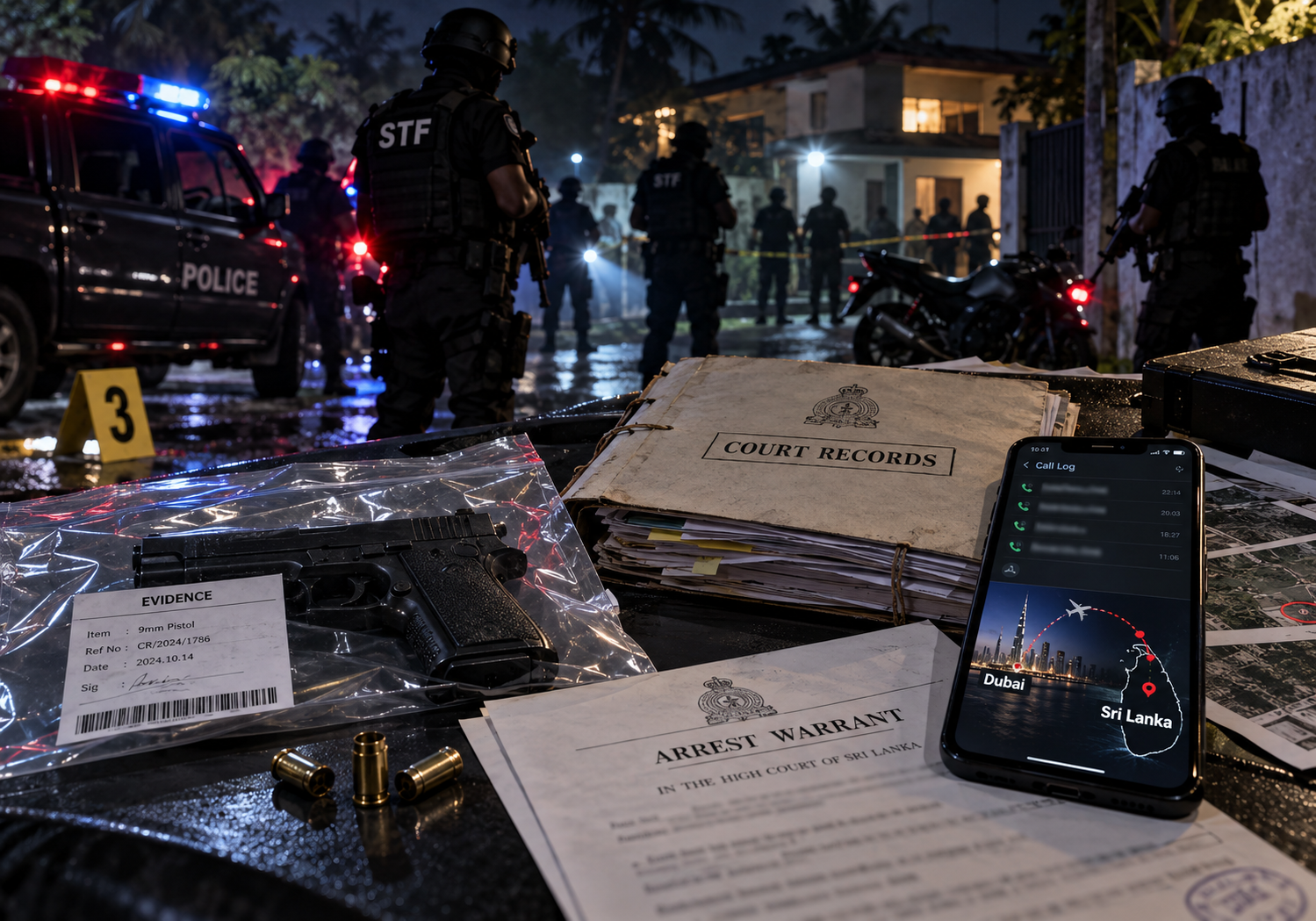
According to investigative findings, direct telephonic contact was established on October 13, 2022, between cartel operatives in Dubai and high-ranking security officials, specifically naming then-senior police figures including Deshabandu Tennakoon and SDIG Waruna Jayasundara.
A price was allegedly set, and the state’s elite units were mobilised.
Under the cover of a planned power blackout, an advance motorcycle intelligence unit allegedly guided a 27-member armed contingent to Indika’s home, where eight operatives stormed the residence.
Witness accounts and subsequent judicial inquiries reportedly established that Inspectors Dharmapriya and Madura physically assaulted Indika inside his home before dragging him away.
To justify the killing, the Special Task Force issued a public statement claiming that Indika had been killed during a defensive exchange of gunfire involving a firearm and a hand grenade.
The judicial inquiry conducted by the Balapitiya Magistrate’s Court reportedly challenged elements of this official narrative.
Forensic audits and crime-scene examinations reportedly identified an absence of gunshot residue on Indika’s hands. The findings recorded no traces of gunshot residue, carbon deposits, or propellant burns.
While the 9mm service pistol belonging to Inspector Colombage — allegedly used in the confrontation — was secured by the court, allegations later arose that there were delays in submitting the weapon and associated ballistic material to the Government Analyst’s Department for mandatory testing.
Furthermore, physical evidence, entry-and-exit wound trajectories, and an alleged lack of retaliatory defensive-fire markers on officers or property were cited as evidence raising questions over whether the incident was a staged execution rather than a dynamic gun battle.
Presiding judicial officers, including Balapitiya Magistrate R.D. Janaka, reportedly rejected the defensive-fire justification and found sufficient grounds for further criminal proceedings.
The court subsequently issued judicial arrest warrants for implicated personnel, including Inspector Colombage.
When state legal officers later attempted to challenge aspects of the judicial process, the judiciary maintained its authority to oversee criminal accountability.
What followed the killing, according to the allegations, was a campaign of suppression, witness intimidation, and evasion of justice.
On October 16, 2022, Indika’s wife, N.G.A.P. Wathsala, attempted to file formal criminal complaints at the Dickwella and Ahungalla police stations but was allegedly turned away.
When she escalated the matter to regional headquarters alongside journalists, officers accepted her statement but allegedly refused to issue a formal complaint reference number.
The intimidation reportedly intensified on November 2, 2022, when, after receiving death threats regarding her impending court testimony, an unidentified gunman on a motorcycle opened fire on Wathsala outside the Dickwella Police Station.
According to the allegations, despite emergency distress calls directed to high-ranking officials, no effective investigation followed.
The institutional controversy deepened when Balapitiya Magistrate R.D. Janaka issued an arrest warrant for IP Colombage on July 9, 2024, assigning its execution to Elpitiya SSP I.U.K. Lokuhetti.
Further allegations claim that Colombage was sheltered inside the Gonahena STF Camp in Kadawatha and that mandatory investigative procedures, including witness interviews and ballistic testing, were delayed or not carried out.
A subsequent investigation file was eventually forwarded to the Attorney General’s Department with a recommendation citing insufficient evidence.
For observers tracking institutional accountability, the Beldeniya case raises serious questions about the relationship between organised crime and sections of the security establishment.
As the legal battles continue, the central question remains unanswered: when those entrusted to protect the law are themselves accused of working with the underworld, what mechanisms remain to protect ordinary citizens from abuse of state power?
Source and original reporting credit: lankaenews.com