By Marlon Dale Ferreira
As Simba’s disappearance at Dubai International Airport raises troubling questions about pet-handling procedures, one of the world’s most sophisticated aviation hubs finds its reputation for security, technology and operational excellence under scrutiny.
DUBAI, October 18, 2026 — For decades, SriLankan Airlines’ two-letter IATA code, UL, has inspired its share of humour among travellers. Once jokingly interpreted as “Usually Late” because of the airline’s historical reputation for delayed departures, the abbreviation later acquired another tongue-in-cheek interpretation among frustrated passengers dealing with missing or mishandled baggage: “Unable to Locate.”
Over the years, however, Sri Lanka’s national carrier worked to move beyond its reputation for delays, achieving significant improvements in punctuality and earning recognition for its on-time performance.
At various points, the airline reported punctuality figures exceeding 90%, demonstrating that the once-popular “Usually Late” joke was no longer necessarily a fair reflection of its operational performance.
Yet an extraordinary incident involving a missing Persian cat at Dubai International Airport has now brought the abbreviation “Unable to Locate” back into the spotlight, this time with considerably more troubling implications.
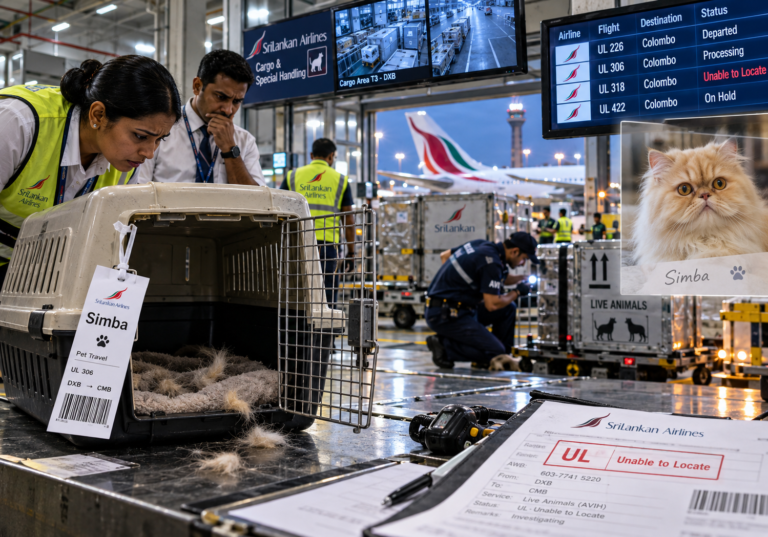
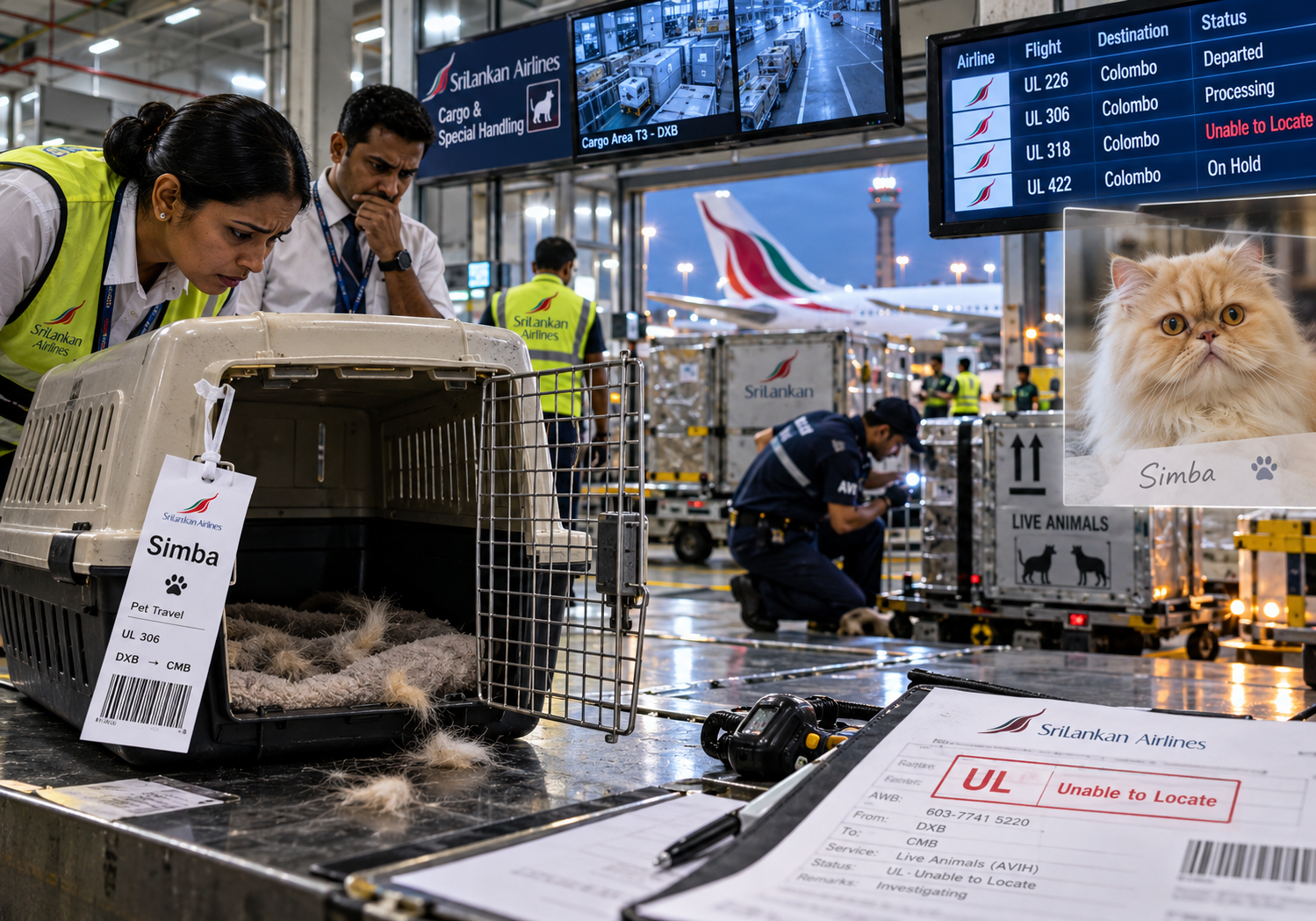
The cat, Simba, reportedly disappeared on October 11, 2026, while being prepared for transportation to Colombo aboard a SriLankan Airlines flight.
More than six days later, his owner, Avishka Kaumadi, was still desperately seeking answers about her beloved pet’s whereabouts.
And while the airline’s UL code has become the subject of renewed wordplay, there is nothing humorous about a missing animal, a distressed owner or the unanswered questions surrounding an incident at one of the world’s most technologically advanced airports.

Dubai’s World-Class Airport Faces Uncomfortable Questions
Dubai International Airport is widely regarded as one of the world’s leading aviation hubs, renowned for its sophisticated infrastructure, extensive security arrangements, advanced technology and passenger-handling capabilities.
The emirate has invested heavily in aviation infrastructure, positioning Dubai as a global gateway connecting continents and serving millions of international travellers.
Security, efficiency and technological innovation remain central to Dubai’s international reputation.
Against that backdrop, the disappearance of a pet reportedly entrusted to an airline’s cargo-handling process presents an uncomfortable contradiction.
How can an airport celebrated for its sophisticated systems and operational excellence struggle to establish the whereabouts of a cat that allegedly escaped within its cargo-handling environment?
For an aviation hub that takes considerable pride in its standards, the episode threatens to become a source of reputational embarrassment unless the circumstances are clearly explained.
The questions are especially relevant given Dubai’s extensive use of surveillance technology and its reputation for public safety.
According to Simba’s owner, she has been unable to obtain satisfactory answers about the circumstances of his disappearance.
Particularly concerning is her account that CCTV coverage was reportedly unavailable in the specific cargo-handling area where Simba was last believed to have been seen.
If confirmed, the absence of usable surveillance footage in the relevant location would raise serious questions about security coverage, animal-handling procedures and the ability to reconstruct incidents involving live cargo.
However, the precise extent of CCTV coverage, the availability of recordings and whether relevant footage has been examined have not been independently established.
It would therefore be premature to conclude that the airport’s cargo facilities have no surveillance coverage or that security procedures were breached.
Nevertheless, the absence of a clear public explanation leaves important questions unanswered.
A Passenger Hands Over Her Pet — Then Receives Disturbing News
According to Kaumadi’s account, she arrived at Dubai International Airport on October 11 to travel to Sri Lanka with Simba, who was being transported through the airline’s designated animal-handling arrangements.
She said she completed the required documentation, paid the applicable charges and presented Simba for inspection.
Following the verification process, the cat was reportedly returned to his carrier before being handed over for onward handling.
Kaumadi subsequently proceeded through immigration, believing that the necessary arrangements had been completed and that Simba would be transported safely to Colombo.
However, she claims she later received a telephone call from an airline representative informing her that Simba had escaped from his carrier.
What should have been a routine journey home quickly developed into a distressing search for her missing pet.
Kaumadi said she spent approximately 28 hours at the airport seeking information and attempting to locate Simba.
Her account raises questions about how the animal allegedly escaped, who had custody of the carrier at the relevant time, and what immediate procedures were activated to recover him.
The precise circumstances of the escape remain unconfirmed.
When a Missing Cat Becomes a ‘Delayed Bag’
One of the more unusual aspects of the incident involves the reported administrative classification of Simba’s disappearance.
According to documentation described by his owner, the missing cat was recorded in an airline report under the designation “Delayed Bag.”
While airlines routinely use baggage-tracing systems to record irregularities involving transported items, the reported classification of a missing live animal has understandably raised eyebrows.
Simba is not an ordinary suitcase or an item of misplaced luggage.
He is a living animal whose safety and welfare depend on appropriate handling, prompt recovery efforts and access to food, water and shelter.
The terminology may reflect an internal administrative reporting system rather than any intended disregard for the animal’s welfare.
Nevertheless, it highlights the importance of ensuring that procedures for missing live animals are distinct from those used for conventional baggage irregularities.
An animal that escapes within an airport environment presents welfare and recovery challenges that cannot simply be addressed through the same processes used to trace a delayed suitcase.
For an airline whose IATA code is UL, the episode has given the phrase “Unable to Locate” an especially unfortunate new meaning.
Accountability Extends Beyond the Airline
Although Simba was reportedly handed over for transportation on a SriLankan Airlines flight, determining responsibility requires establishing exactly which organisation had physical custody of the cat at each stage.
Live-animal transportation can involve airline personnel, contracted ground handlers, cargo agents, airport operators and other authorised service providers.
In Dubai, dnata is among the major ground-handling organisations operating within the airport environment.
Kaumadi has stated that a dnata staff member accompanied her during part of the animal inspection process.
However, this does not, by itself, establish which organisation was responsible for the carrier when Simba reportedly escaped.
That distinction is essential.
A transparent investigation should establish the documented chain of custody, identify when the animal was last securely contained, determine how the escape occurred and clarify what recovery measures were initiated.
It should also determine whether airport security personnel, veterinary authorities and relevant animal rescue services were informed promptly.
The objective should not be to assign blame without evidence, but to establish facts, identify any procedural shortcomings and ensure that similar incidents can be prevented.
A Missing Cat, a Distressed Owner and an International Reputation
Dubai’s standing as a premier international aviation destination has been built through decades of investment, operational development and attention to service standards.
The disappearance of one animal does not erase those achievements.
However, the treatment of an incident involving a vulnerable living creature can become an important test of how effectively those standards operate when something goes wrong.
For Simba’s owner, the issue is not Dubai’s impressive terminals, international rankings or technological sophistication.
It is knowing whether her cat is alive, where he might be and whether every reasonable effort is being made to recover him.
For SriLankan Airlines and the relevant Dubai airport service providers, the incident presents an opportunity to demonstrate transparency, compassion and coordination.
Clear communication with the owner, a documented recovery effort and a comprehensive explanation of the circumstances would go considerably further towards restoring confidence than prolonged uncertainty.
Perhaps UL Can One Day Mean ‘Usually Loving’
For generations of travellers, the letters UL have been the subject of good-natured aviation humour.
“Usually Late” reflected perceptions of an earlier era when delays attracted criticism.
“Unable to Locate” became another joking expression associated with the frustrations of missing baggage.
But Simba’s disappearance has given those two letters a meaning that nobody would wish to see associated with the national carrier.
A missing cat is not a punchline, and an owner’s distress should never become entertainment.
Behind the wordplay is a simple hope shared by Simba’s owner and the animal lovers following his case: that he will be located safely and reunited with his family in Sri Lanka.
The incident also provides an opportunity for SriLankan Airlines and the relevant Dubai authorities to demonstrate that service excellence is measured not only by punctual departures, impressive infrastructure and sophisticated airport systems, but also by how an organisation responds when something goes wrong.
Until Simba is found, the questions surrounding his disappearance will remain.
And perhaps, with a successful recovery, compassionate handling and a commitment to stronger procedures, SriLankan Airlines might one day inspire a rather more positive interpretation of its familiar two-letter code.
UL — “Usually Loving.”
For Simba and his owner, that would be a far more welcome ending to this extraordinary aviation story.