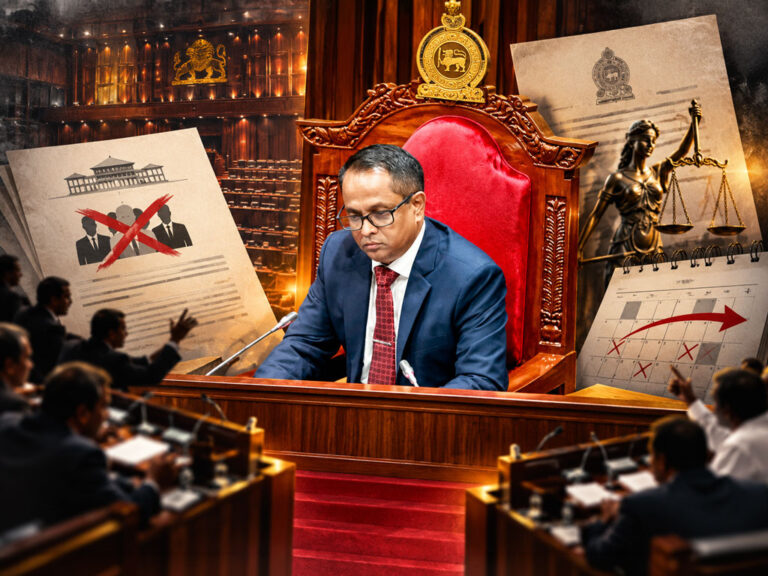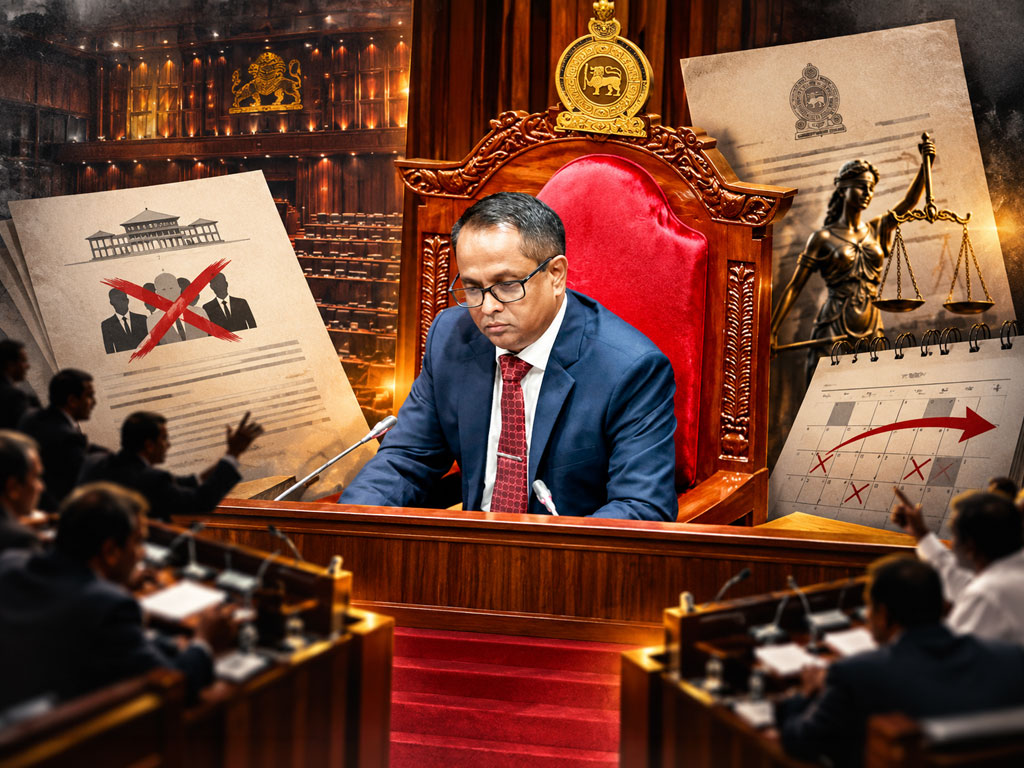
COLOMBO, October 18, 2026 — The Government has sought the Attorney General’s advice over procedural objections to the opposition’s motion against Speaker Dr. Jagath Wickramaratne, leaving the debate without a date amid speculation about his political future.
Parliament has postponed indefinitely the debate on a no-confidence motion against Speaker Dr. Jagath Wickramaratne after Government representatives raised procedural objections and called for the Attorney General’s advice before the motion could be taken up.
The decision was made at the Committee on Parliamentary Business meeting on Friday, October 16, leaving the opposition’s challenge to the Speaker outside the parliamentary agenda for October 20 to 23.
Chief Opposition Whip Gayantha Karunatilaka confirmed that a new date would be considered after the Attorney General’s opinion was received.
The Samagi Jana Balawegaya (SJB) had submitted the motion on October 8, with the support of 44 opposition parliamentarians. It contains approximately 50 allegations and points of contention concerning the Speaker’s conduct.

Although the Government initially indicated that it was prepared to debate the motion promptly, disagreement over the time required for the debate and subsequent objections to its wording have left the proceedings in abeyance.
The postponement has also prompted political speculation about whether Wickramaratne could resign before the motion reaches Parliament.
No official announcement of his resignation has been established, however, and claims that such an outcome is being arranged remain unverified.
Government Seeks Attorney General’s Advice
The Committee on Parliamentary Business had initially considered holding the debate on Tuesday, October 20.
Opposition representatives objected to allocating only one day, arguing that the number and seriousness of the allegations warranted a more extensive examination.
Karunatilaka said the opposition had sought two to three days for the debate, taking into account the approximately 50 allegations in the motion and the participation of several opposition parties.
During the committee meeting, Government representatives subsequently questioned whether the motion complied with the relevant procedural requirements.
They also reportedly challenged the circumstances in which Secretary General of Parliament Kushani Rohanadeera had accepted the motion, maintaining that the Attorney General’s opinion should first be obtained on the disputed technical matters.
As a result, no date was fixed for the debate.
Seeking legal advice does not establish that the motion is invalid. Equally, its submission does not establish that the allegations against the Speaker have been proven.
The Attorney General’s opinion is expected to clarify the disputed procedural issues before the parliamentary authorities decide how to proceed.
Speculation Over Whether the Speaker Will Resign
The postponement has led to a separate political debate over Wickramaratne’s future as Speaker.
The supplied political commentary argues that the Government may prefer his resignation to a lengthy parliamentary debate that could draw further attention to the allegations against him.
According to that interpretation, pressure could be exerted at senior levels of the administration to secure his departure before the no-confidence motion is debated.
The commentary goes further, claiming that many of the allegations contained in the motion have already been substantiated.
That assertion, however, has not been independently established by the material examined for this report.
The existence of allegations, even when formally included in a parliamentary motion, does not amount to a judicial or parliamentary finding of wrongdoing.
Nor has evidence been presented establishing that Government leaders have decided to seek the Speaker’s resignation or that Wickramaratne has agreed to step down.
The possibility of a resignation therefore remains political speculation rather than a confirmed development.
Nevertheless, the decision to postpone the debate leaves the Government facing an unresolved parliamentary challenge involving the official responsible for presiding over the House and maintaining its procedures.
Whether the delay is attributable solely to legitimate procedural objections or also reflects broader political considerations cannot be determined without further evidence.
Opposition Questions Change in Government’s Position
When the motion was submitted on October 8, Leader of the House Bimal Rathnayake indicated that the Government was prepared to arrange a debate at the earliest opportunity.
The subsequent decision to seek the Attorney General’s advice has changed the immediate timetable.
The opposition maintains that the allegations require sufficient parliamentary time for examination, while Government representatives have pointed to procedural concerns that they believe must be resolved first.
Both matters are relevant to the conduct of the debate.
A motion of this nature must comply with applicable parliamentary procedures, but the examination of its allegations also requires an opportunity for members to present their positions.
The immediate question is how quickly the Attorney General’s opinion can be obtained and whether it will require amendments to the motion or permit the debate to proceed in its existing form.
Until those questions are resolved, the no-confidence motion remains pending without a scheduled debate.
Parliament Confirms October 20–23 Agenda
Meanwhile, Secretary General of Parliament Kushani Rohanadeera announced the programme for the next parliamentary sitting week following the October 16 Committee on Parliamentary Business meeting, chaired by Deputy Speaker Dr. Rizvie Salih.
Parliament will meet from Tuesday, October 20, to Friday, October 23.
Each sitting will begin at 9.30 a.m., with the opening half-hour allocated to parliamentary business under Items 1 to 6 of Standing Order 22.
Questions for Oral Answers will be taken from 10.00 a.m. to 11.00 a.m., followed by questions under Standing Order 27(2) from 11.00 a.m. to 11.30 a.m.
The remaining parliamentary business has been scheduled as follows.
October 20, Tuesday
From 11.30 a.m. to 5.30 p.m., Parliament will debate an adjournment motion moved by the opposition.
October 21, Wednesday
From 11.30 a.m. to 5.00 p.m., a resolution under the Public Debt Management Act and a supplementary estimate will be taken up for debate and approval.
The annual reports of five statutory institutions will then be submitted for approval without debate.
From 5.00 p.m. to 5.30 p.m., time has been reserved for Questions at the Adjournment Time.
October 22, Thursday
From 11.30 a.m. to 5.00 p.m., Parliament will take up the second reading of two Bills, numbered 79 and 80, seeking amendments to the Poisons, Opium and Dangerous Drugs Ordinance.
The annual reports of five statutory institutions will subsequently be considered for approval without debate.
An adjournment motion moved by the opposition will be debated from 5.00 p.m. to 5.30 p.m.
October 23, Friday
From 11.30 a.m. to 5.00 p.m., Parliament will debate the second reading of the Elimination of Rabies and Registration of Dogs Bill.
An adjournment motion brought by the Government will occupy the final half-hour of the sitting, from 5.00 p.m. to 5.30 p.m.
No Date Set for Speaker’s No-Confidence Debate
None of the business scheduled for October 20 to 23 includes the no-confidence motion against Wickramaratne.
The Attorney General’s advice is now the immediate procedural step that could determine when the debate is reconsidered.
For the opposition, the delay leaves approximately 50 allegations awaiting parliamentary examination. For the Government, the stated concern is whether the motion satisfies the necessary procedural requirements.
Claims that the Speaker may resign before the debate remain unsubstantiated, as does the assertion that the allegations against him have already been established as wrongdoing.
The next development will depend on the legal opinion received and the decision subsequently taken by the Committee on Parliamentary Business.
Until then, the motion remains pending, and the Speaker’s political future cannot be determined from the postponement alone.