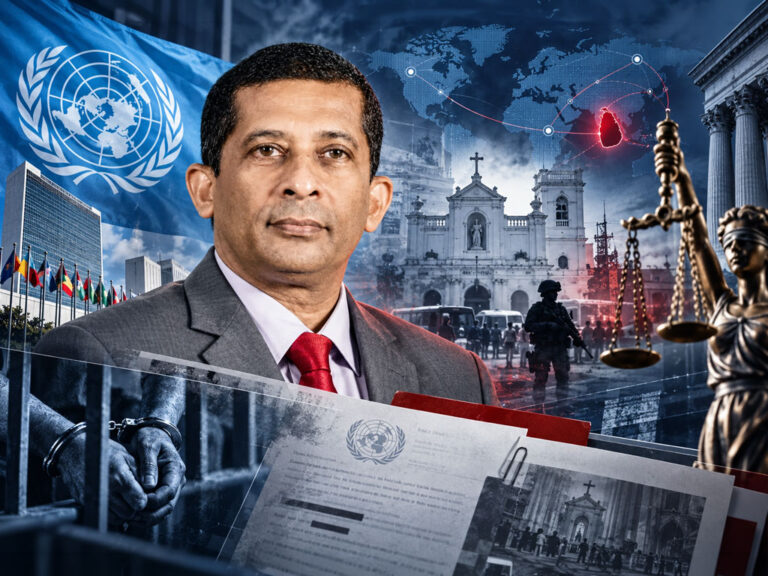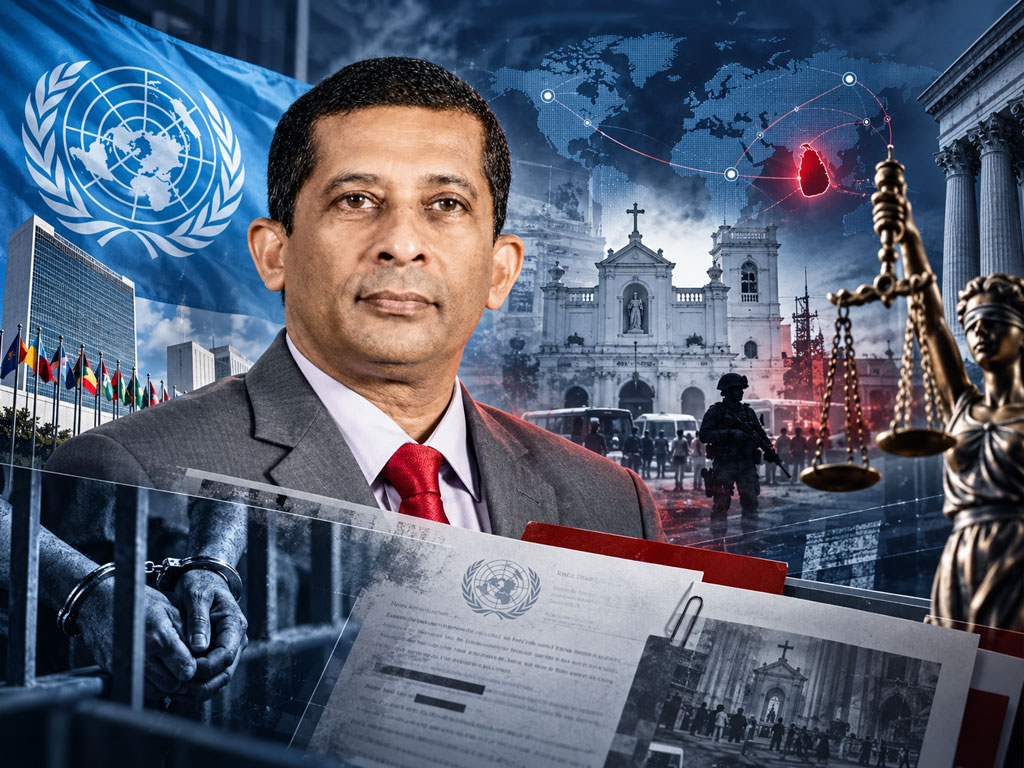
COLOMBO — Government response traces the investigation to a Catholic priest’s complaint over a Channel 4 documentary, but does not publicly identify the evidence relied upon to arrest the former intelligence chief.
Sri Lanka has informed United Nations human rights experts that the investigation leading to the arrest of former State Intelligence Service Director, retired Major General Suresh Sallay, began with a complaint from a Catholic priest concerning allegations broadcast in a Channel 4 documentary about the 2019 Easter Sunday terrorist attacks.
In a response dated September 20, 2026, the Government defended Sallay’s arrest and continued detention under the Prevention of Terrorism Act (PTA), maintaining that investigators had acted on evidence gathered during a lawful criminal inquiry.
The submission, however, did not disclose the specific evidence on which the decision to arrest him was based or explain how the allegations that prompted the initial complaint were subsequently corroborated.
The absence of those details does not establish that investigators lack sufficient evidence. It does mean that the Government’s published explanation does not allow readers to independently assess the evidentiary basis for Sallay’s detention.
The response followed an urgent communication sent by four UN human rights mandate holders on July 20, raising concerns about his detention, alleged ill-treatment, access to legal representation, deteriorating health and the possibility of further harm.
Sallay, who was arrested on February 25, has challenged the lawfulness of his arrest and detention before the Court of Appeal.

Catholic Priest’s Complaint Cited as Starting Point
According to the Government’s submission, the Criminal Investigation Department’s Special Branch began an inquiry following a complaint lodged on October 11, 2024, by a Catholic priest identified as the Executive Director of the Centre for Society and Religion.
The complaint sought an investigation into information presented in a Channel 4 documentary concerning the Easter Sunday bombings of April 21, 2019.
The Government said investigators reported the matter to the Colombo Fort Magistrate’s Court under case reference B 36882/2024 and subsequently continued their inquiries under judicial supervision.
An important distinction remains between the complaint that prompted an investigation and the evidence later used to justify the arrest of a particular suspect.
A complaint can initiate a criminal investigation without necessarily constituting proof of the allegations it contains.
The Government maintains that the decision to arrest Sallay was based on evidence subsequently gathered by investigators.
Earlier reporting about Sallay’s Court of Appeal application, however, gave October 4, 2024, as the date of the complaint.
The discrepancy between the two reported dates requires clarification from the original records.
Government Defends February Arrest Under PTA
Sallay was arrested by the CID on February 25, 2026, in connection with investigations into the Easter Sunday attacks.
The Government’s response states that his arrest followed an “objective assessment of the evidence gathered” and that detention was authorised in accordance with the PTA.
It rejects suggestions that the decision was influenced by his political views, former official responsibilities, ethnicity, religion or other improper considerations.
The authorities also emphasise the importance of accountability for the attacks, which killed more than 260 people and injured hundreds of others.
In its submission, the Government reaffirmed that “no individual is above the law” and maintained that allegations involving serious criminal offences must be investigated regardless of a suspect’s former position or rank.
Nevertheless, the document does not identify the witness statements, documentary records, forensic findings or other material relied upon to support the arrest.
That remains an important limitation of the public explanation.
The Government’s position must also be considered alongside subsequent court reporting.
In March, the CID informed court that Sallay had been named as a suspect and stated that the investigation had produced evidence supporting that decision.
The substance and sufficiency of that material remain matters for the relevant judicial proceedings.
UN Experts Question Detention and Treatment
The Government’s response was prompted by a joint urgent appeal from four UN human rights mechanisms.
They included the Special Rapporteur on human rights while countering terrorism, the Working Group on Arbitrary Detention, the Special Rapporteur on the right to health, and the Special Rapporteur on the independence of judges and lawyers.
Their communication raised concerns about the circumstances of Sallay’s arrest, the legality of his detention and allegations of torture or other ill-treatment.
The experts also sought assurances about access to lawyers, appropriate medical treatment and protection against retaliation or further harm.
These concerns were presented as allegations requiring examination, not as established findings that Sri Lankan authorities had committed violations.
The communication gave the Government an opportunity to respond and explain the safeguards applied during Sallay’s detention.
Sri Lanka subsequently transmitted its position through its Permanent Mission in Geneva.
Court Proceedings Remain Central to the Dispute
The Government maintains that Sallay’s detention has been subject to judicial supervision.
Its submission identifies proceedings before the Colombo Fort Magistrate’s Court and the Court of Appeal, including allegations concerning unlawful detention and ill-treatment.
It also refers to Sallay’s writ application, CA/Writ/232/2026, challenging decisions connected to his arrest and detention.
According to the Government, matters concerning the Easter attacks investigation and allegations involving investigative officers are before the courts.
The submission describes those proceedings as sub judice and states that the authorities do not intend to prejudge their outcome.
Sallay’s lawyers have disputed the legal basis for his arrest, arguing in earlier proceedings that the authorities lacked sufficient grounds to detain him under the PTA.
Those arguments remain contested.
A criminal investigation, the naming of a suspect and a detention order do not establish criminal guilt.
The ultimate determination of any alleged offence rests with the courts following the applicable legal process.
Government Denies Incommunicado Detention
Addressing allegations that Sallay was isolated from legal counsel and relatives, the Government provided a detailed account of the access arrangements it says were made available.
According to the submission, Sallay was informed of the reasons for his arrest and given an opportunity to consult a lawyer.
He was also taken to his residence, where close relatives, including his wife, were able to see him.
The Government says his wife received documentation concerning the arrest, while the Human Rights Commission of Sri Lanka was notified in writing.
It further maintains that Sallay was produced before a judicial medical officer and that the Fort Magistrate’s Court was informed of the arrest.
The response describes the following arrangements during detention:
- Meetings with legal counsel on Wednesdays.
- Telephone conversations with close relatives, including his wife and mother, on Fridays.
- Family visits on Saturdays, including the delivery of food, beverages and clothing.
- Regular oversight of the CID detention facility by the Fort Magistrate.
- Inspection arrangements involving the Human Rights Commission.
On that basis, the Government rejects the allegation that Sallay was held incommunicado.
It also states that communications between a detainee and legal counsel are confidential and protected under the applicable legal framework.
These are the arrangements described by the Government. Their implementation and adequacy are distinct questions that may require examination through court records, detention registers and other independent evidence.
Medical Treatment and Hospitalisation Explained
A substantial portion of the Government’s response concerns Sallay’s medical condition.
The authorities say he underwent an examination by a judicial medical officer following his arrest and was subsequently referred for specialist treatment.
The submission records treatment for ear and dental problems at Colombo National Hospital, followed by another judicial medical examination on April 29.
Sallay was also reportedly assessed by a dermatologist, nutrition specialist, neurologist and ophthalmologist.
According to the Government, additional medical investigations included laboratory testing through the Medical Research Institute and an MRI scan at Colombo National Hospital.
Nutritional supplements and vitamins were also provided.
The authorities further state that Sallay was referred for assessment by a doctor attached to the National Institute of Mental Health in Angoda.
During a hunger strike, the Government says he received medical monitoring and was admitted to hospital on medical advice.
At the time of the September 20 response, Sallay was reportedly receiving inpatient treatment in the Cardiology Unit of Colombo National Hospital.
The submission states that investigators had not recorded a statement from him following his hospital admission.
It also maintains that decisions concerning further treatment and any return to detention would take account of medical recommendations.
The September account does not, by itself, establish Sallay’s current medical condition in October.
Torture Allegations Rejected by Government
The UN experts’ communication included allegations of torture and other cruel, inhuman or degrading treatment.
Sri Lanka’s response refers to Article 11 of the Constitution, which prohibits torture, and the Convention Against Torture and Other Cruel, Inhuman or Degrading Treatment or Punishment Act, No. 22 of 1994.
The Government states that “no such allegation has been substantiated or established to date”.
It maintains that allegations supported by credible evidence will be examined through the appropriate investigative and judicial procedures.
The submission further states that evidence obtained through torture or ill-treatment cannot lawfully be relied upon to justify criminal proceedings or continued detention.
These assertions represent the Government’s response to the allegations, rather than an independently established finding that every aspect of Sallay’s treatment complied with the law.
The authorities have also addressed concerns about possible retaliation if he is transferred from hospital back into custody.
According to the submission, retaliation, intimidation and mistreatment of detainees are prohibited.
Any restrictions on family access, the Government says, must comply with applicable law, security requirements and judicial directions.
It undertakes to ensure that such restrictions are “lawful, necessary and proportionate”.
Government Reaffirms Counter-Terrorism Commitments
The response also addresses Sri Lanka’s broader counter-terrorism legislation.
The Government maintains that its counter-terrorism framework must operate consistently with constitutional safeguards and international human rights obligations.
It refers to continuing legislative reform and states that any replacement or amendment of existing counter-terrorism laws will proceed through the constitutionally prescribed process.
The PTA has long been the subject of scrutiny over detention powers, access to legal representation and safeguards against abuse.
Sallay’s detention has consequently attracted attention not only because of the Easter Sunday investigation but also because it involves legislation whose application continues to generate legal and human rights debate.
Evidence and Judicial Review Remain the Key Questions
Sri Lanka’s response to the UN provides extensive details about the Government’s stated legal position, detention arrangements and medical treatment.
It also establishes the authorities’ account of how the investigation began, tracing it to a complaint concerning the Channel 4 documentary.
What the diplomatic submission does not provide is a detailed explanation of the evidence said to connect Sallay to suspected criminal conduct.
That omission cannot settle the question of whether the arrest was justified. Nor can the Government’s assertion that evidence was objectively assessed substitute for the courts’ evaluation of its legality and sufficiency.
The authorities maintain that they will cooperate with the UN human rights mechanisms, monitor Sallay’s medical condition and ensure protection against unlawful treatment.
For the families of those killed in the Easter attacks, the need for a credible investigation remains paramount.
For Sallay, the central issue is whether his continued deprivation of liberty satisfies the legal requirements governing arrest and detention.
The next meaningful answers must come from the judicial process, the evidence presented through it and any subsequent findings concerning the conduct of investigators and the treatment of the detainee.