COLOMBO — Global conflicts are beyond Sri Lanka’s control, but its dependence on imported fuel, the pace of energy reform and the protection afforded to vulnerable households are matters of domestic policy.
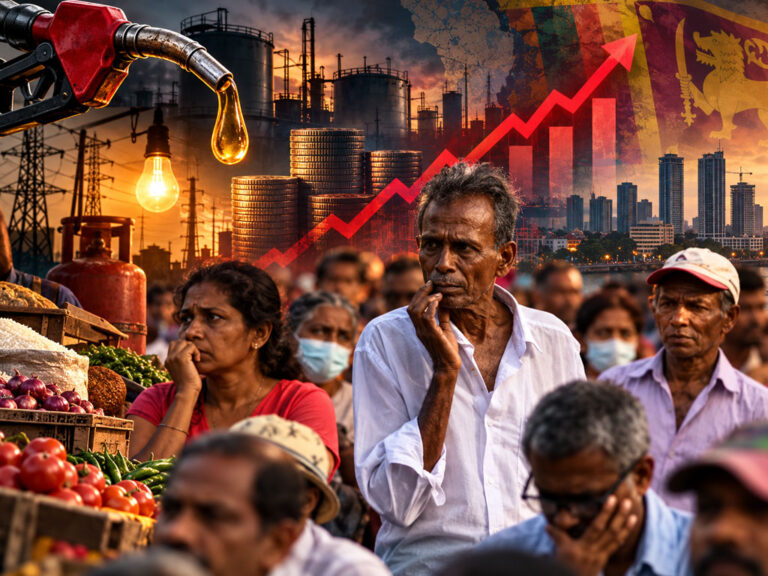
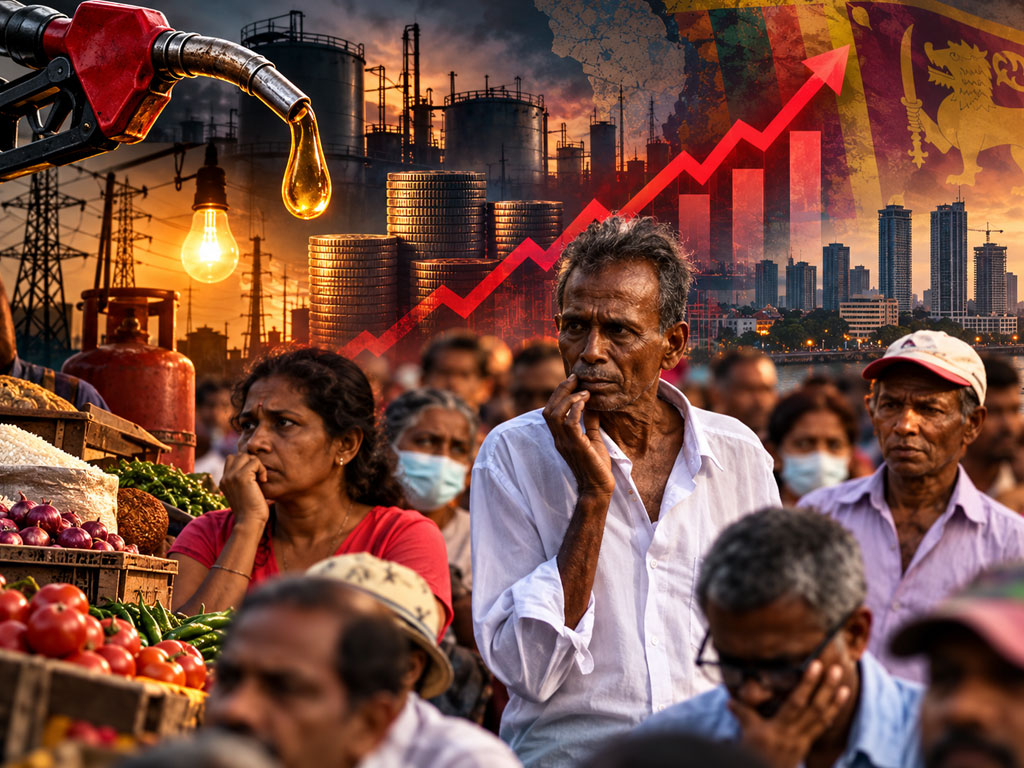
Sri Lanka’s inflation reached 8% in September 2026, placing renewed pressure on households still recovering from the economic crisis of 2022, as rising international oil prices threaten to drive up transport, food and electricity costs.
The Colombo Consumer Price Index recorded headline inflation of 8%, food inflation of 8.7% and core inflation of 5.4% in September. The figures reflect an economy in which the cost of everyday necessities is once again becoming a major concern.
Under the Central Bank’s monetary policy framework, the inflation target is 5%, with an accountability margin of two percentage points on either side, assessed through quarterly average inflation.
International developments are making that objective harder to achieve.
Brent crude closed at approximately US$109.55 a barrel on October 19, as conflict in the Middle East, attacks affecting regional energy infrastructure and uncertainty over oil shipments continued to unsettle global markets.
The war that began with US-Israeli strikes on Iran on February 28 has disrupted energy trade, while Houthi forces have claimed attacks on Saudi infrastructure. The continuing Russia-Ukraine conflict adds further uncertainty to international fuel, fertiliser and agricultural markets.
These pressures are being felt well beyond Sri Lanka. Australia, despite its larger economy and domestic energy resources, faces renewed inflation risks from expensive fuel, higher transport costs and changing agricultural conditions.
For Sri Lanka, which relies on imported petroleum, the consequences are more immediate.
The country cannot end wars in the Middle East or Ukraine. It can, however, determine how exposed its economy remains to external shocks and how fairly their consequences are distributed among its citizens.

Distant Wars Reach the Sri Lankan Kitchen
The effects of higher international energy prices reach ordinary households through four principal channels.
Fuel. Sri Lanka imports crude oil for its Sapugaskanda refinery and refined petroleum products from international suppliers. Disruptions to Middle Eastern production and shipping routes increase procurement costs regardless of where the final shipment originates.
Domestic fuel prices rose sharply during 2026. Following the October 1 revision, a litre of Petrol 92 cost Rs. 414, while Auto Diesel reached Rs. 392.
Sri Lanka’s IMF-supported economic programme emphasises cost recovery and financial discipline in the energy sector. Nevertheless, the Government has also introduced targeted relief, including temporary arrangements to absorb part of the higher diesel cost.
The challenge is whether such measures can protect essential economic activity without creating unsustainable public liabilities.
Transport and food. Diesel is essential to the movement of rice, vegetables, fish and other goods across the country.
Higher transport expenses affect wholesalers, retailers and consumers, particularly when businesses pass additional distribution costs into selling prices.
Food inflation reached 8.7% in September, while core inflation increased to 5.4%.
Although these figures do not establish that fuel costs caused every price increase, they demonstrate the broader inflationary pressures confronting households.
Electricity. Sri Lanka’s electricity system depends on a combination of renewable generation, coal and petroleum-based thermal power.
Increases in imported fuel prices can raise electricity generation costs and eventually influence the tariffs paid by households and businesses.
Bakeries, garment manufacturers, hotels, workshops and small retailers are particularly sensitive to higher energy expenditure.
The rupee. Fuel imports also place pressure on foreign-exchange requirements.
Sri Lanka spent approximately US$3.17 billion on fuel imports during the first half of 2026, an increase of 58.8% compared with the corresponding period of 2025.
Greater demand for foreign currency can contribute to exchange-rate pressure, although the rupee is also influenced by exports, remittances, tourism, capital flows and monetary conditions.
A weaker currency makes imported products more expensive in rupee terms, adding to the cost of fuel, medicines, machinery and other essential goods.
The Russia-Ukraine conflict compounds these risks through international energy and agricultural markets. Shipping costs, war-risk insurance and potential El Niño-related changes to rainfall can also affect food production and hydroelectricity generation.
For an island economy reliant on imported goods and international transport, these pressures rarely remain confined to a single sector.
The People Paying the Highest Price
For millions of Sri Lankans, renewed inflation is not simply another economic cycle. It is a further burden imposed before the consequences of the previous crisis have fully subsided.
Inflation approached 70% during the 2022 economic collapse, sharply reducing purchasing power and pushing many households into poverty.
Although the subsequent decline in inflation slowed the pace of price increases, it did not restore the purchasing power lost during that period.
This distinction matters.
Lower inflation does not necessarily mean that food, transport or household bills return to their earlier levels. It means that prices are increasing more slowly.
Wages, pensions and daily earnings have not necessarily recovered at the same pace.
The most vulnerable groups include daily-wage workers, Malaiyaha Tamil communities, fishing families dependent on kerosene and diesel, farmers facing higher fertiliser and transport expenses, and pensioners living on fixed incomes.
Low-income households typically devote a larger proportion of their earnings to food, transport and energy. They therefore have less flexibility when prices rise.
Many citizens supported political change in 2024 in the expectation that economic recovery would gradually improve their living standards.
Repeated increases in essential expenditure, without adequate protection for vulnerable households, risk weakening that confidence.
Economic reform cannot be judged solely by fiscal balances, reserve levels or inflation projections. Its durability also depends on whether ordinary people can afford the necessities of daily life.
Vehicle Imports Add to Long-Term Fuel Dependence
Sri Lanka resumed private vehicle imports in February 2025 after restrictions imposed during the foreign-exchange crisis.
The decision restored consumer choice, generated customs revenue and supported businesses connected to vehicle imports.
It also increased demand for foreign currency.
The country spent substantial sums on motor vehicle imports during 2025. In the first six months of 2026 alone, the import bill reached US$1.254 billion.
In May, the Government introduced a temporary surcharge equivalent to 50% of the existing customs import duty on motor vehicles, citing the economic consequences of conflict in the Middle East.
Vehicle import expenditure subsequently declined by 27.1% from May to June, reaching US$182 million.
The reduction is consistent with the expected effect of higher import costs, although it cannot be attributed exclusively to the surcharge without further analysis of demand, shipments and other market conditions.
Import taxation can moderate foreign-exchange expenditure in the short term.
It does not, however, resolve the longer-term question of what kinds of vehicles the country should encourage.
Petrol- and diesel-powered vehicles can remain in use for well over a decade. Their purchase therefore creates continuing demand for imported fuel.
Sri Lanka effectively commits foreign exchange twice: first when the vehicle is imported and repeatedly thereafter when fuel is purchased.
A revenue strategy heavily dependent on vehicle taxation also creates a difficult policy incentive. The Treasury benefits from imports that can subsequently increase pressure on the energy import bill.
A more durable approach would encourage fuel-efficient vehicles, electric public transport and mobility systems that reduce dependence on private automobiles.
Sri Lanka’s Renewable Opportunity Remains Underused
Sri Lanka possesses substantial renewable energy resources, including solar, wind and hydropower.
The country has set a target of obtaining 70% of electricity generation from renewable sources by 2030.
Households and businesses have responded to the opportunity offered by rooftop solar, with installed capacity expanding considerably in recent years.
Yet rapid adoption has exposed weaknesses in the electricity network.
Changes to rooftop solar compensation, limitations on new net-metering arrangements and temporary restrictions on electricity exports have created uncertainty for investors.
Large rooftop installations have also faced curtailment requirements during periods when daytime electricity supply exceeds demand.
The problem is not simply the availability of sunshine.
Electricity generated at midday must be consumed, transmitted, stored or curtailed. Without sufficient network flexibility, additional solar capacity can become difficult to accommodate.
Cutting solar exports may address an immediate grid stability concern, but repeated restrictions can undermine confidence in renewable energy investment.
The long-term answer requires better transmission infrastructure, improved demand management, reliable storage capacity and consistent electricity-purchasing arrangements.
Battery Storage Offers a Way Forward
Sri Lanka’s first standalone grid-scale battery energy storage facility was connected to the national grid at Anuradhapura on September 18, 2026.
The facility has a capacity of 10 MW and can store 40 MWh of electricity.
It forms part of a programme to develop 13 battery storage facilities with a combined capacity of 130 MW and storage capability of 520 MWh.
Further battery projects are being pursued, including tenders covering 250 MW and other capacity allocations.
Storage systems can absorb excess renewable electricity during periods of high production and release it when demand rises.
This could reduce the need to operate expensive thermal generation during evening peak periods, although the economic benefit depends on storage duration, efficiency, operating costs and the generation displaced.
Longer-term pumped-storage developments could provide further flexibility.
The restructuring of Sri Lanka’s electricity sector also presents an opportunity to improve planning, procurement and operational accountability.
However, institutional reform alone will not produce cheaper electricity unless projects are completed efficiently and the network can integrate additional generation.
Every unnecessary delay in viable renewable energy and storage projects leaves the country more exposed to imported fuel costs.
Seven Priorities for the NPP Government
The National People’s Power Government was elected on a programme promising changes to economic management and public administration.
The renewed cost-of-living pressures present a test of whether those commitments can be translated into practical protection for households while reducing the country’s long-term exposure to international energy markets.
Seven policy priorities deserve consideration.
1. Lighten the immediate cost-of-living burden
Aswesuma assistance should be reviewed regularly against the actual cost of essential household expenditure, with additional support considered when food and fuel prices rise sharply.
Affordable electricity for low-consumption households, adequately funded school meals and carefully targeted assistance for fishing and farming communities could help protect vulnerable groups.
Authorities must also address hoarding, market manipulation and unjustified profiteering where evidence of such conduct exists.
Affordable bus fares for workers and students should remain an important priority.
2. Treat energy security as foreign-exchange policy
The Government should establish measurable annual targets for reducing petroleum imports through renewable energy, energy efficiency and improvements to transport.
The Treasury and Central Bank could publish progress alongside reserve and external-sector indicators.
This would connect energy investment decisions more directly with the country’s foreign-exchange vulnerability.
3. Expand rooftop solar alongside storage
A predictable long-term framework for rooftop solar would encourage households and businesses to invest with greater confidence.
Electricity purchase arrangements could reward battery-backed supplies during periods of high demand, subject to careful assessment of system costs.
Concessionary finance through state banks and community solar schemes could extend participation to lower-income households.
4. Accelerate grid modernisation
Transmission expansion, battery storage and pumped-storage developments should be treated as essential national infrastructure.
Projects must also respect affected communities, livelihoods, homes and environmental safeguards.
Smart inverters, improved forecasting and flexible network management could reduce the need for unnecessary renewable electricity curtailment.
5. Link vehicle taxation to fuel efficiency
Rather than relying primarily on temporary import surcharges, Sri Lanka should examine a transparent vehicle duty structure reflecting fuel consumption and emissions.
Electric buses, three-wheelers and motorcycles could receive greater consideration, while vehicles with high fuel consumption could face proportionately higher taxation.
Such a system would need to account for affordability, charging infrastructure and the environmental consequences of electricity generation.
6. Invest in public transport
A portion of revenue generated from vehicle duties could be directed towards better bus services, railway improvements and the gradual electrification of public transport.
The feasibility of subsidised or free travel on selected state-run services could also be examined, particularly for students and vulnerable groups.
Reliable public transport reduces congestion, fuel consumption and the need for expensive private vehicles.
Its benefits extend beyond fuel savings to improved productivity, cleaner air and greater mobility for households without private transport.
7. Build an energy buffer and communicate clearly
Sri Lanka should diversify petroleum suppliers, assess opportunities for longer-term procurement arrangements and improve strategic fuel storage.
Further development of the Trincomalee oil tank facilities could contribute to energy security, provided investment and operational arrangements are commercially justified.
A transparent and fiscally sustainable mechanism to cushion exceptional price shocks should also be considered within the country’s IMF commitments.
Most importantly, the Government should publish an energy security roadmap setting out practical milestones, financing requirements and expected savings.
Households and businesses need predictable policies rather than repeated emergency responses.
Breaking the Cycle of Imported Inflation
Sri Lanka cannot prevent international conflicts from disrupting energy markets.
It can reduce the damage those conflicts inflict on its economy.
Rooftop solar, battery storage, efficient vehicles and dependable public transport can all contribute to reducing long-term exposure to imported petroleum.
Their benefits will not be immediate or identical, and none can eliminate the need for conventional generation overnight. They nevertheless offer a more durable response than repeated price revisions and temporary tax measures.
Fiscal discipline, cost-reflective pricing and IMF commitments need not be incompatible with targeted social assistance or investment in energy independence.
The challenge is to design those policies together rather than allow one to undermine the other.
Sri Lankans have already endured a prolonged period of economic hardship. Their expectations of recovery cannot be met simply by asking them to absorb another round of international price shocks.
The Government’s most important task is to use the time gained through temporary relief to create lasting protection against the next crisis.
That requires shielding vulnerable households today while building an energy and transport system that leaves the country less dependent on expensive imported fuel tomorrow.