COLOMBO — The former UN human rights chief’s international recognition has revived competing assessments of accountability, the LTTE’s broken commitments and the international community’s response to civilians trapped in the final stages of Sri Lanka’s war.
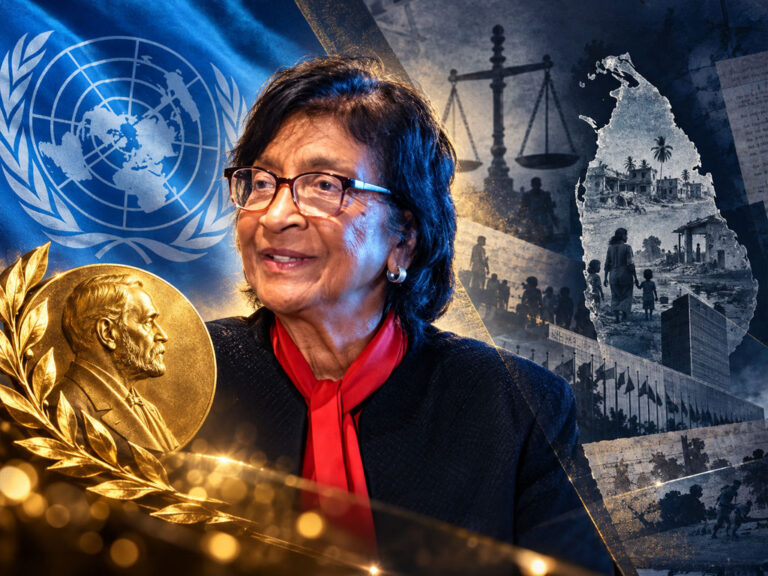
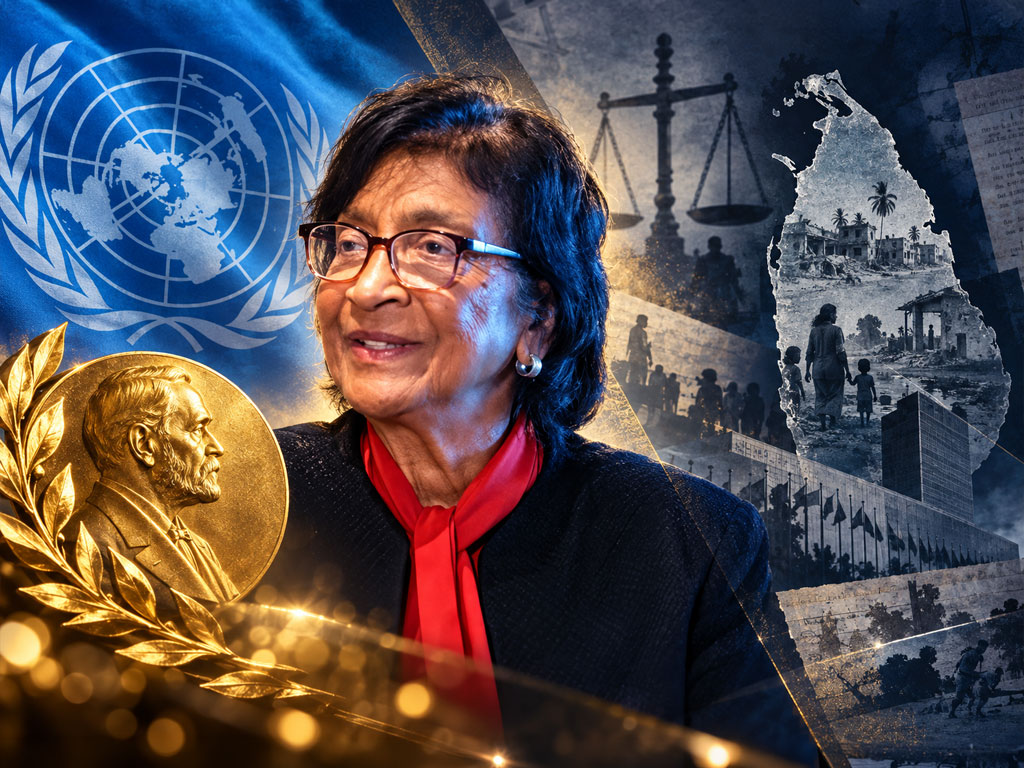
The awarding of the 2026 Nobel Peace Prize to former United Nations High Commissioner for Human Rights Navanethem “Navi” Pillay has revived debate over the international community’s response to Sri Lanka’s civil war, including its inability to secure compliance with commitments made by the Liberation Tigers of Tamil Eelam (LTTE) and the continuing controversy over accountability for wartime violations.
Pillay, the 85-year-old South African jurist who served as UN human rights chief from September 2008 to August 2014, was announced as this year’s Nobel laureate on October 9.
The Norwegian Nobel Committee recognised her contribution to international law, her involvement in landmark human rights proceedings and her efforts to promote accountability for war crimes, crimes against humanity and genocide.
Her selection has been welcomed by Sri Lankan civil society organisations and Tamil diaspora groups that regard her intervention during and after the conflict as instrumental in maintaining international attention on allegations of serious wartime abuses.
For critics of the UN’s handling of the war, however, the award provides an opportunity to examine whether international diplomacy adequately addressed LTTE violations, particularly the recruitment of children and the prevention of civilians from leaving areas under its control.
Such scrutiny must also acknowledge documented allegations concerning the conduct of Sri Lankan government forces and the UN’s own subsequent examination of its institutional failures.

Peace Council and Tamil Diaspora Welcome Pillay’s Nobel
The National Peace Council (NPC), whose executive director is Dr. Jehan Perera, congratulated Pillay in a statement titled “Nobel Peace Prize to Navanethem Pillay is Reminder to Sri Lanka of Unfinished Commitments.”
The organisation highlighted her efforts to promote accountability, protect human rights and encourage reconciliation after Sri Lanka’s armed conflict.
It drew particular attention to her 2013 visit to Sri Lanka and the subsequent international investigation authorised by the UN Human Rights Council in 2014.
According to the NPC, Sri Lanka continues to face unresolved obligations concerning wartime violations, enforced disappearances, the protection of victims and witnesses, occupied land, demilitarisation and institutional reform.
The Global Tamil Forum (GTF), based in the United Kingdom, also welcomed the announcement.
The organisation praised Pillay for helping keep allegations of war crimes and crimes against humanity on the international agenda when victims and survivors feared that their experiences would be forgotten.
Tamil Guardian similarly welcomed her contribution to international accountability efforts.
Pillay’s career extends well beyond Sri Lanka. She served at the International Criminal Tribunal for Rwanda and the International Criminal Court and is currently an ad hoc judge at the International Court of Justice in proceedings brought by The Gambia against Myanmar under the Genocide Convention.
Her international record was central to the Nobel Committee’s decision.
Nevertheless, her tenure coincided with the final stages of Sri Lanka’s war and the beginning of an international accountability process that remains politically divisive.
Kilinochchi’s Fall and the Final Months of War
Pillay assumed office on September 1, 2008, when Sri Lankan security forces were advancing through the Vanni against the LTTE.
By then, government forces had regained the Eastern Province following military operations that concluded in 2007.
The Army’s northern offensive, launched that year, progressively weakened the LTTE’s territorial control.
On January 2, 2009, security forces captured Kilinochchi, the town that had served as the organisation’s administrative centre.
The loss represented a major strategic defeat for the LTTE and strengthened the Government’s expectation that the remaining territory could be recovered.
Government forces had previously regained Jaffna during operations in 1995 and 1996, although the LTTE subsequently mounted major offensives elsewhere, including its capture of Elephant Pass in 2000.
By early 2009, fighting had intensified in the Vanni’s eastern sector as the LTTE retreated into a progressively smaller area containing large numbers of civilians.
The Government regarded the military campaign as necessary to defeat an armed organisation responsible for suicide bombings, assassinations, forced recruitment and other attacks.
International humanitarian organisations, however, increasingly warned that civilians trapped within the conflict area faced grave danger from both LTTE practices and government military operations.
The final military defeat of the LTTE came in May 2009.
UN Condemned Civilian Confinement but Failed to Secure Their Release
The protection of civilians in the final months of the conflict remains one of the most contested aspects of the UN’s Sri Lanka record.
The LTTE prevented many civilians from leaving areas under its control, forcibly recruited adults and children, and was accused of firing upon people attempting to escape.
On March 13, 2009, Pillay publicly expressed alarm about civilian casualties and warned that conduct by both the LTTE and Sri Lankan forces could constitute serious violations of international humanitarian law.
Her intervention acknowledged allegations of LTTE abuses while also raising concerns about shelling and civilian deaths in areas designated as no-fire zones.
Earlier, on February 20, UN Special Representative Radhika Coomaraswamy had explicitly called upon the LTTE to release civilians, particularly children, and urged the Sri Lankan Government to exercise restraint in artillery and aerial operations.
Consequently, the claim that the UN never called for civilian release is not supported by its public record.
A more substantial criticism concerns the effectiveness of those interventions.
Despite repeated international appeals, the LTTE did not release the trapped civilian population as demanded, and the fighting continued.
The central question is whether more coordinated and sustained diplomatic intervention could have secured civilian evacuation or reduced casualties.
It is possible to argue that international pressure was insufficient. Establishing that different action would definitely have prevented the final offensive or saved a particular number of lives, however, requires evidence beyond the available record.
The UN’s Own Review Acknowledged Serious Failures
Criticism of the UN’s performance is not limited to commentators who opposed its approach towards the Sri Lankan Government.
In November 2012, an internal review panel headed by Charles Petrie examined the organisation’s conduct during the final stages of the conflict.
The review identified serious failures within the UN system concerning the protection of civilians, the handling of information and the response to escalating humanitarian risks.
Then UN Secretary-General Ban Ki-moon acknowledged the need to learn from those findings.
The review is important because it demonstrates that concerns about UN shortcomings were not merely allegations advanced by one side of Sri Lanka’s political debate.
However, the panel’s findings do not establish that the UN was secretly supporting the LTTE or deliberately seeking to prolong the war.
Those remain interpretations requiring additional evidence.
The documented failures provide a sufficient basis for examining whether the organisation acted with the urgency, coherence and institutional independence required by the circumstances.
The 1998 UN-LTTE Agreement and Broken Promises
One of the strongest historical criticisms concerns the LTTE’s commitments to the United Nations in May 1998.
Olara Otunnu, then the UN Secretary-General’s Special Representative for Children and Armed Conflict, visited Sri Lanka with government approval and met senior LTTE representatives in the Vanni.
The discussions included LTTE political adviser Anton Balasingham and political wing leader S. P. Thamilselvan.
Following the visit, the UN announced commitments concerning the protection of children and conflict-affected civilians.
The principal undertakings included:
- The LTTE would immediately cease deploying children under 18 in combat and stop recruiting children under 17.
- The organisation would not prevent displaced people from moving into government-controlled areas and would allow Muslims expelled from the Northern Province in 1990 to return to their homes.
- The LTTE would not obstruct humanitarian relief intended for civilians in areas under its control.
- Its leadership would promote awareness of the Convention on the Rights of the Child among combatants and other personnel.
- The organisation would review military practices affecting civilians and non-military targets.
The LTTE also accepted, in principle, the creation of arrangements to monitor its commitments.
The agreement represented a significant diplomatic opportunity.
Yet recruitment and use of children continued.
Human Rights Watch later documented repeated LTTE promises to end child recruitment, including further assurances obtained in 2001 and 2003.
The continuation of such practices demonstrates that international engagement did not secure the promised compliance.
It also raises an enduring question about whether the UN and the wider diplomatic community possessed, or adequately employed, mechanisms capable of enforcing commitments made by a non-state armed organisation.
Kadirgamar’s Warning About LTTE Commitments
Then Foreign Minister Lakshman Kadirgamar was sceptical that the LTTE would honour its promises without sustained international pressure.
According to the source article’s account of contemporary reporting in The Island, Kadirgamar told the writer that responsibility for ensuring implementation rested with the UN.
He reportedly feared that the LTTE could not sustain its military operations without continuing to replenish its ranks.
The source refers to two May 1998 reports documenting Otunnu’s visit and the Government’s demand that the LTTE translate its commitments into action.
Those reports provide useful historical leads, although the precise wording attributed to Kadirgamar should be checked against the original newspaper editions before being reproduced as a direct quotation.
The LTTE had been designated a foreign terrorist organisation by the United States in 1997.
For the group, engagement with international representatives also provided an opportunity to project itself as a political actor despite its use of armed violence.
For the UN, engagement was intended to secure humanitarian concessions.
The failure to translate those concessions into lasting behavioural change remains a legitimate subject for examination.
The Failed 1994–95 Peace Initiative
The 1998 agreement was not the first occasion on which international engagement failed to prevent renewed warfare.
President Chandrika Bandaranaike Kumaratunga pursued negotiations with the LTTE following her election in 1994.
Talks continued into 1995, accompanied by arrangements for monitoring the cessation of hostilities.
Foreign personnel from Norway, Canada and the Netherlands were associated with proposed monitoring committees, while the International Committee of the Red Cross facilitated discussions.
The source account identifies Norwegian representatives Audun Holm and Johan Gabrielson, retired Canadian Major General C. Milner, and retired Dutch Lieutenant Colonel Paul Horsting among those involved.
The arrangements were intended to provide oversight of the fragile peace process.
Instead, fighting resumed in April 1995.
On April 19, the LTTE attacked Sri Lankan Navy gunboats at Trincomalee. It subsequently shot down two Avro military transport aircraft near Palaly, demonstrating an emerging capacity to threaten aviation operations.
These attacks imposed serious operational challenges on government forces maintaining supply routes to the Jaffna Peninsula.
The breakdown illustrated the limitations of negotiations when the parties lacked sufficient confidence in compliance and the arrangements could not prevent renewed military action.
The subsequent recapture of Jaffna by Sri Lankan security forces in 1995–96 altered the military situation but did not end the conflict.
Detained UN Workers and Questions About Diplomacy
The original account also raises questions about the detention of two UN workers by the LTTE in the Vanni during 2007.
According to the account, the workers were accused by the LTTE of assisting civilians seeking to leave territory under its control.
The writer alleges that UN officials initially attempted to secure their release through private contacts and did not immediately inform the Sri Lankan Government.
Those details, including the duration of detention and the timing of communications with New York and Colombo, require verification against contemporary UN records.
They should not be treated as proof that UN personnel were cooperating with the LTTE.
The incident nevertheless highlights the difficult choices confronting humanitarian organisations operating in territory controlled by armed groups.
Private negotiations can sometimes be necessary to protect detained personnel or civilians, but they also create questions concerning transparency, coordination and accountability.
The original article further refers to a February 16, 2009, communication from Norwegian Ambassador Tore Hattrem to presidential adviser Basil Rajapaksa concerning proposals for releasing civilians from LTTE-held territory.
According to the supplied quotation, the proposal had been conveyed through several channels but had received no positive response.
The document would be relevant to assessing the diplomatic efforts undertaken during the final offensive, although the original correspondence should be authenticated before its contents are presented as conclusively established.
Accountability Cannot Be Selective
The broader debate surrounding Pillay’s Nobel Peace Prize illustrates the different interpretations of Sri Lanka’s war and its aftermath.
Organisations such as the National Peace Council and Global Tamil Forum emphasise the need for credible investigations into allegations involving government forces, justice for victims and meaningful reconciliation.
Critics of the international response argue that the LTTE’s recruitment of children, confinement of civilians, attacks on non-combatants and repeated violations of negotiated commitments have not received sufficient scrutiny.
Both areas warrant examination.
The LTTE’s defeat did not erase the abuses attributed to the organisation. Equally, its grave violations do not remove the responsibility to investigate credible allegations involving government personnel.
International humanitarian law places obligations upon all parties to armed conflict.
A credible historical assessment must also distinguish institutional mistakes, political disagreements and deliberate misconduct rather than treating them as interchangeable.
Pillay’s 2026 Nobel recognition does not settle arguments about the UN’s performance in Sri Lanka between 2008 and 2014.
It provides an occasion to examine the record more thoroughly, including the UN’s documented failures, its efforts to protect civilians, the LTTE’s broken commitments and the continuing demands of victims and survivors.
The most valuable outcome would be a comprehensive assessment grounded in original diplomatic records, humanitarian reporting and evidence of conduct by all parties.
Such an inquiry would serve Sri Lanka better than either uncritical celebration or accusations that cannot be substantiated.