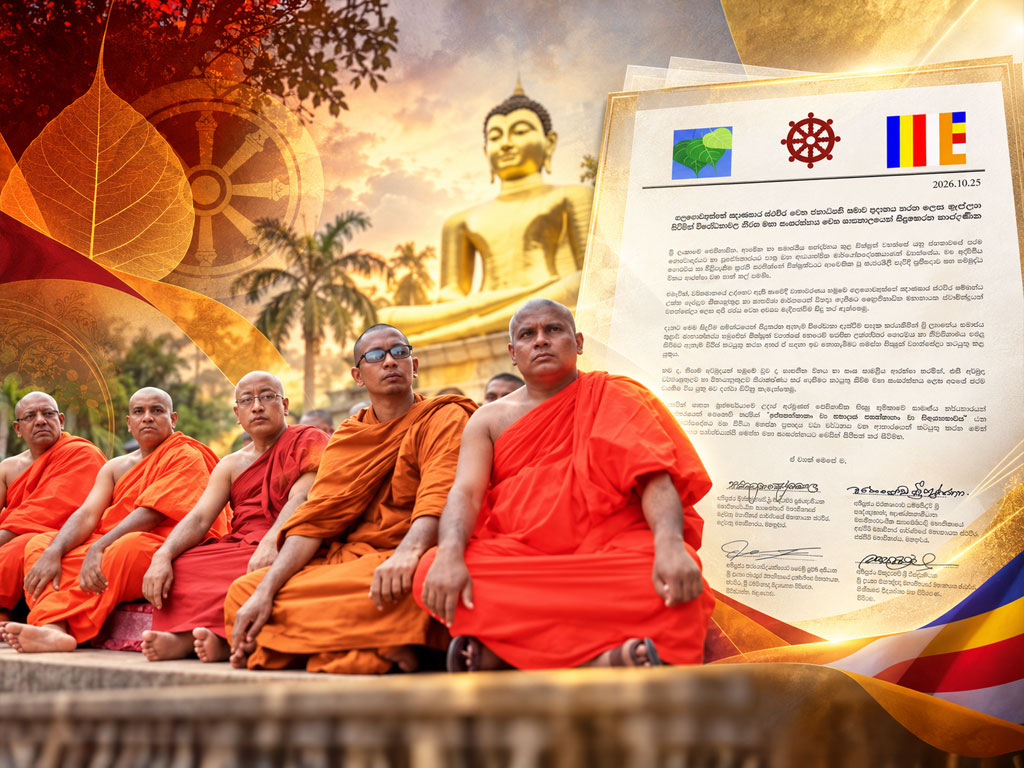
COLOMBO — As monks suspend their campaign for Ven. Gnanasara Thero’s release, the Chief Prelates’ appeal for discipline raises a wider question about the Maha Sangha’s responsibilities towards human rights, justice and the rule of law.
The Maha Nayaka Theras of Sri Lanka’s principal Buddhist monastic fraternities have urged monks to preserve the discipline and dignity of the Buddha Sasana following a satyagraha at Viharamahadevi Park demanding a presidential pardon for Ven. Galagodaatte Gnanasara Thero.
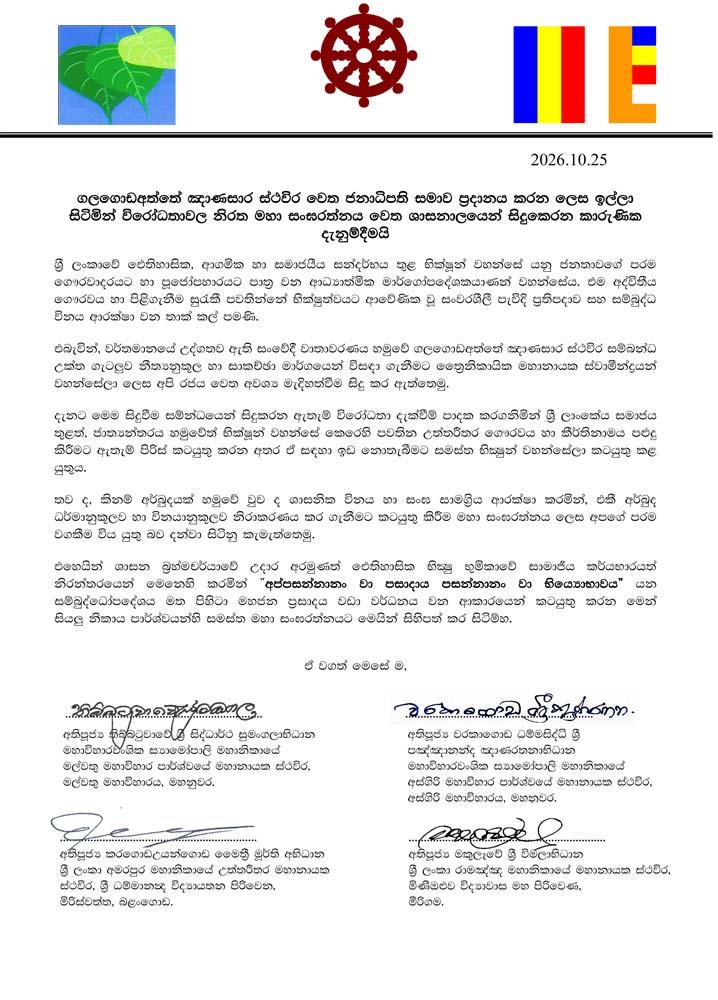
Their joint statement, issued on October 25, 2026, warned that certain parties were attempting to exploit the protest in ways that could damage the respect traditionally accorded to the Maha Sangha.
The senior prelates said they had already intervened with the Government and initiated discussions aimed at resolving the matter through legal procedures and dialogue.
Later that day, Ven. Ulapane Sumangala Thero announced the temporary suspension of the protest, which had continued for approximately 10 days.
The intervention invites examination of a larger question concerning the contemporary Buddhist clergy: should monks mobilise primarily around disputes involving members of their own religious community, or should their social responsibility extend equally to injustices affecting the wider population?

Chief Prelates Call for Discipline and Restraint
The statement was signed by the Chief Prelates of the Malwathu and Asgiriya Chapters of the Siam Nikaya, the Amarapura Nikaya and the Ramanna Nikaya.
It emphasised the exceptional respect accorded to Buddhist monks within Sri Lanka’s historical, religious and social traditions.
The original translation of the statement expresses the central principle as follows:
“In Sri Lanka’s historical, religious, and social context, the monk is the spiritual guide who is worthy of the people’s supreme respect and offerings. That unique respect and recognition will be preserved only as long as the disciplined monastic practice inherent to monkhood and the Buddha’s Vinaya are protected.”
The message identifies monastic discipline as the foundation of the respect traditionally extended to the clergy.
It also warns against political or other interests taking advantage of disputes involving members of the Sangha.
In the supplied translation, the prelates caution that certain parties are attempting to damage the reputation of Buddhist monks, both within Sri Lanka and internationally, by exploiting protests surrounding the incident.
They urge the wider monastic community not to create opportunities for such efforts to succeed.
The warning should not automatically be interpreted as an accusation against every monk who participated in the satyagraha.
Rather, it reflects concern about how religious protest, public behaviour and outside political involvement may affect the standing of the Buddhist clergy.
Gnanasara Thero Satyagraha Temporarily Suspended
The campaign at Viharamahadevi Park sought a presidential pardon for Ven. Galagodaatte Gnanasara Thero, General Secretary of the Bodu Bala Sena.
Gnanasara Thero is serving a prison sentence following legal proceedings involving contempt of court. His imprisonment and earlier presidential pardon have been the subject of further judicial proceedings.
Supporters argue that he should be released and have challenged aspects of his treatment and detention.
The protest began on October 16 after monks gathered near the Presidential Secretariat and subsequently moved to Viharamahadevi Park.
Tensions arose between protesters and the police, and the Colombo Chief Magistrate’s Court directed those occupying the park to vacate the premises.
Despite the court order, participating monks initially continued their campaign.
On October 25, however, organisers announced that the protest would be temporarily suspended following communication from the Chief Prelates.
Ven. Balangoda Kassapa Thero said the intervention had provided reassurance that the senior religious authorities would pursue the matter through discussions with the Government.
The suspension represents a practical outcome of the Maha Nayaka Theras’ intervention, although it does not establish whether a presidential pardon will ultimately be granted.
Should Monks Become Instruments of Political Campaigns?
Sri Lanka’s Buddhist clergy has historically occupied a position extending beyond the confines of temples and religious ceremonies.
Monks have participated in education, public debate, social reform and discussions concerning state governance.
Their influence arises not simply from institutional authority but also from the expectation that they will offer moral guidance grounded in the Dhamma.
That influence carries responsibilities.
The right of Buddhist monks to express opinions and participate peacefully in public life should not be dismissed merely because their activities involve political questions.
Nevertheless, religious authority can become vulnerable when a campaign is shaped primarily by partisan interests or seeks to place particular individuals beyond ordinary legal scrutiny.
The original commentary asks whether the desire to sustain a protest movement has begun to overshadow the broader spiritual and social responsibilities of the clergy.
It also questions whose political objectives may be advanced when substantial religious attention is devoted to obtaining a pardon for one imprisoned monk.
Such questions are legitimate subjects of opinion and public debate.
They do not establish that the satyagraha was orchestrated by unidentified political actors or that participating monks were knowingly serving an external agenda.
Any accusation of organised political manipulation would require evidence identifying those responsible and the actions they undertook.
The more substantive question is whether the moral influence of the Maha Sangha is being exercised consistently across matters affecting society.
Prevention of Terrorism Act and the Defence of Civil Liberties
One area deserving greater religious and public attention is the protection of fundamental rights.
Sri Lanka’s Prevention of Terrorism Act (PTA) has long attracted criticism from human rights organisations over detention powers, procedural safeguards and the risk of arbitrary deprivation of liberty.
Proposed replacement legislation and amendments to security laws have also prompted debate about the balance between protecting public safety and safeguarding civil liberties.
These concerns are not limited to any particular religious or political community.
A law capable of authorising exceptional detention powers can affect individuals whose backgrounds, opinions and circumstances differ considerably.
The original commentary challenges Buddhist monks to consider whether their historic role as moral guides should include opposition to laws that permit arbitrary arrest or restrict freedom of expression.
That question becomes particularly significant when religious leaders invoke the importance of justice in seeking relief for a member of their own community.
A principled defence of liberty cannot depend solely on the identity of the person detained.
It must also consider the fairness of the procedures used against those who have little political influence or public support.
Custodial Deaths and the Right to Life
Deaths involving people held in police custody present an even more immediate test of society’s commitment to justice.
Sri Lanka has experienced repeated allegations of torture, custodial violence and deaths during police operations.
In May 2025, the Human Rights Commission of Sri Lanka issued guidelines aimed at preventing deaths in custody and during police encounters.
The Commission stressed the need to protect the rights to life and bodily integrity, while strengthening police procedures and accountability.
The existence of such guidelines demonstrates that these concerns extend beyond isolated accusations or political rhetoric.
The original article asks why the Maha Sangha does not mobilise with comparable urgency when young people die after being arrested by the police.
That challenge must be expressed carefully. Buddhist monks and religious organisations have participated in various humanitarian and rights-related initiatives, and the absence of a prominent protest on a particular occasion does not establish complete indifference.
Nevertheless, the underlying moral question remains compelling.
A person suspected or convicted of a crime remains entitled to the protection of the law.
Arrest is not a punishment in itself, and police custody does not remove the State’s responsibility to safeguard human life.
Where criminal conduct is established, punishment must follow lawful judicial procedures.
Rehabilitation and reintegration may also form part of society’s response, depending on the offence and applicable law.
Death or unlawful violence in custody cannot be justified as an alternative to prosecution.
If Buddhist teachings are invoked in defence of compassion, restraint and justice, their relevance should extend to people who are unpopular, accused of wrongdoing or otherwise vulnerable to abuse.
The Sangha’s Responsibility Beyond Individual Cases
The current dispute highlights a tension between defending the rights of an individual monk and confronting broader failures of public institutions.
These responsibilities need not be mutually exclusive.
The Maha Sangha may legitimately express concern about Gnanasara Thero’s treatment while also demanding accountability for custodial deaths, arbitrary detention and restrictions on civil liberties.
A protest seeking relief for a religious figure does not inherently contradict Buddhist teachings.
Its wider moral credibility, however, depends partly on whether the principles invoked apply consistently to others.
The danger arises when compassion and legal fairness are demanded for familiar individuals but receive less attention when the victims belong to another community or have no influential advocates.
The original commentary argues that monks should not become instruments of political campaigns.
Instead, it calls upon them to speak according to the Dhamma when state institutions abuse power, the rule of law deteriorates or human life is treated without sufficient respect.
Such a role would not require monks to endorse a particular political party.
It would require them to place ethical principles above partisan loyalties.
Maha Nayaka Theras’ Final Appeal to the Sangha
The Chief Prelates concluded their October 25 statement by urging the Buddhist clergy to remain conscious of the spiritual aims of monastic life and its historic responsibilities towards society.
Their appeal invoked the Pali expression:
“අප්පසන්නානං වා පසාදාය පසන්නානං වා භිය්යෝභාවාය”
The expression concerns inspiring confidence among those without faith and strengthening the confidence of those who already possess it.
In the context of the statement, it serves as a reminder that the conduct of monks influences how the public understands and respects the Buddha Sasana.
The broader significance of the Maha Nayaka Theras’ intervention should therefore not be confined to the temporary suspension of one satyagraha.
It offers an opportunity for the monastic community to consider how its public influence is exercised, whose interests it serves and whether its interventions reflect the ethical principles it teaches.
The outcome of discussions concerning Gnanasara Thero remains uncertain.
What should endure beyond those discussions is a wider commitment to justice, compassion and the dignity of human life.
The measure of the Sangha’s social responsibility is not simply its willingness to defend a monk facing imprisonment. It is also its readiness to speak for those whose rights are threatened and whose suffering might otherwise go unheard.